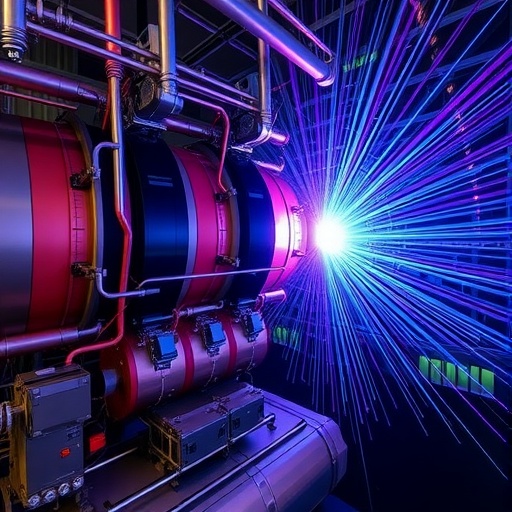
In an innovative leap for the field of particle physics and the exploration of dark matter, a researcher from Tokyo Metropolitan University has introduced a novel approach to search for elusive dark photons using existing infrastructure at synchrotron facilities. This emerging methodology harnesses standard safety monitoring equipment and synchrotron radiation, framing a cost-effective and efficient experiment aimed at elucidating dark photon properties—hypothetical particles thought to be potential components of dark matter. Unlike large-scale, dedicated experimental setups traditionally favored by the physics community, this proposal uniquely utilizes an undulator-based X-ray source coupled with conventional Geiger-Muller detectors embedded within radiation safety shielding.
Fundamentally, experimental particle physics has traditionally relied on massive collaborations involving intricate apparatuses and dedicated facilities—such as the landmark discovery of the Higgs boson—to probe the fundamental building blocks of the universe. However, dark matter, constituting a staggering fraction of the universe’s mass-energy but remaining invisible to conventional detectors, presents one of science’s greatest enigmas. This invisible matter does not interact with electromagnetic forces, making traditional detection methods ineffective. To tackle this, Light-Shining-through-a-Wall (LSW) experiments have emerged as promising pathways. LSW entails directing high-intensity laser beams through magnetic fields, followed by opaque barriers, with detectors positioned to sense photons that might re-emerge beyond the wall, potentially after converting into hypothetical particles like axions or dark photons.
At the heart of this groundbreaking proposal lies the undulator, a key component intrinsic to synchrotron light sources. Undulators produce intense, highly collimated beams of X-ray photons by forcing relativistic electron beams to wiggle through periodic magnetic arrays. These photons, generated in a controlled magnetic environment, provide an ideal medium where standard photons could theoretically mix or oscillate into dark photons, the elusive particles proposed within extensions of the Standard Model. The conceptual breakthrough here is to regard the protective safety shielding—normally designed to block harmful radiation—as analogous to the “wall” used in LSW experiments, potentially allowing dark photons to traverse it undisturbed and subsequently be detected beyond.
The detection apparatus proposed comprises a Geiger-Muller (GM) counter, a time-tested tool for radiation monitoring that counts ionizing events with precision and simplicity. Dr. Wen Yin from Tokyo Metropolitan University integrates this rudimentary detector into the experimental framework, theorizing that dark photons generated in the synchrotron beam could pass through the shielding and induce signals in the GM counter. This arrangement capitalizes on existing safety monitoring infrastructure, circumventing the need to set up new facilities or interfere with ongoing experiments. By analyzing background radiation levels and detecting anomalies consistent with dark photon passage, researchers can infer restrictive bounds on the “mixing parameter”—a fundamental quantity characterizing how strongly dark photons couple with regular photons.
Dr. Yin’s theoretical modeling impressively constrains the mixing parameter to less than one part in 100,000 compared to the electromagnetic interaction—specifically focusing on dark photons with masses ranging between 1 and 50 electronvolts. These findings outstrip previous laboratory-only LSW experiments conducted within corresponding mass windows, marking a significant tightening of existing experimental limits. Such stringent upper bounds are pivotal in narrowing the vast parameter space for dark photon characteristics, inching closer to unveiling dark matter’s nature or ruling out certain theoretical models once thought plausible.
Importantly, the research emphasizes efficiency and pragmatism, proposing an inclusive experiment that runs concurrently with standard synchrotron operations. Unlike prior large-scale dark matter detections that require exclusive setup time and intensive resources, this procedure maximizes scientific output by leveraging routine safety protocols and equipment. This layered complexity within a simplified paradigm represents a paradigm shift in experimental design philosophy, blending practicality with pioneering physics.
Synchrotron facilities worldwide, renowned for their role in material science, chemistry, and biology through intense X-ray beams probing atomic structures, could thus assume a novel scientific mantle. By extending their utility beyond conventional purposes and venturing into the frontiers of particle physics and cosmology, these sites may offer new windows into the shadowy components of the cosmos, empowering ongoing dark matter investigations without demanding significant additional investment.
Moreover, the method’s capacity to generate real-time data on radiation levels while simultaneously contributing to fundamental physics expeditions signals a promising synergy between operational safety and cutting-edge research. Geiger-Muller counters, historically considered simple instruments, hence attain an elevated role within this scheme, highlighting the interplay of classical detection technology and modern theoretical constructs.
This approach also exemplifies the growing trend to repurpose existing experimental setups ingeniously within particle physics, particularly for elusive phenomena like dark matter and dark photons, where signals are inherently weak and interactions infrequent. By integrating precision measurement protocols with innovative theoretical frameworks, the experiment could enhance the sensitivity and robustness of dark photon searches markedly.
The implications of this research transcend the immediate goals of particle physics. Probing dark photons holds profound significance for astrophysics and cosmology, as understanding dark matter composition directly informs models of galaxy formation, cosmic microwave background anisotropies, and large-scale structure evolution in the universe. Expanding experimental avenues potentially accelerates progress toward resolving the dark matter mystery, a foundational challenge implicating the entirety of modern physics.
Future experimental campaigns based on this proposal could involve systematic variation of synchrotron operational parameters, optimizing detection efficiency and exploring diverse dark photon mass ranges. Collaboration across synchrotron centers worldwide and integration of complementary detection systems may deepen the experiment’s reach, fostering international scientific cooperation toward a unified quest to demystify dark matter.
In summary, this novel proposal to exploit standard synchrotron radiation production and safety monitoring infrastructure to constrain dark photon interactions embodies a strategic innovation in particle physics. It leverages well-established technologies and existing facilities to push the experimental frontier, offering new hope in the dark matter hunt. By advancing experimental limits on the dark photon mixing parameter within critical mass ranges without necessitating expensive dedicated experiments, the work paves an exciting avenue for future research, reinforcing the vibrant intersection of experimental ingenuity and theoretical physics in contemporary science.
Subject of Research: Dark photon detection and dark matter research using synchrotron radiation and radiation safety equipment.
Article Title: Novel Limits on Dark Photon Mixing from Radiation Safety
News Publication Date: 3-Apr-2026
Web References: DOI: 10.1103/snnn-wqxg
Image Credits: Tokyo Metropolitan University
Keywords
Particle physics, Dark matter, Particle theory, Synchrotron radiation, Experimental physics
Tags: cost-effective exotic particle searchesdark matter particle detection methodsexperimental particle physics infrastructureGeiger-Muller detectors in particle experimentsinnovative dark matter detection strategieslight-shining-through-a-wall experimentsnovel dark photon experimental techniquesradiation safety monitoring in synchrotronssynchrotron facilities for fundamental physicssynchrotron radiation dark photon searchTokyo Metropolitan University particle researchundulator-based X-ray sources in physics