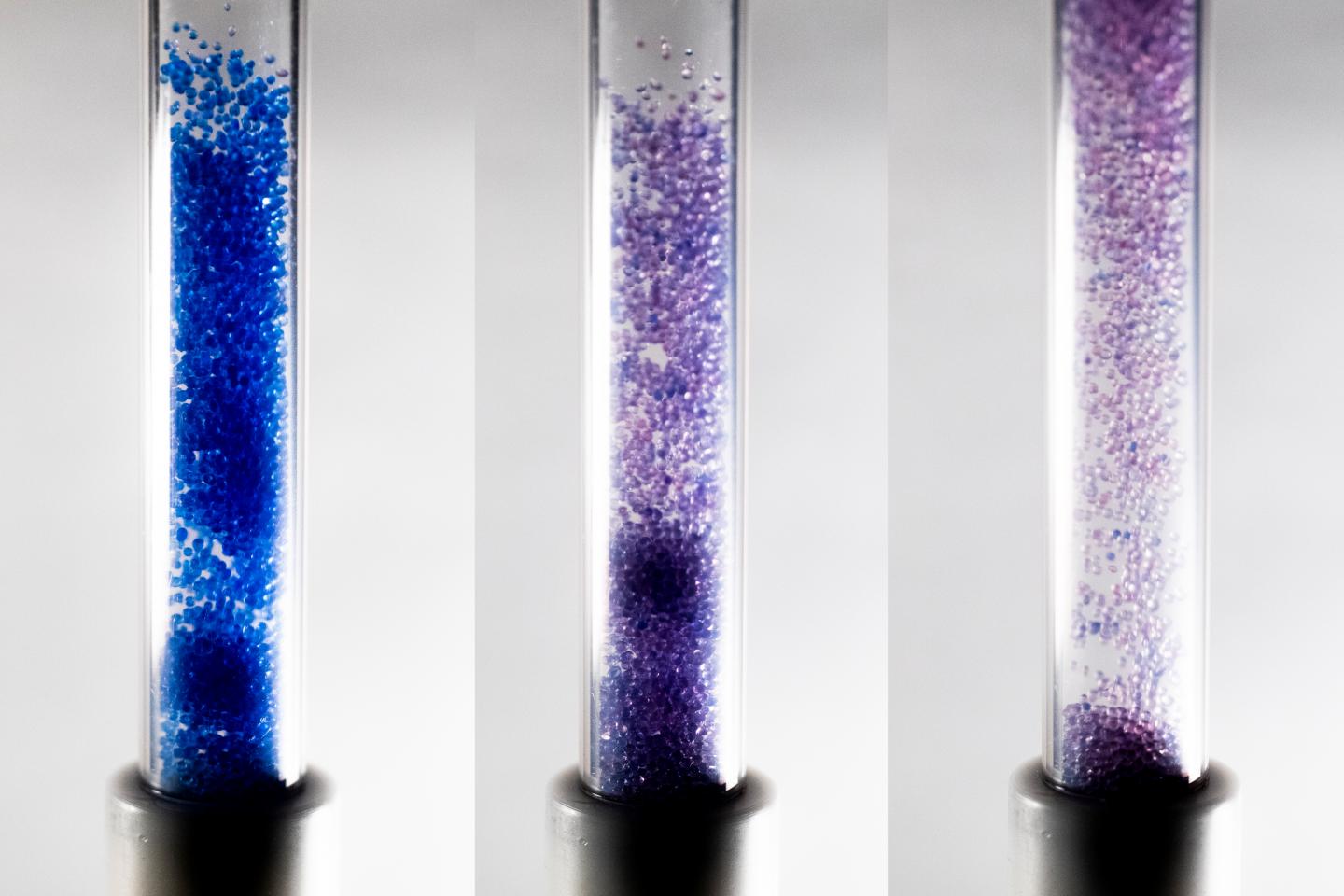
Researchers seek to create more efficient, cost-effective method
SAN ANTONIO — June 1, 2021 — Engineers and chemists at Southwest Research Institute have teamed up to create a low-cost method of harvesting water from atmospheric air on a much larger scale than previously attempted. Supported by $300,000 in internal research funding, the group is using silica gel beads, which are commonly used to keep items from gathering moisture during shipment, to capture water molecules from the air around us.
“There is always water vapor in the air around us,” said Program Manager Kevin Supak. “If you’re enjoying a cold beverage on a humid day, you’ll see condensation gathering on the glass. We can capture that moisture and turn it into a resource.”
Many cities around the world are facing water availability crises. In 2018, Cape Town, South Africa came very close to running out of water. One solution the city turned to was atmospheric water harvesting using refrigeration, which involves running air over a cool surface to create condensation, similar to air conditioner technology. While this method could be highly beneficial to communities where water is scarce, it is energy intensive and impractical at low humidity conditions.
SwRI is researching another form of atmospheric water harvesting based on adsorption, where water vapor molecules present in the air attach to the surface of materials called desiccants, even at low humidity levels. Researchers have utilized high-performance desiccants made from metal-organic frameworks, however this material can cost thousands of dollars per kilogram. SwRI is considering the use of silica gel beads to lower the cost of the process.
“Silica is a basic material that is widely available,” Supak said. “Almost everyone has bought clothes, equipment or shoes and found a packet of silica gel beads placed inside to adsorb moisture while items are sitting on a shelf or being shipped. It’s commercially available, inexpensive and highly effective.”
The method involves using a fan to blow atmospheric air through a bed of silica gel beads to adsorb the water vapor molecules.
“The water vapor will attach to the adsorbent material through hydrogen bonding. When we introduce heat, the water is exuded in gaseous form but at much higher humidity,” Supak said. “This high-humidity air can be more easily condensed, and the result is potable water.”
The group is utilizing a fluidized bed process to expand the scale of the water harvesting system by roughly 10 times what has previously been demonstrated. Most research groups studying this process are using a fixed bed of absorbent material, which is a simpler design but results in a lower production rate.
The system SwRI is creating is designed to yield about 5 liters of water a day. Supak believes that their method could also significantly reduce the production time.
“Essentially, we are expanding the lab-scale fundamental studies to a unique field-scale demonstration,” Supak said. “Our process utilizes a fluidized bed. We flow air over the material in pellet form to enhance the water absorption and desorption rates.”
The team plans to test the system for up to 1,000 cycles–10 times more than any previous demonstration. This high volume of cyclic testing is critical to understand if the material performance degrades over time.
The project, which has been funded by SwRI for a year, is expected to be completed in October.
###
View a video about this project: https:/
For more information, visit https:/
Media Contact
Joanna Carver
[email protected]
Original Source
https:/