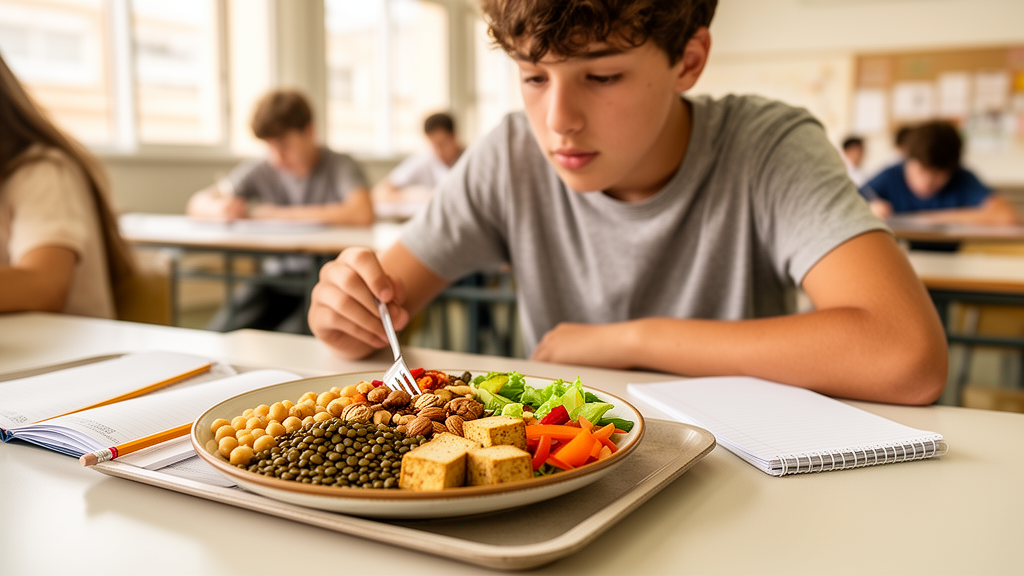
Replacing even a small share of the protein in an adolescent's diet with plant-based sources was consistently associated with better school results, according to a secondary analysis of data from the Eating Healthy and Daily Life Activities (EHDLA) study published in Pediatric Research. The analysis included 769 Spanish adolescents aged 12 to 17, of whom 55.5 percent were girls, and found that substituting animal-based protein with plant-based protein was linked to higher scores on a grade point average as well as on specific subjects including language, mathematics, and foreign language. All reported associations reached the study's statistical threshold, with p values below 0.001.
The researchers used an isocaloric substitution framework, a statistical approach that models what happens when one dietary component replaces another while total energy intake is held constant. In this study, dietary intake was assessed with a 45-item food-frequency questionnaire, and the substitution models were estimated using robust linear regression. The models adjusted for relevant sociodemographic, lifestyle, and anthropometric factors, meaning the analysis attempted to account for differences in family circumstances, health behaviors, and body size that could independently relate to school performance.
The size of the modeled effect was framed in terms of dietary share: replacing 5 percent of total energy intake from animal-based protein with plant-based protein was associated with a higher grade point average and with higher subject-specific scores. When the authors examined which animal protein sources drove the pattern, the associations were primarily attributable to replacing protein from red and processed meat, and from certain fish, with plant-based sources. In other words, the observed signal was not simply that any animal food displaced by plants corresponded to better grades; the specific origin of the displaced animal protein mattered, with dietary patterns carrying a higher contribution of red and processed meat protein relative to plant protein being associated with less favorable academic outcomes.
The study's authors describe this as the first investigation to apply an isocaloric substitution approach to the question of protein source and academic performance in adolescents. Protein source has previously been linked in the literature to cognitive outcomes, but the researchers note that evidence on the association between isocaloric substitution of protein sources and academic performance in adolescents specifically has been limited, which they cite as the rationale for the analysis. They conclude that the findings highlight the potential importance of protein source within dietary patterns related to educational outcomes.
Several constraints on interpretation deserve emphasis. The analysis identifies associations, not causal effects, so it cannot establish that changing protein sources would improve grades, only that the substitution was associated with academic performance in this population. The authors also note that the underlying datasets, being sensitive in nature, are not publicly available but can be requested from the corresponding author on reasonable request.
The findings come from a single Spanish cohort, and the evidence remains at the level of observed association.
Subject of Research: Association between isocaloric substitution of animal-based protein with plant-based protein and academic performance in Spanish adolescents
Article Title: Isocaloric substitution of animal-based protein with plant-based protein and academic performance in Spanish adolescents: The EHDLA study
Article References: López-Gil, J. F., Cristi-Montero, C., Muñoz-Pardeza, J., Miño, C., Quiroz-Cárdenas, F., Yáñez-Sepúlveda, R., Quiroz-Cárdenas, D., Ridgell, L., Yon, D. K., & López-Moreno, M. (2026). Isocaloric substitution of animal-based protein with plant-based protein and academic performance in Spanish adolescents: The EHDLA study. Pediatric Research. https://doi.org/10.1038/s41390-026-05552-w
Image Credits: AI Generated
DOI: 10.1038/s41390-026-05552-w
Keywords: adolescent nutrition, plant-based protein, animal protein, academic performance, isocaloric substitution, EHDLA study, dietary patterns, red and processed meat, grade point average, Pediatric Research, Spain, Isocaloric
News Source: Daisy Hatcher. (October 24, 2026). Swapping Animal Protein for Plant Protein Tied to Better Grades in Spanish Teens. Scienmag.