• HOME
  • NEWS
  • EXPLORE
    • CAREER
      • Companies
      • Jobs
    • EVENTS
    • iGEM
      • News
      • Team
    • PHOTOS
    • VIDEO
    • WIKI
  • BLOG
  • COMMUNITY
    • FACEBOOK
    • INSTAGRAM
    • TWITTER
Tuesday, June 16, 2026
BIOENGINEER.ORG
No Result
View All Result
  • Login
  • HOME
  • NEWS
  • EXPLORE
    • CAREER
      • Companies
      • Jobs
        • Lecturer
        • PhD Studentship
        • Postdoc
        • Research Assistant
    • EVENTS
    • iGEM
      • News
      • Team
    • PHOTOS
    • VIDEO
    • WIKI
  • BLOG
  • COMMUNITY
    • FACEBOOK
    • INSTAGRAM
    • TWITTER
  • HOME
  • NEWS
  • EXPLORE
    • CAREER
      • Companies
      • Jobs
        • Lecturer
        • PhD Studentship
        • Postdoc
        • Research Assistant
    • EVENTS
    • iGEM
      • News
      • Team
    • PHOTOS
    • VIDEO
    • WIKI
  • BLOG
  • COMMUNITY
    • FACEBOOK
    • INSTAGRAM
    • TWITTER
No Result
View All Result
Bioengineer.org
No Result
View All Result
Home NEWS Science News

SUTD wins best paper at 35th AAAI conference on Artificial Intelligence 2021

Bioengineer by Bioengineer
March 10, 2021
in Science News
Reading Time: 2 mins read
0
IMAGE
Share on FacebookShare on TwitterShare on LinkedinShare on RedditShare on Telegram

The researchers have developed a novel connection which can help in the design of more efficient multi-agent AI systems.
IMAGE

Credit: SUTD

Game theory is known to be a useful tool in the study of Machine Learning (ML) and Artificial Intelligence (AI) Multi-Agent interactions.

One basic component of these ML and AI systems is the exploration-exploitation trade-off, a fundamental dilemma between taking a risk with new actions in the quest for more information about the environment (exploration) and repeatedly selecting actions that result in the current maximum reward or (exploitation).

However, the outcome of the exploration-exploitation process is often unpredictable in practice and the reasons behind its volatile performance have been a long-standing open question in the ML and AI communities.

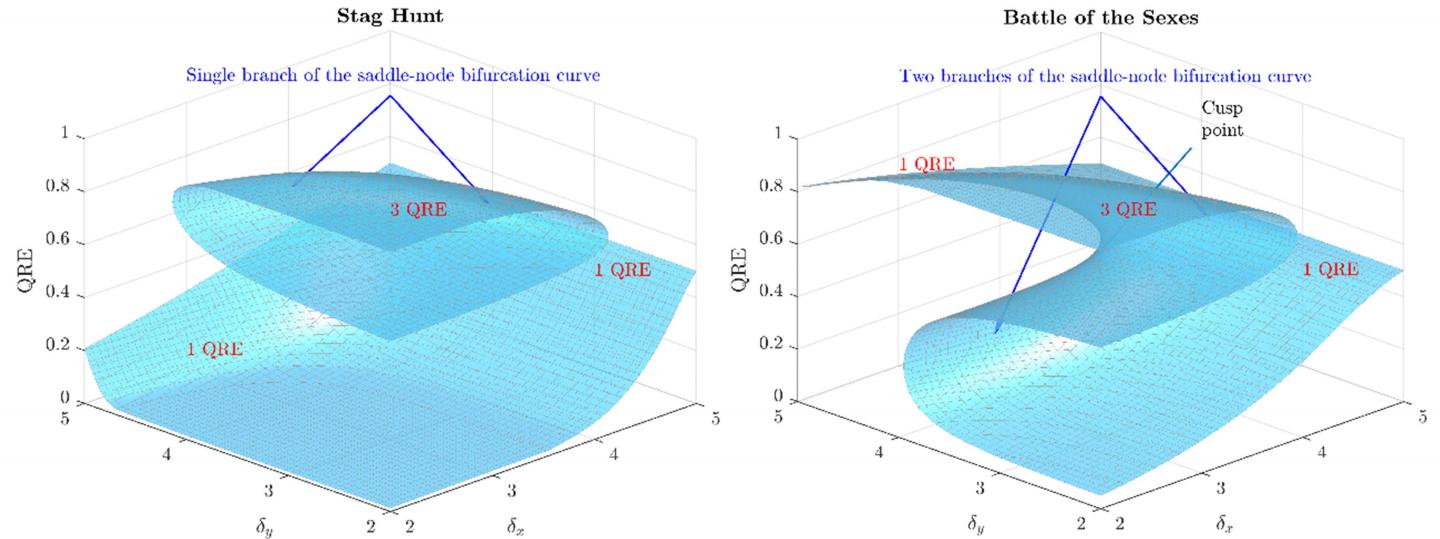
Dr Stefanos Leonardos and Assistant Professor Georgios Piliouras, researchers from the Singapore University of Technology and Design (SUTD), applied analytical tools from the theory of dynamical systems in the study of multi-agent systems and established a deep connection between exploration-exploitation and Catastrophe Theory (Figures 1 and 2). The latter is a branch of mathematics that formally explains phase transitions in all kinds of natural systems ranging from the transition from water to ice and disease outbreaks to collapses of financial markets.

This newly established connection provides a tool to predict the consequences and improve the performance of exploration-exploitation techniques in the development of multi-agent AI systems, such as robotic space missions, healthcare management or automated financial investing algorithms.

Their work, titled ‘Exploration-Exploitation in Multi-Agent Learning: Catastrophe Theory Meets Game Theory’, was honored with the Best Paper Award at the 35th AAAI Conference on Artificial Intelligence 2021.

“In this work, we reasoned about the rich mathematical structure in multi-agent interactions and showed how this underlying geometry shapes the performance of AI systems. We believe our new findings will support the research community in achieving its ambitious goal to push beyond the current AI boundaries,” explained first author Dr Stefanos Leonardos from SUTD.

“We are deeply honored by this recognition and are excited to continue our investigation of phase transitions and their implications to AI systems,” added Assistant Professor Georgios Piliouras from SUTD.

###

Media Contact
Jessica Sasayiah
[email protected]

Original Source

https://arxiv.org/pdf/2012.03083.pdf

Tags: Computer TheoryMathematics/StatisticsResearch/DevelopmentRobotry/Artificial IntelligenceTechnology/Engineering/Computer ScienceTheoretical SciencesTheory/Design
Share12Tweet8Share2ShareShareShare2

Related Posts

Breakthrough in Optical Computing: Introducing the Digital Twin System — Chemistry

Breakthrough in Optical Computing: Introducing the Digital Twin System

June 16, 2026
Microbiota from Undernourished Kids Causes Mouse Enteropathy — Biology

Microbiota from Undernourished Kids Causes Mouse Enteropathy

June 16, 2026

Red-Shifted GRAB Sensors Enable In Vivo Multiplex Imaging

June 16, 2026

PAINT Database Enables FAIR Data for Solar Plants

June 16, 2026
Please login to join discussion

POPULAR NEWS

  • ESMO 2025: mRNA COVID Vaccines Enhance Efficacy of Cancer Immunotherapy

    325 shares
    Share 130 Tweet 81
  • Saying Goodbye to PGY-6: Pediatric Fellowship Realities

    101 shares
    Share 40 Tweet 25
  • Multi-Hospital Study Reveals Long Covid Burden Is Twice as High as Current Estimates

    91 shares
    Share 36 Tweet 23
  • Detection of EDCs in Breast Milk and Infant Urine Up to Six Months Highlights Early Exposure Risks

    75 shares
    Share 30 Tweet 19

About

We bring you the latest biotechnology news from best research centers and universities around the world. Check our website.

Follow us

Recent News

Breakthrough in Optical Computing: Introducing the Digital Twin System

Microbiota from Undernourished Kids Causes Mouse Enteropathy

Red-Shifted GRAB Sensors Enable In Vivo Multiplex Imaging

Subscribe to Blog via Email

Enter your email address to subscribe to this blog and receive notifications of new posts by email.

Join 82 other subscribers
  • Contact Us

Bioengineer.org © Copyright 2023 All Rights Reserved.

Welcome Back!

Login to your account below

Forgotten Password?

Retrieve your password

Please enter your username or email address to reset your password.

Log In
No Result
View All Result
  • Homepages
    • Home Page 1
    • Home Page 2
  • News
  • National
  • Business
  • Health
  • Lifestyle
  • Science

Bioengineer.org © Copyright 2023 All Rights Reserved.