• HOME
  • NEWS
  • EXPLORE
    • CAREER
      • Companies
      • Jobs
    • EVENTS
    • iGEM
      • News
      • Team
    • PHOTOS
    • VIDEO
    • WIKI
  • BLOG
  • COMMUNITY
    • FACEBOOK
    • INSTAGRAM
    • TWITTER
Monday, May 11, 2026
BIOENGINEER.ORG
No Result
View All Result
  • Login
  • HOME
  • NEWS
  • EXPLORE
    • CAREER
      • Companies
      • Jobs
        • Lecturer
        • PhD Studentship
        • Postdoc
        • Research Assistant
    • EVENTS
    • iGEM
      • News
      • Team
    • PHOTOS
    • VIDEO
    • WIKI
  • BLOG
  • COMMUNITY
    • FACEBOOK
    • INSTAGRAM
    • TWITTER
  • HOME
  • NEWS
  • EXPLORE
    • CAREER
      • Companies
      • Jobs
        • Lecturer
        • PhD Studentship
        • Postdoc
        • Research Assistant
    • EVENTS
    • iGEM
      • News
      • Team
    • PHOTOS
    • VIDEO
    • WIKI
  • BLOG
  • COMMUNITY
    • FACEBOOK
    • INSTAGRAM
    • TWITTER
No Result
View All Result
Bioengineer.org
No Result
View All Result
Home NEWS Science News

SUTD researchers use nanoscale 3D printing to create high-resolution light field prints

Bioengineer by Bioengineer
September 6, 2025
in Science News
Reading Time: 2 mins read
0
IMAGE
Share on FacebookShare on TwitterShare on LinkedinShare on RedditShare on Telegram

Wouldn’t it be amazing if printed images can look three-dimensional (3D)? Unfortunately, conventional prints like photographs display two-dimensional (2D) images with a fixed appearance as they contain only intensity and colour information. These prints are unable to display a 3D image because they lack directional control of light rays, hence resulting in the loss of depth information.

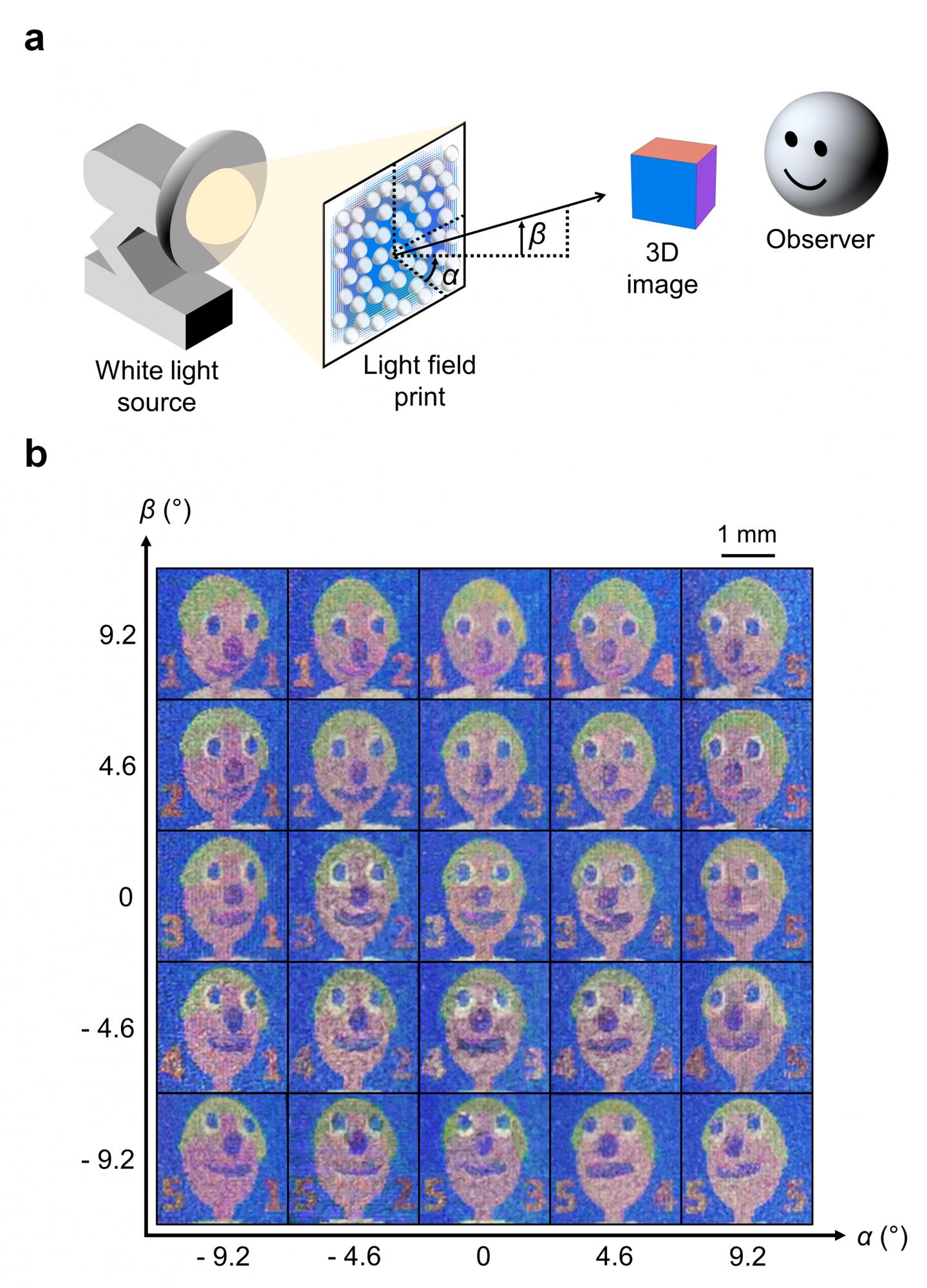
To address this problem, a team of researchers from the Singapore University of Technology and Design (SUTD) used a nanoscale 3D printing technique to create high-resolution light field prints (LFP). The LFP comprises an array of microlenses aligned on top of an array of structural colour pixels. When the LFP is illuminated by ordinary white light, a 3D image is displayed. The 3D image is autostereoscopic, which means that it can be viewed without needing to wear special glasses. The image changes appearance as it is viewed from varying angles, which gives the LFP a special 3D visual effect.

More importantly, high-resolution LFPs are needed to display ultra-realistic 3D images that have potential applications in artworks and security items. By using nanoscale 3D printing to create LFPs, the team achieved a maximum pixel resolution of 25,400 dots per inch (dpi), which surpasses the pixel resolution of consumer inkjet printers ~1,200 dpi. The structural colour pixels in the LFP are made of nanopillars (~300nm diameter). Perhaps the most remarkable result is that each colour pixel can be represented by a single nanopillar to produce the LFP at its maximum resolution.

SUTD Associate Professor Joel Yang, who is the principal investigator of this research, remarked: “This is possibly the first time that 3D printing is used to entirely create a multi-coloured light field print (LFP) in a single step, without the use of dyes, and without the need for manual alignment of microlenses to the colour pixels. The prints are embedded with up to 225 frames within a single LFP to generate smooth viewing transitions at unprecedented resolution. These effects will lead to 2D prints that produce ultra-realistic 3D visuals in future.”

The team anticipates that high-resolution LFPs will become more readily available in the market when nanotechnology allows greater scalability and throughput. This research was published in Nature Communications.

###

Media Contact
Melissa Koh
[email protected]

Related Journal Article

http://dx.doi.org/10.1038/s41467-021-23964-6

Tags: Chemistry/Physics/Materials SciencesNanotechnology/MicromachinesOptics
Share12Tweet8Share2ShareShareShare2

Related Posts

Humans and Zebra Finches Share Similar Speech Learning Techniques #ASA190 — Chemistry

Humans and Zebra Finches Share Similar Speech Learning Techniques #ASA190

May 11, 2026
New Study Uncovers How Fungal Parasites Attack Strawberries and Raspberries — Agriculture

New Study Uncovers How Fungal Parasites Attack Strawberries and Raspberries

May 11, 2026

City of Hope Researchers to Present Groundbreaking Immunotherapy and Precision Medicine Advances Across Multiple Cancer Types at ASCO 2026

May 11, 2026

Medicaid Expansion Reduces Mortality in Young Adults with Kidney Failure

May 11, 2026
Please login to join discussion

POPULAR NEWS

  • Research Indicates Potential Connection Between Prenatal Medication Exposure and Elevated Autism Risk

    841 shares
    Share 336 Tweet 210
  • New Study Reveals Plants Can Detect the Sound of Rain

    728 shares
    Share 290 Tweet 182
  • Salmonella Haem Blocks Macrophages, Boosts Infection

    62 shares
    Share 25 Tweet 16
  • Breastmilk Balances E. coli and Beneficial Bacteria in Infant Gut Microbiomes

    57 shares
    Share 23 Tweet 14

About

We bring you the latest biotechnology news from best research centers and universities around the world. Check our website.

Follow us

Recent News

Humans and Zebra Finches Share Similar Speech Learning Techniques #ASA190

New Study Uncovers How Fungal Parasites Attack Strawberries and Raspberries

City of Hope Researchers to Present Groundbreaking Immunotherapy and Precision Medicine Advances Across Multiple Cancer Types at ASCO 2026

Subscribe to Blog via Email

Enter your email address to subscribe to this blog and receive notifications of new posts by email.

Join 82 other subscribers
  • Contact Us

Bioengineer.org © Copyright 2023 All Rights Reserved.

Welcome Back!

Login to your account below

Forgotten Password?

Retrieve your password

Please enter your username or email address to reset your password.

Log In
No Result
View All Result
  • Homepages
    • Home Page 1
    • Home Page 2
  • News
  • National
  • Business
  • Health
  • Lifestyle
  • Science

Bioengineer.org © Copyright 2023 All Rights Reserved.