• HOME
  • NEWS
  • EXPLORE
    • CAREER
      • Companies
      • Jobs
    • EVENTS
    • iGEM
      • News
      • Team
    • PHOTOS
    • VIDEO
    • WIKI
  • BLOG
  • COMMUNITY
    • FACEBOOK
    • INSTAGRAM
    • TWITTER
Sunday, June 28, 2026
BIOENGINEER.ORG
No Result
View All Result
  • Login
  • HOME
  • NEWS
  • EXPLORE
    • CAREER
      • Companies
      • Jobs
        • Lecturer
        • PhD Studentship
        • Postdoc
        • Research Assistant
    • EVENTS
    • iGEM
      • News
      • Team
    • PHOTOS
    • VIDEO
    • WIKI
  • BLOG
  • COMMUNITY
    • FACEBOOK
    • INSTAGRAM
    • TWITTER
  • HOME
  • NEWS
  • EXPLORE
    • CAREER
      • Companies
      • Jobs
        • Lecturer
        • PhD Studentship
        • Postdoc
        • Research Assistant
    • EVENTS
    • iGEM
      • News
      • Team
    • PHOTOS
    • VIDEO
    • WIKI
  • BLOG
  • COMMUNITY
    • FACEBOOK
    • INSTAGRAM
    • TWITTER
No Result
View All Result
Bioengineer.org
No Result
View All Result
Home NEWS Science News Chemistry

SUTD and MIT scientists first to simulate a large-scale virus, M13

Bioengineer by Bioengineer
December 17, 2020
in Chemistry
Reading Time: 2 mins read
0
IMAGE
Share on FacebookShare on TwitterShare on LinkedinShare on RedditShare on Telegram

IMAGE

Credit: SUTD

Atomistic simulations are a powerful tool to study the movement and interactions of atoms and molecules. In many biological processes, large-scale effects, for example, assembly of large viruses to nanoparticles are important. The assembly processes of these large viruses are of fundamental importance to the design of many devices and viral protein-targeted therapeutics. However, the time and length scale of these assembly processes are usually too large for simulations at molecular resolution.

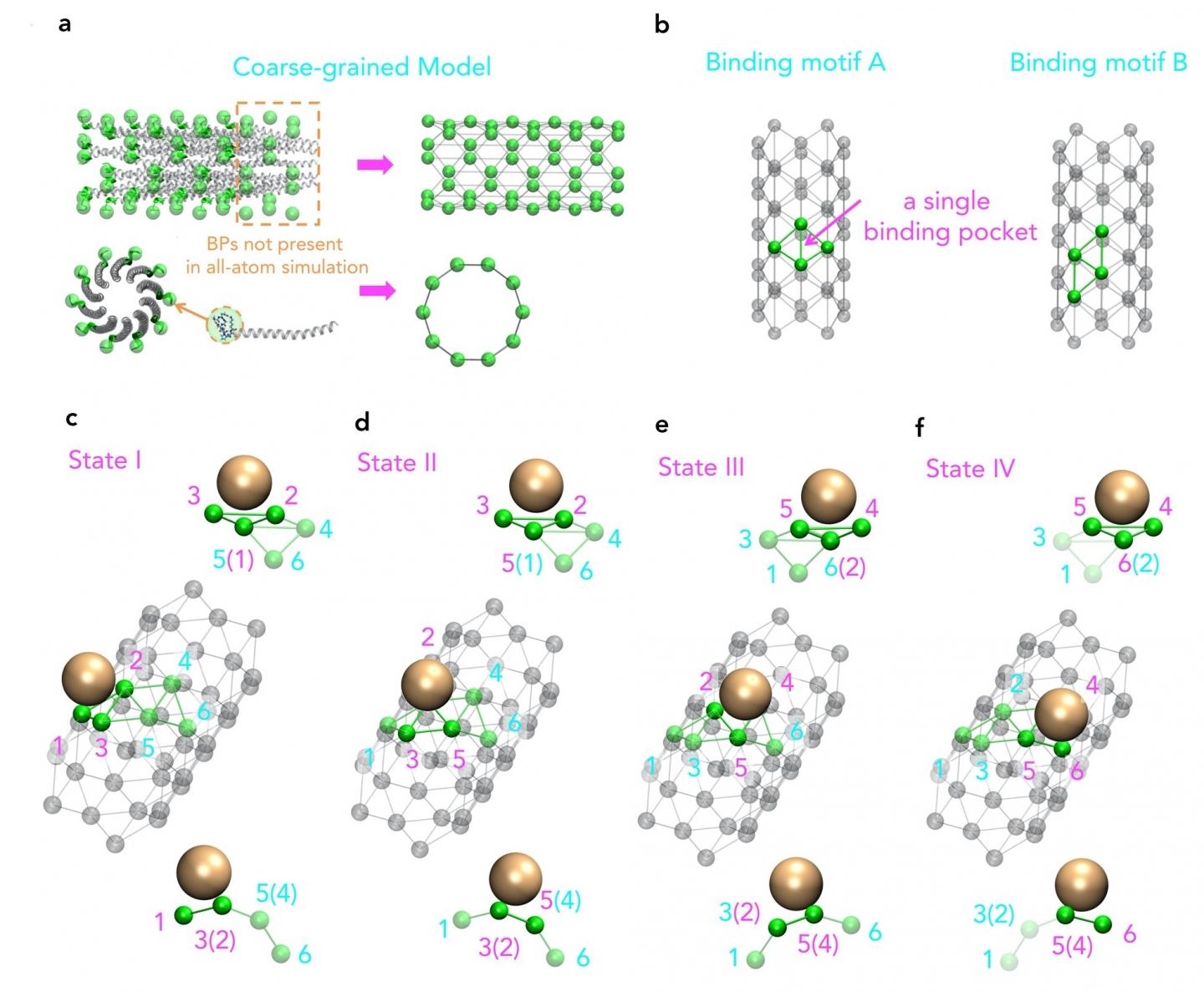
Moreover, even though an increase in computing power allows for more complex and longer simulations, virus structures, such as M13, are still beyond reach. That is why a research group from the Singapore University of Technology and Design (SUTD) and the Massachusetts Institute of Technology (MIT) has developed a procedure that links large-scale assembly processes to molecular simulations. Assistant Prof Desmond Loke from SUTD’s Science, Mathematics and Technology cluster said, “For the simulation of M13, we started with different sets of force fields. Suitable force fields were chosen and they were used as the inputs for a molecule dynamics simulations with the coarse-grain model designed to capture key pattern of the assembly process.”

“While we know that M13-based manufacturing can be fundamentally driven by nanoparticle-peptide interactions, which may also be a key principle behind M13-type bioengineering, we have little knowledge of how repeated patterns of short-end-peptides on a M13 surface are actually involved in these interactions. To study this, we ideally have to include a full structure of the viral coat-protein, which is a difficult task for current state-of-the-art molecular dynamics simulations,” adds Dr Lunna Li, first author of the article.

The procedure allows users to add different types of nanoparticles to a solution, at a realistic level. Inspired by this procedure, Assistant Professor Loke and his colleagues were able to simulate a large-scale virus with nanoparticles and inside a solution for fifty nanoseconds.

Dr Li said, “The virus structure and solution contain about 700,000 atoms overall.” Considering the shape and size of the features, the complexity of this simulation can be larger than any simulation performed previously.

“A simulation performed in microseconds would have been possible if a smaller M13 model was used, but it can be worthwhile to reduce the time to actually observe how the full structure may influence the assembly between the M13 and nanoparticles,” explained Assistant Prof Loke.

###

MIT Biological Engineering Professor Angela Belcher, was also part of the research team that was simulating M13. This research was published in journal Nanoscale.

Media Contact
Melissa Koh
[email protected]

Related Journal Article

http://dx.doi.org/10.1039/D0NR07320B

Tags: BacteriologyBiochemistryBiologyChemistry/Physics/Materials SciencesMolecular Physics
Share12Tweet8Share2ShareShareShare2

Related Posts

AI and Physics Collaborate to Design Advanced Hydrogen Storage Materials

June 25, 2026

International Team Including Dresden Scientists Develops Novel Designer Proteins for Advanced Study of Living Tissue

June 25, 2026

New Study Uncovers Key Factors Driving Water Chemistry in Nanoscale Environments

June 25, 2026

Plasma Technology Extends Catalyst Lifespan in Hydrogen Production

June 24, 2026
Please login to join discussion

POPULAR NEWS

  • Saying Goodbye to PGY-6: Pediatric Fellowship Realities

    103 shares
    Share 41 Tweet 26
  • Multi-Hospital Study Reveals Long Covid Burden Is Twice as High as Current Estimates

    92 shares
    Share 36 Tweet 23
  • Detection of EDCs in Breast Milk and Infant Urine Up to Six Months Highlights Early Exposure Risks

    77 shares
    Share 31 Tweet 19
  • New Drug Candidate Developed at McMaster Shows Potential for Treating Brain Cancer

    58 shares
    Share 23 Tweet 15

About

We bring you the latest biotechnology news from best research centers and universities around the world. Check our website.

Follow us

Recent News

Tracking Lanthanide-Labeled Microplastics in Plants

POSTECH Researchers Slash Cost of Reconstituted Cell-Free Systems by 95%

AI and Physics Collaborate to Design Advanced Hydrogen Storage Materials

Subscribe to Blog via Email

Success! An email was just sent to confirm your subscription. Please find the email now and click 'Confirm' to start subscribing.

Join 82 other subscribers
  • Contact Us

Bioengineer.org © Copyright 2023 All Rights Reserved.

Welcome Back!

Login to your account below

Forgotten Password?

Retrieve your password

Please enter your username or email address to reset your password.

Log In
No Result
View All Result
  • Homepages
    • Home Page 1
    • Home Page 2
  • News
  • National
  • Business
  • Health
  • Lifestyle
  • Science

Bioengineer.org © Copyright 2023 All Rights Reserved.