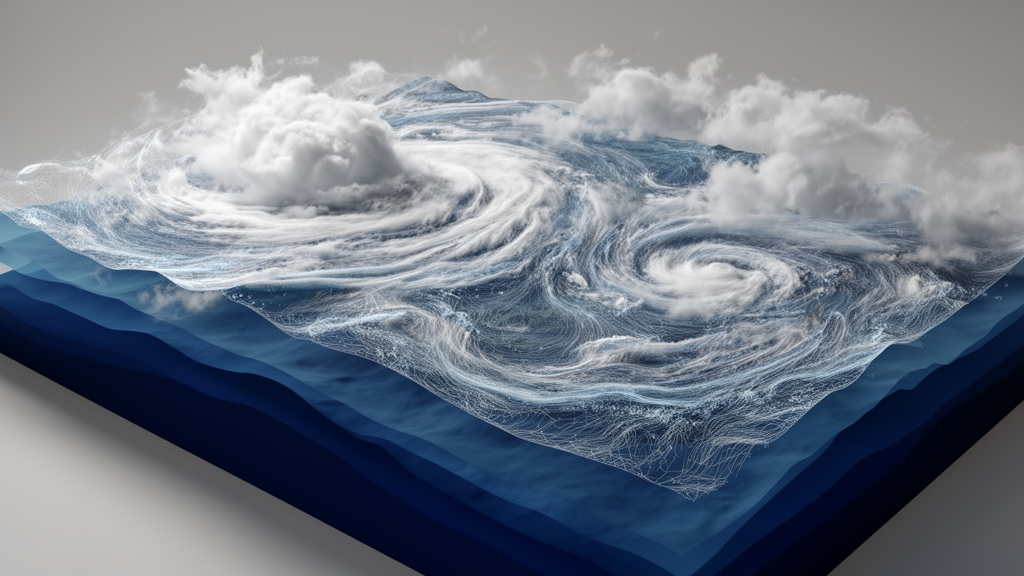
Generative diffusion models are finding expanding applications across atmospheric and oceanic research, according to a survey published in the Journal of Big Data. Researchers led by Xiang Zhu and colleagues analyzed how these machine learning frameworks are being adapted to meteorology and oceanography. By simulating the noise diffusion process in datasets, these architectures capture latent patterns and trends to address common domain challenges such as data noise and the rising frequency of extreme weather events.
The survey reviews the fundamental principles and derivative models that define diffusion architectures, outlining their specific application strategies and advantages within earth science domains. The authors categorize existing research into three core operational tasks: data assimilation, forecasting, and post-processing.
The review notes that comprehensive evaluations of diffusion models in these fields have previously remained limited despite widespread success in computer vision and multimodal learning. The authors outline existing technical challenges, examine future developmental trajectories, and provide insights intended to guide further research and practical implementation across both atmospheric and oceanic sciences.
Subject of Research: Applications of generative diffusion models in meteorology and oceanography
Article Title: Diffusion models in atmospheric and oceanic research: a survey
Article References: Zhu, X., Xu, W., Li, X., Luo, X., Ren, X., Wu, S., & Ren, K. (2026). Diffusion models in atmospheric and oceanic research: a survey. Journal of Big Data. https://doi.org/10.1186/s40537-026-01598-z
Image Credits: AI Generated
DOI: 10.1186/s40537-026-01598-z
Keywords: diffusion models, generative models, meteorology, oceanography, data assimilation, weather forecasting, post-processing, atmospheric research, oceanic research, machine learning, noise diffusion, extreme weather events, multimodal learning, data noise, Journal of Big Data, generative AI
News Source: Denise Maddox. (November 19, 2026). Survey Examines Applications of Diffusion Models in Meteorology and Oceanography. Scienmag.