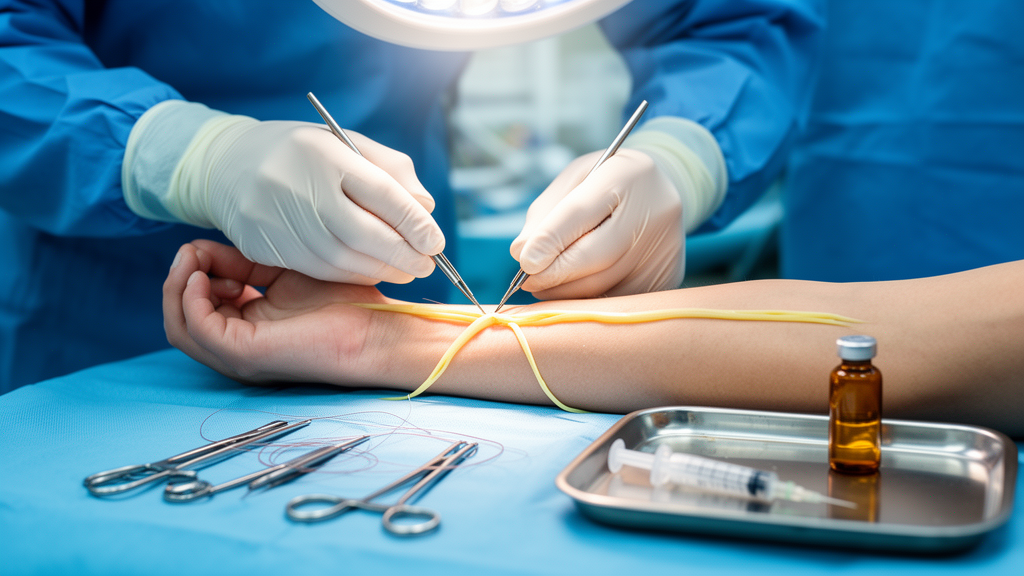
Peripheral nerve injuries — from crushed wrists to entrapped ulnar nerves — leave millions of people struggling with numbness, weakness, and chronic pain, and recovery is often frustratingly slow. A new randomized clinical trial from Jieyang People’s Hospital in Guangdong, China, now suggests that pairing a well-known surgical technique with a familiar vitamin may unlock substantially better outcomes than either approach on its own. The study, published in Frontiers in Integrative Neuroscience, found that combining surgical neurolysis with oral methylcobalamin, the active form of vitamin B12, produced recovery rates that neither treatment could achieve alone.
The trial enrolled ninety patients with focal, mechanically caused peripheral nerve injuries — the kind produced by crush trauma, traction, lacerations, or chronic compression syndromes such as carpal tunnel and cubital tunnel disorder. Participants were randomly divided into three equal groups of thirty. One group underwent neurolysis surgery alone, a second took methylcobalamin tablets at 0.5 milligrams three times daily, and the third received both interventions. Every patient also followed the same standardized rehabilitation program, and all groups completed two consecutive thirty-day treatment courses before their sixty-day assessments.
The headline result was striking. The combination group achieved a total effective rate of 86.67 percent, meaning most patients in that group showed clear grade improvements on the Carroll Upper Extremity Function Test, a validated zero-to-ninety-nine scale of hand and arm function. By contrast, the neurolysis-only group reached 50.00 percent and the methylcobalamin-only group 53.33 percent. Ten patients in the combination arm were classified as fully cured, compared with four in the surgery group and five in the vitamin group, and only four combination patients remained in the ineffective category.
Objective electrophysiological measurements told the same story. Using nerve conduction studies, the researchers tracked motor conduction velocity, sensory conduction velocity, compound muscle action potential amplitude, and latency. While all three groups improved significantly from baseline, the combination group posted the largest gains across every parameter. Motor conduction velocity, for example, rose from roughly 38 meters per second at baseline to nearly 50 meters per second after treatment in the combined arm, versus gains of about six meters per second in each monotherapy group. Faster conduction and higher amplitudes signal restored axonal integrity and improved myelination — the biological substrate of real-world function.
Those electrical improvements translated into movement. Active and passive joint range of motion, measured with a goniometer, improved in all groups but soared in the combination arm: active range of motion climbed from about 10.5 degrees to 42.2 degrees, and passive range of motion from about 24 degrees to nearly 63 degrees, roughly double the gains seen in either monotherapy group. Pain scores on the Global Pain Scale, which covers clinical symptoms, emotional state, daily activities, and pain intensity, fell in every group, but the combination group recorded the lowest post-treatment scores in all four domains.
Blood tests added a biochemical dimension to the findings. The researchers measured serum levels of three inflammatory mediators — nuclear factor kappa B (NF-κB), tumor necrosis factor-alpha (TNF-α), and interleukin-6 (IL-6) — using enzyme-linked immunosorbent assays on fasting blood samples. All three markers dropped after treatment in every group, but the combination group achieved the deepest suppression: NF-κB fell to 13.76 micrograms per liter, TNF-α to 16.45 micrograms per liter, and IL-6 to 6.37 picograms per milliliter, all significantly lower than in either monotherapy arm. The trial also reported markedly lower rates of limb numbness, joint stiffness, chronic pain, and limb atrophy among combination patients.
The logic behind the synergy is biologically coherent. Neurolysis is a mechanical fix: surgeons meticulously free the injured nerve from scar tissue, adhesions, or fibro-osseous tunnels, restoring its ability to glide and re-establishing blood supply. But surgery alone does little to correct the hostile biochemical environment inside the damaged nerve, where inflammatory cascades perpetuate injury and stall regeneration. Methylcobalamin works from the opposite direction. As the neuroactive form of vitamin B12, it supports axonal regeneration, promotes myelin synthesis, sustains neuronal survival, and — as prior research has shown — inhibits NF-κB signaling and the downstream cytokines that drive neuropathic pain. What it cannot do is physically decompress a nerve trapped in constrictive scar tissue.
The trial’s methodology deserves attention. It was prospective, randomized, and evaluator-blinded: an independent statistician generated the allocation sequence using permuted blocks, assignments were concealed in sequentially numbered opaque envelopes, and all outcome assessments — functional testing, nerve conduction studies, range-of-motion measurements, pain scoring, and laboratory analyses — were performed by assessors blinded to group allocation. Patients and surgeons could not be blinded to surgery, but the intention-to-treat analysis and blinded data handling reduce the risk of detection bias. The sample size was determined a priori by power analysis, and baseline characteristics, injury etiologies, and severity were balanced across the three groups.
The authors are candid about limitations. The study was single-center, so results may not generalize to other populations or surgical teams. The follow-up window was only sixty days, which captures early recovery but says nothing about long-term durability, symptom recurrence, or late complications. The patient cohort mixed several injury subtypes, and subtle variations in surgical technique and rehabilitation adherence are unavoidable in clinical practice. Larger, multicenter trials with follow-up of twelve months or longer, homogeneous injury groups, and optimized methylcobalamin dosing regimens will be needed before the combined approach can be considered a standard of care.
Even with those caveats, the findings carry real weight for a condition that has long lacked rigorous comparative evidence. Traumatic peripheral nerve injuries affect an estimated 13 to 23 people per 100,000 each year, and the resulting disability and chronic pain impose heavy personal and economic costs. If the synergy holds up in larger trials, the message for clinicians would be straightforward: mechanical decompression and pharmacological neuroprotection are not competing strategies but complementary halves of the same problem. Freeing the nerve gives it room to heal; feeding it methylcobalamin helps it actually regenerate. The combination, this trial suggests, is more than the sum of its parts.
Subject of Research: Combined neurolysis surgery and methylcobalamin therapy for peripheral nerve injury recovery
Article Title: Synergistic efficacy of combined neurolysis and methylcobalamin in peripheral nerve injury: a randomized clinical trial
Article References: Hu, X., & Li, Z. (2026). Synergistic efficacy of combined neurolysis and methylcobalamin in peripheral nerve injury: a randomized clinical trial. Frontiers in Integrative Neuroscience, 20, Article 1747898. https://doi.org/10.3389/fnint.2026.1747898
Image Credits: AI Generated
DOI: 10.3389/fnint.2026.1747898
Keywords: peripheral nerve injury, neurolysis, methylcobalamin, vitamin B12, nerve conduction, inflammation, NF-κB, TNF-alpha, IL-6, randomized clinical trial, neuropathic pain, nerve regeneration
News Source: Ophelia Keating. (October 17, 2026). Surgery Plus Vitamin B12 Outperforms Either Alone in Peripheral Nerve Injury Trial. Scienmag.