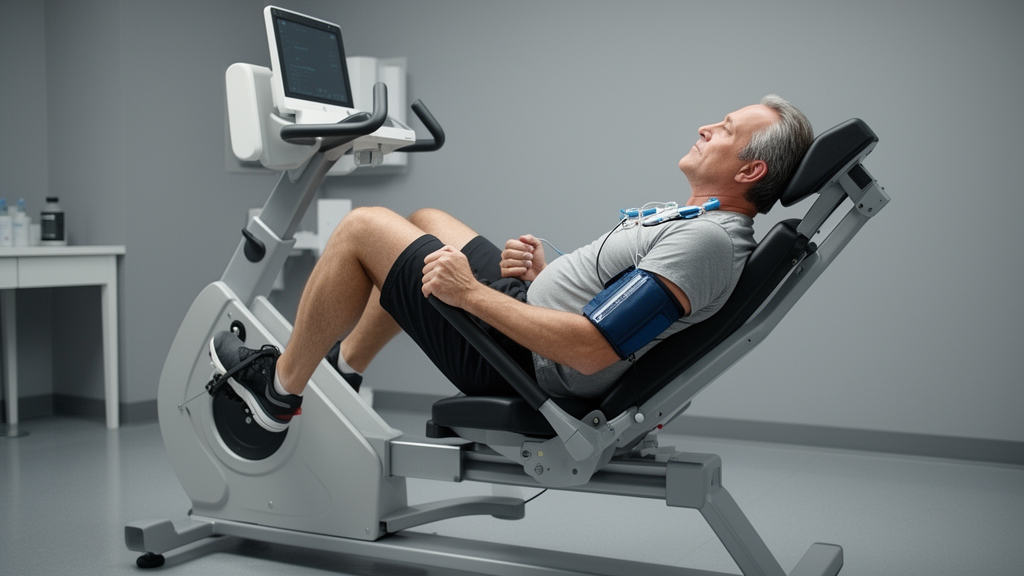
Researchers evaluating clinical stress testing have established normative physiological reference values for supine bicycle stress echocardiography in patients with normal test outcomes from an unselected chest pain cohort. The retrospective investigation, conducted at Wythenshawe Hospital within a major tertiary cardiac centre in Manchester, analysed 260 qualifying patient examinations to provide clinical benchmarks for systolic blood pressure, heart rate, total exercise duration, and peak rate pressure product. Clinicians frequently utilise supine bicycle stress echocardiography to evaluate myocardial function in individuals presenting with suspected coronary artery disease, where a normal examination is associated with an excellent long-term prognosis. While treadmill exercise protocols have long maintained well-characterised reference standards that predict patient survival, equivalent baseline ranges for supine bicycle testing have remained absent from medical literature. The newly established dataset provides direct clinical utility for interpreting cardiovascular performance in symptomatic patients referred for evaluation.
Supine bicycle stress echocardiography possesses distinct operational and diagnostic characteristics when contrasted with conventional treadmill stress testing conducted under the Bruce protocol. Treadmill protocols traditionally restrict physiological measurements and ultrasound imaging to two distinct points: pre-exercise baseline and immediate cessation following peak exertion. In contrast, bicycle ergometry in the supine position permits continuous cardiac monitoring and real-time image acquisition across incremental stages of exertion. This configuration yields a higher sensitivity for identifying myocardial ischaemia compared to treadmill stress echocardiography. Because systolic pressure reaches greater peak levels, patients achieve a higher overall rate pressure product on a bicycle, rendering treadmill exercise durations non-transferable to supine cycling.
The study cohort was derived from a consecutive series of 776 patients undergoing clinical supine bicycle stress echocardiography between September 2022 and April 2024. To isolate true physiological norms, investigators applied rigorous pre-determined exclusion criteria that eliminated 516 patients from the primary analysis. Exclusions comprised 197 individuals with established coronary artery disease, prior myocardial infarction, previous percutaneous coronary intervention, or coronary artery bypass grafting; 148 patients presenting with moderate or severe valvular heart disease; 60 patients exhibiting an abnormal hypertensive response during exertion; 44 who experienced premature test cessation; 34 demonstrating ventricular cavity dilatation during stress; 31 with a documented history of cardiac arrhythmias; and 2 patients with documented heart failure. The remaining 260 patients, consisting of 153 men and 107 women, met strict echocardiographic criteria for normal performance, defined as normal baseline left ventricular function, a greater than 10 percent increase in ejection fraction, cavity size reduction, and an absence of inducible wall motion abnormalities.
Exercise testing utilised a dedicated supine bicycle ergometer paired with a GE Healthcare Vivid E Series cardiovascular ultrasound platform, adhering to a World Health Organisation bicycle protocol with a constant pedalling cadence between 50 and 60 revolutions per minute. The testing protocol commenced with a standardised 25-watt ramp workload, during which clinicians continuously monitored cardiac rhythm via three-channel electrocardiography and withheld beta-blocker medications for 48 hours prior to testing. Prior to exercise, clinicians evaluated baseline two-dimensional echocardiographic parameters, including left and right ventricular dimensions, baseline wall motion, ventricular systolic function, aortic root size, and aortic valve opening. Pre-specified criteria for test termination included limiting symptoms such as severe chest pain, dyspnoea, or leg fatigue; significant regional wall motion abnormalities; severe cardiac arrhythmias; or a hypertensive safety threshold of systolic blood pressure exceeding 220 millimetres of mercury or diastolic pressure exceeding 120 millimetres of mercury. In the absence of termination criteria, exertion continued to physical exhaustion.
Mathematical analyses evaluated exercise capacity and cardiac workload through rate pressure product and estimated metabolic equivalents. Rate pressure product was calculated as the product of peak heart rate and peak systolic blood pressure, while metabolic equivalents were calculated using the American College of Sports Medicine formula incorporating work rate in watts, body mass, resting oxygen uptake, and cycling oxygen consumption. Baseline measurements revealed significant sex-related differences across the cohort. Men demonstrated a lower resting heart rate than women, averaging 77 beats per minute with a standard deviation of 15, compared to 83 beats per minute with a standard deviation of 13 in women. Conversely, resting systolic blood pressure was 6.1 percent higher among men, averaging 143 millimetres of mercury versus 135 millimetres of mercury in women. Across age brackets, resting heart rate remained relatively stable, whereas baseline systolic blood pressure rose systematically from 127 millimetres of mercury in patients under 40 to 151 millimetres of mercury in those over 70.
Exertion provoked divergent physiological endpoints between sexes despite similar relative cardiovascular adjustments from rest. Peak heart rate was significantly lower in men than women, recording 141 beats per minute versus 145 beats per minute, although the net increase above baseline was comparable between sexes at 64 and 62 beats per minute, respectively. Men attained a 9.7 percent higher peak systolic blood pressure than women, reaching 185 millimetres of mercury compared to 169 millimetres of mercury, while the absolute blood pressure rise during exercise showed no significant divergence at 40 millimetres of mercury in men and 34 millimetres of mercury in women. Men achieved a 20.5 percent longer total exercise time than women, cycling for an average of 577 seconds compared to 477 seconds, and generated a 6.8 percent higher peak rate pressure product of 26000 compared to 24348.
Advancing age exerted substantial effects on physical endurance and hemodynamic response patterns during graded bicycle exercise. Among all patients combined, peak heart rate decreased progressively from 156 beats per minute in individuals aged under 40 years to 129 beats per minute in individuals aged over 70 years. Concurrently, mean peak systolic blood pressure rose significantly from 153 millimetres of mercury in the youngest cohort to 188 millimetres of mercury in the oldest group. Total exercise duration diminished alongside age, falling from an average of 609 seconds in participants under 40 years to 475 seconds in those over 70 years. Crucially, because the age-related decline in peak heart rate was counterbalanced by a commensurate elevation in peak systolic blood pressure, the calculated peak rate pressure product remained essentially identical across age groups, averaging 23881 in patients under 40 and 24343 in those over 70, with a non-significant probability value of 0.988.
Single-factor analysis of variance across age categories for combined male and female data revealed statistically significant age differences for patient weight, height, resting systolic blood pressure, peak heart rate, peak systolic blood pressure, peak rate pressure product, and total exercise time. Body mass index and baseline heart rate did not differ significantly between age cohorts, showing probability values of 0.25 and 0.43, respectively. Subsequent post-hoc Tukey analysis indicated that weight differences were isolated to comparisons between individuals aged 50 to 59 years and those over 70 years, whereas height exhibited significant declines across multiple comparisons. Resting systolic blood pressure was significantly elevated in older groups compared to those under 40 and those aged 40 to 49. Peak heart rate declined significantly across every pairwise age group comparison, whereas peak systolic blood pressure was significantly higher in older groups versus those under 40. Notably, despite overall variance, no individual pairwise comparison for peak rate pressure product reached statistical significance on Tukey testing.
Sex-stratified analysis of variance confirmed distinct physiological aging patterns between men and women. Among men, significant age-related differences emerged for height, resting systolic blood pressure, peak heart rate, peak systolic blood pressure, and exercise time, whereas weight, body mass index, baseline heart rate, and peak rate pressure product showed no significant age variance. Post-hoc testing in men demonstrated significant peak heart rate reductions across nearly all age brackets, elevated peak systolic pressure in older men relative to those under 40, and shorter exercise times in men aged 60 to 69 compared to those under 40. In women, analysis of variance similarly demonstrated significant differences for weight, height, resting systolic pressure, peak heart rate, and exercise time, with non-significant results for body mass index, baseline heart rate, peak systolic blood pressure, and peak rate pressure product. Pairwise post-hoc comparisons in women confirmed universal peak heart rate declines, higher resting systolic blood pressure in older groups, and significantly curtailed exercise duration in women over 70.
The study contextualises its normative data against prior registry benchmarks and exercise testing literature, while defining specific clinical and methodological boundaries. Earlier cardiopulmonary data from the FRIEND registry, encompassing 1717 men and 2777 women, similarly identified substantial sex disparities in maximal workload and oxygen consumption, though the routine absence of cardiopulmonary gas exchange in standard clinical echocardiography limits direct translation. Longitudinal treadmill research by Myers and colleagues previously established that every one-metabolic-equivalent increase in exercise capacity correlates with a 12 percent reduction in mortality risk. The authors acknowledge that their retrospective investigation evaluated symptomatic chest pain referrals rather than an asymptomatic healthy population, potentially introducing selection bias, and included patients with controlled resting hypertension to reflect real-world clinical practice. Furthermore, sample sizes at extreme ages were modest, and direct respiratory oxygen uptake was not measured, meaning rate pressure product cannot be directly equated to metabolic equivalents. Nonetheless, the static stability of peak rate pressure product across ages suggests it serves as an objective, age-independent index of maximal effort during supine stress echocardiography.
Subject of Research: Reference physiological values for supine bicycle stress echocardiography in normal patients
Article Title: Supine bicycle exercise blood pressure, heart rate and rate pressure product in patients with normal stress echocardiograms in an unselected chest pain population
Article References: Flynn, J. C., Elliott, B. L., Macnab, A., Pearce, K., Stout, M., & Dobson, L. E. (2026). Supine bicycle exercise blood pressure, heart rate and rate pressure product in patients with normal stress echocardiograms in an unselected chest pain population. Echo Research & Practice, 13(1), Article 4. https://doi.org/10.1186/s44156-026-00103-9
Image Credits: AI Generated
DOI: 10.1186/s44156-026-00103-9
Keywords: stress echocardiography, supine bicycle, rate pressure product, blood pressure, heart rate, exercise capacity, chest pain, cardiovascular hemodynamics, Supine, bicycle, exercise, blood
News Source: Ophelia Keating. (November 8, 2026). Supine Bicycle Stress Tests Establish Normal Cardiovascular Benchmark Values Across Age Groups. Scienmag.