• HOME
  • NEWS
  • EXPLORE
    • CAREER
      • Companies
      • Jobs
    • EVENTS
    • iGEM
      • News
      • Team
    • PHOTOS
    • VIDEO
    • WIKI
  • BLOG
  • COMMUNITY
    • FACEBOOK
    • INSTAGRAM
    • TWITTER
Monday, December 22, 2025
BIOENGINEER.ORG
No Result
View All Result
  • Login
  • HOME
  • NEWS
  • EXPLORE
    • CAREER
      • Companies
      • Jobs
        • Lecturer
        • PhD Studentship
        • Postdoc
        • Research Assistant
    • EVENTS
    • iGEM
      • News
      • Team
    • PHOTOS
    • VIDEO
    • WIKI
  • BLOG
  • COMMUNITY
    • FACEBOOK
    • INSTAGRAM
    • TWITTER
  • HOME
  • NEWS
  • EXPLORE
    • CAREER
      • Companies
      • Jobs
        • Lecturer
        • PhD Studentship
        • Postdoc
        • Research Assistant
    • EVENTS
    • iGEM
      • News
      • Team
    • PHOTOS
    • VIDEO
    • WIKI
  • BLOG
  • COMMUNITY
    • FACEBOOK
    • INSTAGRAM
    • TWITTER
No Result
View All Result
Bioengineer.org
No Result
View All Result
Home NEWS Science News Chemistry

Superworms digest plastic, with help from their bacterial sidekicks

Bioengineer by Bioengineer
May 27, 2020
in Chemistry
Reading Time: 2 mins read
0
IMAGE
Share on FacebookShare on TwitterShare on LinkedinShare on RedditShare on Telegram

IMAGE

Credit: Adapted from Environmental Science & Technology 2020, DOI: 10.1021/acs.est.0c01495

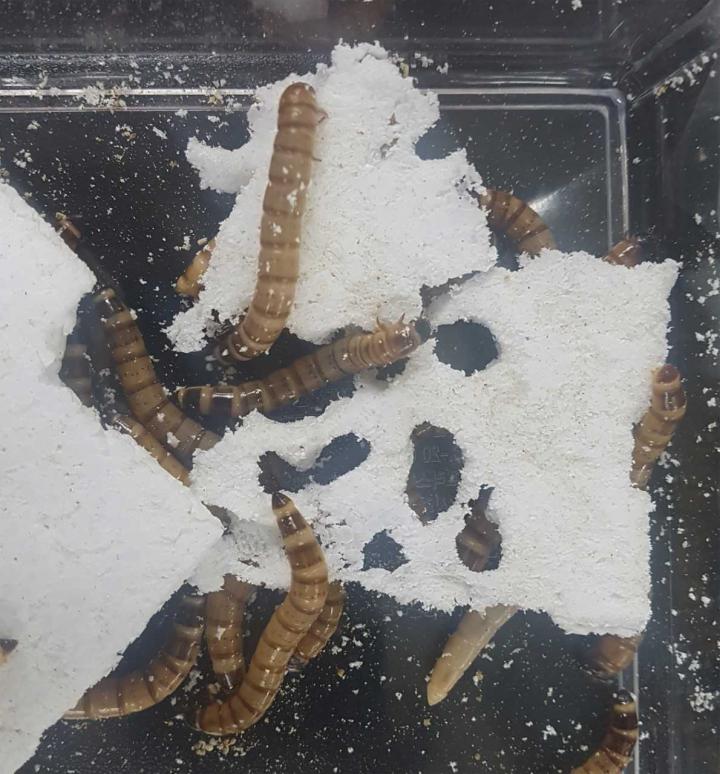
Resembling giant mealworms, superworms (Zophobas atratus) are beetle larvae that are often sold in pet stores as feed for reptiles, fish and birds. In addition to their relatively large size (about 2 inches long), these worms have another superpower: They can degrade polystyrene plastic. Now, researchers reporting in ACS’ Environmental Science & Technology have linked this ability to a strain of bacteria that lives in the larvae’s gut.

Polystyrene is used in packaging containers, disposable cups and insulating materials. When thrown in landfills or littered in the environment, the plastic takes several hundred years to completely break down. Recently, several studies have found that mealworms and superworms can ingest and degrade polystyrene within a few weeks. In mealworms, this ability was linked to a certain strain of polystyrene-degrading bacteria in the worms’ gut. Jiaojie Li, Dae-Hwan Kim and colleagues wanted to search for similar bacteria in superworms.

The team placed 50 superworms in a chamber with polystyrene as their only carbon source, and after 21 days, the worms had consumed about 70% of the plastic. The researchers then isolated a strain of Pseudomonas aeruginosa bacteria from the gut of the worms and showed that it that could grow directly on the surface of polystyrene and break it down. Finally, they identified an enzyme from the bacteria, called serine hydrolase, that appeared to be responsible for most of the biodegradation. This enzyme, or the bacteria that produce it, could someday be used to help break down waste polystyrene, the researchers say.

The authors acknowledge funding from the CJ Blossom Idea Lab of the CJ Corporation, the Undergraduate Research Program at Daegu Gyeongbuk Institute of Science and Technology and the INGE funds of Gwangju Institute of Science and Technology.

The abstract that accompanies this paper can be viewed here.

The American Chemical Society (ACS) is a nonprofit organization chartered by the U.S. Congress. ACS’ mission is to advance the broader chemistry enterprise and its practitioners for the benefit of Earth and its people. The Society is a global leader in providing access to chemistry-related information and research through its multiple research solutions, peer-reviewed journals, scientific conferences, eBooks and weekly news periodical Chemical & Engineering News. ACS journals are among the most cited, most trusted and most read within the scientific literature; however, ACS itself does not conduct chemical research. As a specialist in scientific information solutions (including SciFinder® and STN®), its CAS division powers global research, discovery and innovation. ACS’ main offices are in Washington, D.C., and Columbus, Ohio.

To automatically receive news releases from the American Chemical Society, contact [email protected].

Follow us: Twitter | Facebook

###

Media Contact
Katie Cottingham
[email protected]

Tags: BacteriologyChemistry/Physics/Materials SciencesEntomologyPollution/RemediationPolymer Chemistry
Share12Tweet8Share2ShareShareShare2

Related Posts

Cutting Electrolyte Reduction Boosts High-Energy Battery Performance

Cutting Electrolyte Reduction Boosts High-Energy Battery Performance

December 19, 2025
Microenvironment Shapes Gold-Catalysed CO2 Electroreduction

Microenvironment Shapes Gold-Catalysed CO2 Electroreduction

December 11, 2025

Photoswitchable Olefins Enable Controlled Polymerization

December 11, 2025

Cation Hydration Entropy Controls Chloride Ion Diffusion

December 10, 2025
Please login to join discussion

POPULAR NEWS

  • Nurses’ Views on Online Learning: Effects on Performance

    Nurses’ Views on Online Learning: Effects on Performance

    70 shares
    Share 28 Tweet 18
  • NSF funds machine-learning research at UNO and UNL to study energy requirements of walking in older adults

    71 shares
    Share 28 Tweet 18
  • Unraveling Levofloxacin’s Impact on Brain Function

    54 shares
    Share 22 Tweet 14
  • Exploring Audiology Accessibility in Johannesburg, South Africa

    51 shares
    Share 20 Tweet 13

About

BIOENGINEER.ORG

We bring you the latest biotechnology news from best research centers and universities around the world. Check our website.

Follow us

Recent News

METS-VF Links Arterial Stiffness and Type 2 Diabetes

Revolutionizing Pancreatic Cancer Surgery: SBRT and Intraoperative EBT

Cenobamate Shows Promise for Focal Seizures in Chinese Patients

Subscribe to Blog via Email

Enter your email address to subscribe to this blog and receive notifications of new posts by email.

Join 70 other subscribers
  • Contact Us

Bioengineer.org © Copyright 2023 All Rights Reserved.

Welcome Back!

Login to your account below

Forgotten Password?

Retrieve your password

Please enter your username or email address to reset your password.

Log In
No Result
View All Result
  • Homepages
    • Home Page 1
    • Home Page 2
  • News
  • National
  • Business
  • Health
  • Lifestyle
  • Science

Bioengineer.org © Copyright 2023 All Rights Reserved.