• HOME
  • NEWS
  • EXPLORE
    • CAREER
      • Companies
      • Jobs
    • EVENTS
    • iGEM
      • News
      • Team
    • PHOTOS
    • VIDEO
    • WIKI
  • BLOG
  • COMMUNITY
    • FACEBOOK
    • INSTAGRAM
    • TWITTER
Monday, July 13, 2026
BIOENGINEER.ORG
No Result
View All Result
  • Login
  • HOME
  • NEWS
  • EXPLORE
    • CAREER
      • Companies
      • Jobs
        • Lecturer
        • PhD Studentship
        • Postdoc
        • Research Assistant
    • EVENTS
    • iGEM
      • News
      • Team
    • PHOTOS
    • VIDEO
    • WIKI
  • BLOG
  • COMMUNITY
    • FACEBOOK
    • INSTAGRAM
    • TWITTER
  • HOME
  • NEWS
  • EXPLORE
    • CAREER
      • Companies
      • Jobs
        • Lecturer
        • PhD Studentship
        • Postdoc
        • Research Assistant
    • EVENTS
    • iGEM
      • News
      • Team
    • PHOTOS
    • VIDEO
    • WIKI
  • BLOG
  • COMMUNITY
    • FACEBOOK
    • INSTAGRAM
    • TWITTER
No Result
View All Result
Bioengineer.org
No Result
View All Result
Home NEWS Science News

Supersonic spray yields new nanomaterial for bendable, wearable electronics

Bioengineer by Bioengineer
November 22, 2016
in Science News
Reading Time: 3 mins read
0
Share on FacebookShare on TwitterShare on LinkedinShare on RedditShare on Telegram
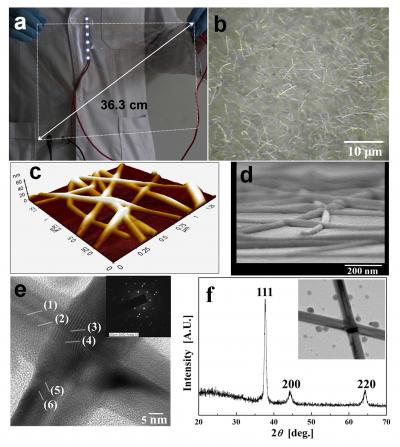
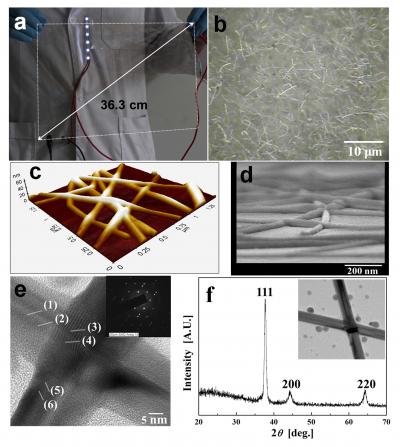
IMAGE

Credit: S.K. Yoon, Korea University

A new, ultrathin film that is both transparent and highly conductive to electric current has been produced by a cheap and simple method devised by an international team of nanomaterials researchers from the University of Illinois at Chicago and Korea University.

The film is also bendable and stretchable, offering potential applications in roll-up touchscreen displays, wearable electronics, flexible solar cells and electronic skin. The results are reported in Advanced Functional Materials.

The new film is made of fused silver nanowires, and is produced by spraying the nanowire particles through a tiny jet nozzle at supersonic speed. The result is a film with nearly the electrical conductivity of silver-plate — and the transparency of glass, says senior author Alexander Yarin, UIC Distinguished Professor of Mechanical Engineering.

"The silver nanowire is a particle, but very long and thin," Yarin said. The nanowires measure about 20 microns long, so four laid end-to-end would span the width of a human hair. But their diameter is a thousand times smaller — and significantly smaller than the wavelength of visible light, which minimizes light scattering.

The researchers suspended the nanowire particles in water and propelled them by air through a de Laval nozzle, which has the same geometry as a jet engine, but is only a few millimeters in diameter.

"The liquid needs to be atomized so it evaporates in flight," Yarin said. When the nanowires strike the surface they are being applied to at supersonic speed, they fuse together, as their kinetic energy is converted to heat.

"The ideal speed is 400 meters per second," Yarin said. "If the energy is too high, say 600 meters per second, it cuts the wires. If too low, as at 200 meters per second, there's not enough heat to fuse the wires."

The researchers applied the nanowires to flexible plastic films and to three-dimensional objects. "The surface shape doesn't matter," Yarin said.

The transparent flexible film can be bent repeatedly and stretched to seven times its original length and still work, said Sam Yoon, the corresponding author of the study and a professor of mechanical engineering at Korea University.

Earlier this year, Yarin and Yoon and their colleagues produced a transparent conducting film by electroplating a mat of tangled nanofiber with copper. Compared to that film, the self-fused silver nanowire film offers better scalability and production rate, Yoon said.

"It should be easier and cheaper to fabricate, as it's a one-step versus a two-step process," said Yarin. "You can do it roll-to-roll on an industrial line, continuously."

###

Co-authors with Yarin and Yoon are Jong-Gun Lee, Do-Yeon Kim, Jong-Hyuk Lee and Donghwan Kim of Korea University; Suman Sinha-Ray of the Indian Institute of Technology in Indore, India; and Mark T. Swihart of the State University of New York at Buffalo.

The research was supported by the National Research Foundation, GFHIM-2013M3A6B1078879, and the Industrial Strategic Technology Development Program, 10045221, funded by the Ministry of Knowledge Economy of Korea.

Media Contact

Bill Burton
[email protected]
312-996-2269
@uicnews

http://www.uic.edu

############

Story Source: Materials provided by Scienmag

Share13Tweet8Share2ShareShareShare2

Related Posts

Hypothermic Preservation Extends Function in Aging Isolated Hepatocytes

July 13, 2026
Early Chemistry Boosts 847 mV Voltage in Wide-Bandgap CZTS Solar Cells

Early Chemistry Boosts 847 mV Voltage in Wide-Bandgap CZTS Solar Cells

July 13, 2026

Perineurium Links Leptin to Sympathetic Response to Combat Obesity

July 13, 2026

Machine Learning Supports Dementia Caregivers in Managing Behavioral Symptoms

July 13, 2026
Please login to join discussion

POPULAR NEWS

  • Detection of EDCs in Breast Milk and Infant Urine Up to Six Months Highlights Early Exposure Risks

    77 shares
    Share 31 Tweet 19
  • New Drug Candidate Developed at McMaster Shows Potential for Treating Brain Cancer

    58 shares
    Share 23 Tweet 15
  • KTU Researchers Explore Ultrasound’s Role in Enhancing Blood Flow Beyond Diagnostics

    53 shares
    Share 21 Tweet 13
  • Experimental Therapy Simultaneously Destroys Prostate Tumor Cells and Reactivates Antitumor Immunity

    46 shares
    Share 18 Tweet 12

About

We bring you the latest biotechnology news from best research centers and universities around the world. Check our website.

Follow us

Recent News

Hypothermic Preservation Extends Function in Aging Isolated Hepatocytes

Early Chemistry Boosts 847 mV Voltage in Wide-Bandgap CZTS Solar Cells

Perineurium Links Leptin to Sympathetic Response to Combat Obesity

Subscribe to Blog via Email

Enter your email address to subscribe to this blog and receive notifications of new posts by email.

Join 85 other subscribers
  • Contact Us

Bioengineer.org © Copyright 2023 All Rights Reserved.

Welcome Back!

Login to your account below

Forgotten Password?

Retrieve your password

Please enter your username or email address to reset your password.

Log In
No Result
View All Result
  • Homepages
    • Home Page 1
    • Home Page 2
  • News
  • National
  • Business
  • Health
  • Lifestyle
  • Science

Bioengineer.org © Copyright 2023 All Rights Reserved.