

• HOME
  • NEWS
  • EXPLORE
    • CAREER
      • Companies
      • Jobs
    • EVENTS
    • iGEM
      • News
      • Team
    • PHOTOS
    • VIDEO
    • WIKI
  • BLOG
  • COMMUNITY
    • FACEBOOK
    • INSTAGRAM
    • TWITTER
Sunday, July 12, 2026
BIOENGINEER.ORG
No Result
View All Result
  • Login
  • HOME
  • NEWS
  • EXPLORE
    • CAREER
      • Companies
      • Jobs
        • Lecturer
        • PhD Studentship
        • Postdoc
        • Research Assistant
    • EVENTS
    • iGEM
      • News
      • Team
    • PHOTOS
    • VIDEO
    • WIKI
  • BLOG
  • COMMUNITY
    • FACEBOOK
    • INSTAGRAM
    • TWITTER
  • HOME
  • NEWS
  • EXPLORE
    • CAREER
      • Companies
      • Jobs
        • Lecturer
        • PhD Studentship
        • Postdoc
        • Research Assistant
    • EVENTS
    • iGEM
      • News
      • Team
    • PHOTOS
    • VIDEO
    • WIKI
  • BLOG
  • COMMUNITY
    • FACEBOOK
    • INSTAGRAM
    • TWITTER
No Result
View All Result
Bioengineer.org
No Result
View All Result
Home NEWS Science News Biology

Superior pathological diagnosis using transparent tissues

Bioengineer by Bioengineer
September 13, 2017
in Biology
Reading Time: 2 mins read
0
Share on FacebookShare on TwitterShare on LinkedinShare on RedditShare on Telegram
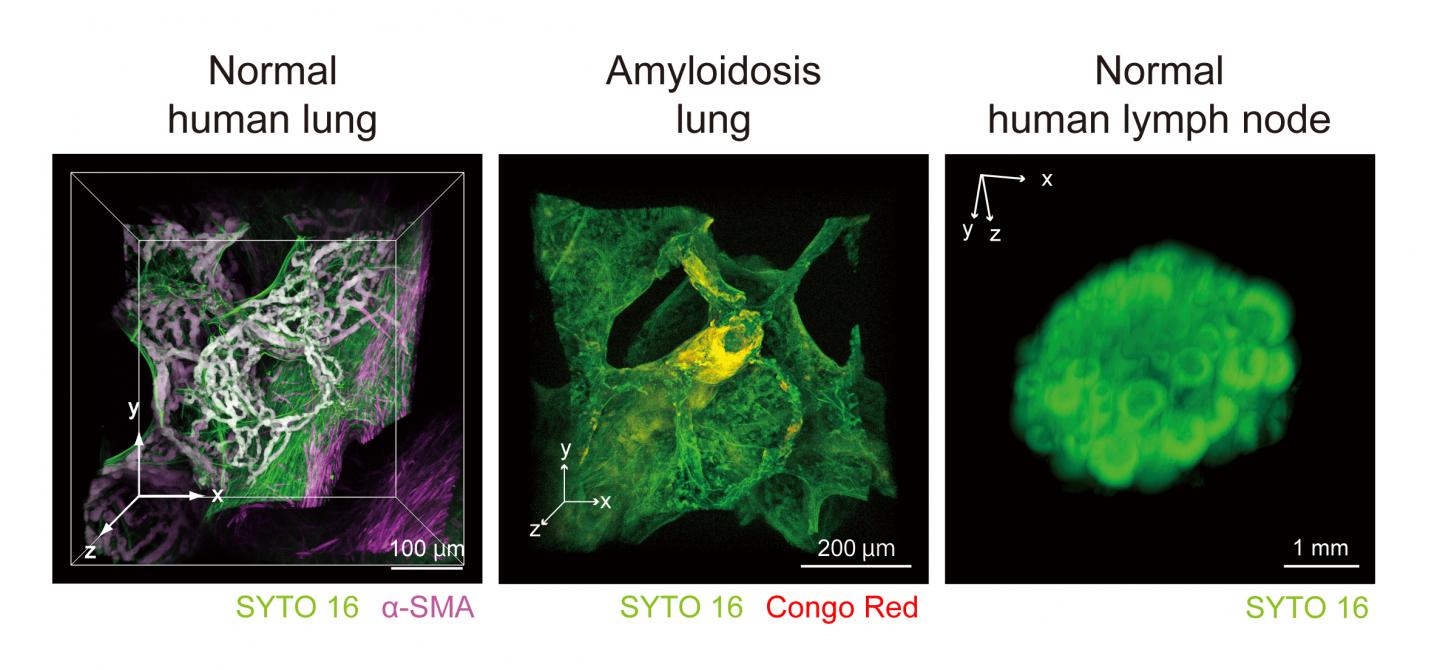
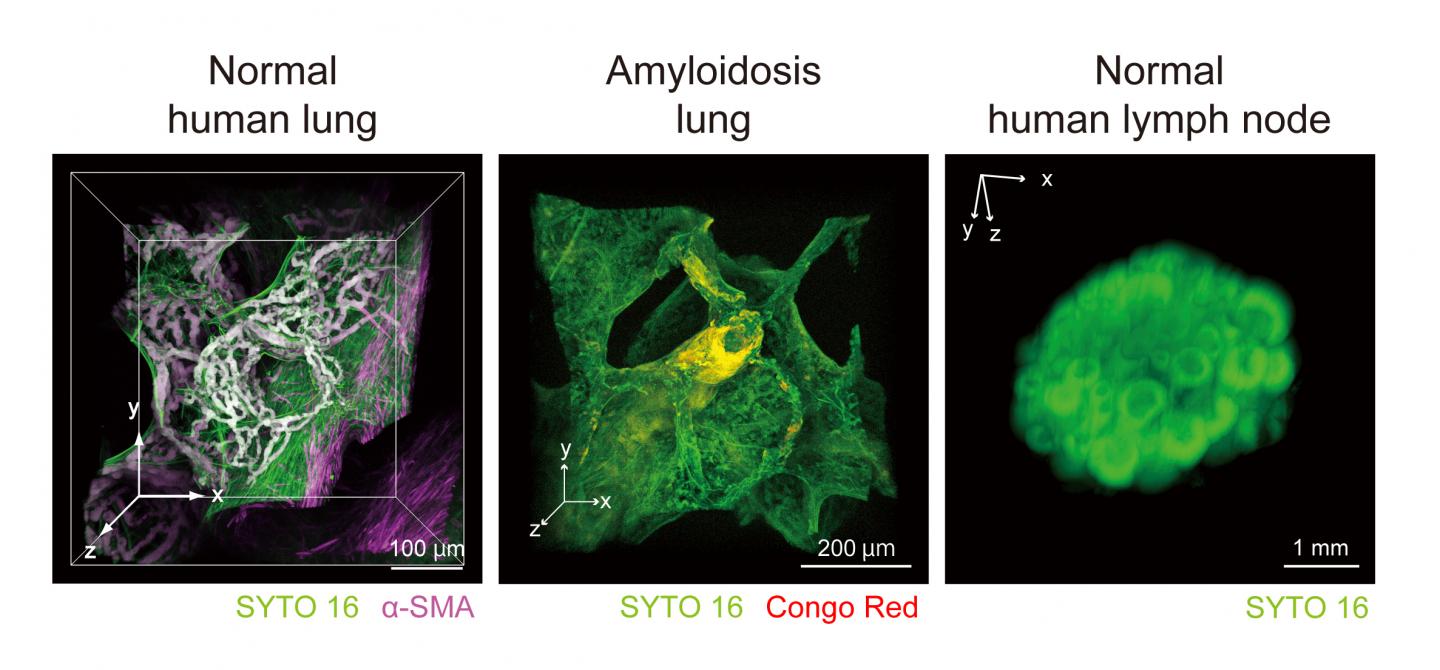
IMAGE

Credit: 2017 Nojima S. et al. Scientific Reports, 7:9269, 1-14. DOI: 10.1038/s41598-017-09117-0

(Osaka, Japan) To some, the idea of invisibility leads to mischief, seeing things without being seen. To the pathologist, the idea of invisibility leads to simplicity, seeing the disease in its fullest. In a new study published in Scientific Reports, Japanese researchers report, CUBIC, a technique including a tissue processing that makes human organs transparent, provides better assessment of lesions for pathological diagnosis.

"Traditionally, pathological diagnosis is made by taking 2D sections of a specimen resected from patients. It is effective, but we cannot exclude the possibility that important findings away from the cut surface are overlooked," explains Osaka University Professor Eiichi Morii, who co-corresponding-authored the study.

Contemporary methods are based on staining techniques from the 19th Century. Patient specimens are cut into thin sections that are stained and analyzed individually under a microscope. However, this method has limitations in its relatively narrow range of observation area and in its two-dimensionality. CUBIC (Clear, Unobstructed Brain/Body Imaging Cocktails and Computational Analysis) was first reported by RIKEN Group Director Hiroki R. Ueda, who is the corresponding author of this study, and his colleagues three years ago. CUBIC has been used to observe whole organs mainly from experimental animals. In the new study, Ueda and his colleagues demonstrated that CUBIC can be used to observe organs from humans and that it surpasses current methods for pathological diagnosis/study.

The study shows CUBIC applicability to the 3D imaging of patient lung and lymph node tissues, clearly delineating normal and abnormal regions (Figure 1, Figure 2). After routine observation, many patient samples are stored at hospitals as paraffin-embedded tissue blocks. Additionally, the study shows that the combination of appropriate deparaffinization and CUBIC enabled 3D imaging of these older specimens.

"These results mean that we can use not only newly fixed samples but also paraffin-embedded tissues stored in the pathological archives of hospitals," said Osaka University Assistant Professor Satoshi Nojima, who first-authored the study.

The scientists also examined the practical diagnostic potential of CUBIC. They showed that CUBIC was much more capable of detecting metastatic carcinomas in lymph node specimens compared to standard pathology techniques (Figure 3).

"This is outstanding result to demonstrate the usefulness of CUBIC on practical clinical examination," Nojima said.

These findings show the potential of CUBIC for retrospective and prospective clinicopathological diagnosis.

"Our wish is to improve CUBIC so that it leads to the establishment of a novel field of medical science based on 3D histopathology." Ueda said.

###

Media Contact

Saori Obayashi
[email protected]
81-661-055-886
@osaka_univ_e

http://www.osaka-u.ac.jp/en

Original Source

http://resou.osaka-u.ac.jp/en/research/2017/20170830_3 http://dx.doi.org/10.1038/s41598-017-09117-0
Share12Tweet8Share2ShareShareShare2

Related Posts

Han directs new $15M NIH center for organ-on-chip technology

Han directs new $15M NIH center for organ-on-chip technology

July 11, 2026
Bacteriophages Enable Next-Gen Smart Pathogen Detection Sensors

Bacteriophages Enable Next-Gen Smart Pathogen Detection Sensors

July 10, 2026

Temperature Fluctuations Have Greater Impact Than Previously Believed

July 10, 2026

New Study Uncovers Biology Behind Glioma Cancer Progression

July 10, 2026
Please login to join discussion

POPULAR NEWS

  • Detection of EDCs in Breast Milk and Infant Urine Up to Six Months Highlights Early Exposure Risks

    77 shares
    Share 31 Tweet 19
  • New Drug Candidate Developed at McMaster Shows Potential for Treating Brain Cancer

    58 shares
    Share 23 Tweet 15
  • KTU Researchers Explore Ultrasound’s Role in Enhancing Blood Flow Beyond Diagnostics

    53 shares
    Share 21 Tweet 13
  • 高齢者の骨粗鬆症治療の持続性比較

    51 shares
    Share 20 Tweet 13

About

BIOENGINEER.ORG

We bring you the latest biotechnology news from best research centers and universities around the world. Check our website.

Follow us

Recent News

Living Alone and Poverty Heighten Risks for Older Nigerians in Cities

YEARS Algorithm Enhances Pulmonary Embolism Diagnosis in Cancer Patients

Diverse Symptom Burdens and Care Needs in Older Ischemic Stroke Patients

Subscribe to Blog via Email

Enter your email address to subscribe to this blog and receive notifications of new posts by email.

Join 85 other subscribers
  • Contact Us

Bioengineer.org © Copyright 2023 All Rights Reserved.

Welcome Back!

Login to your account below

Forgotten Password?

Retrieve your password

Please enter your username or email address to reset your password.

Log In
No Result
View All Result
  • Homepages
    • Home Page 1
    • Home Page 2
  • News
  • National
  • Business
  • Health
  • Lifestyle
  • Science

Bioengineer.org © Copyright 2023 All Rights Reserved.