Every fluid — from Earth’s atmosphere to blood pumping through the human body — has viscosity, a quantifiable characteristic describing how the fluid will deform when it encounters some other matter. If the viscosity is higher, the fluid flows calmly, a state known as laminar. If the viscosity decreases, the fluid undergoes the transition from laminar to turbulent flow. The degree of laminar or turbulent flow is referred to as the Reynolds number, which is inversely proportional to the viscosity. The Reynolds law of dynamic similarity or Reynolds similitude, states that if two fluids flow around similar structures with different length scales, they are hydrodynamically identical provided they exhibit the same Reynolds number.
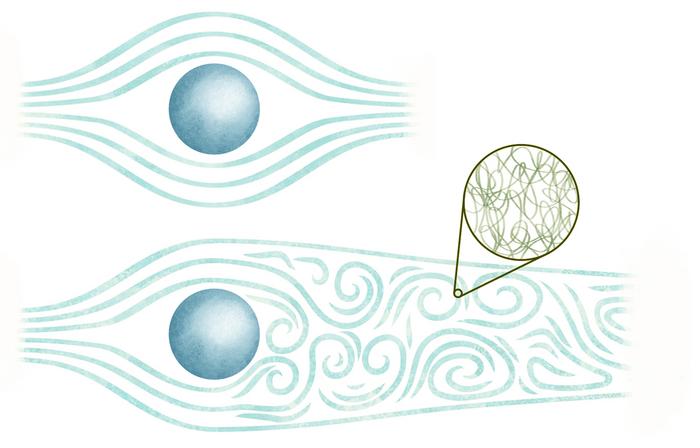
Credit: Hiromitsu Takeuchi, Osaka Metropolitan University
Every fluid — from Earth’s atmosphere to blood pumping through the human body — has viscosity, a quantifiable characteristic describing how the fluid will deform when it encounters some other matter. If the viscosity is higher, the fluid flows calmly, a state known as laminar. If the viscosity decreases, the fluid undergoes the transition from laminar to turbulent flow. The degree of laminar or turbulent flow is referred to as the Reynolds number, which is inversely proportional to the viscosity. The Reynolds law of dynamic similarity or Reynolds similitude, states that if two fluids flow around similar structures with different length scales, they are hydrodynamically identical provided they exhibit the same Reynolds number.
However, this Reynolds similitude is not applied to quantum superfluids, as they do not have viscosity — at least, that’s what researchers have believed. Now, a researcher from the Nambu Yoichiro Institute of Theoretical and Experimental Physics at Osaka Metropolitan University in Japan has theorized a way to examine the Reynolds similitude in superfluids, which could demonstrate the existence of quantum viscosity in superfluids.
Dr. Hiromitsu Takeuchi, a lecturer in the Graduate School of Science at Osaka Metropolitan University, published his approach on January 11, 2024, in Physical Review B.
“Superfluids have long been considered an obvious exception to the Reynolds similitude,” Dr. Takeuchi said, explaining that the Reynolds law of similitude states that if two flows have the same Reynolds number, then they are physically identical. “The concept of quantum viscosity overturns the common sense of superfluid theory, which has a long history of more than half a century. Establishing similitude in superfluids is an essential step to unify classical and quantum hydrodynamics.”
However, quantum superfluids can have turbulence, resulting in a quantum quandary: Turbulence in fluids requires dissipation, so how can superfluid turbulence experience dissipation without viscosity? They must have dissipation and may follow the Reynolds similitude, but the right approach to examine it had not yet been developed.
These characteristics could be examined, Dr. Takeuchi theorizes, by analyzing how a solid sphere falls into a superfluid. By combining the terminal speed of the sphere’s fall with the resistance the sphere encounters from the fluid as it falls, researchers can determine an analogue for the Reynolds similitude. This means effective viscosity, called the quantum viscosity, can be measured.
“This study focuses on a theoretical issue in understanding quantum turbulence in superfluids and shows that the Reynolds similitude in superfluids can be verified by measuring the terminal velocity of an object falling in a superfluid,” Dr. Takeuchi said. “If this verification can be made, then this suggests that quantum viscosity exists even in pure superfluids at absolute zero. I can’t wait to see it verified through experimentation.”
###
About OMU
Osaka Metropolitan University is the third largest public university in Japan, formed by a merger between Osaka City University and Osaka Prefecture University in 2022. OMU upholds “Convergence of Knowledge” through 11 undergraduate schools, a college, and 15 graduate schools. For more research news visit https://www.omu.ac.jp/en/ or follow us on Twitter: @OsakaMetUniv_en, or Facebook.
Journal
Physical Review B
DOI
10.1103/PhysRevB.109.L020502
Method of Research
Computational simulation/modeling
Subject of Research
Not applicable
Article Title
Quantum viscosity and the Reynolds similitude of a pure superfluid
Article Publication Date
11-Jan-2024