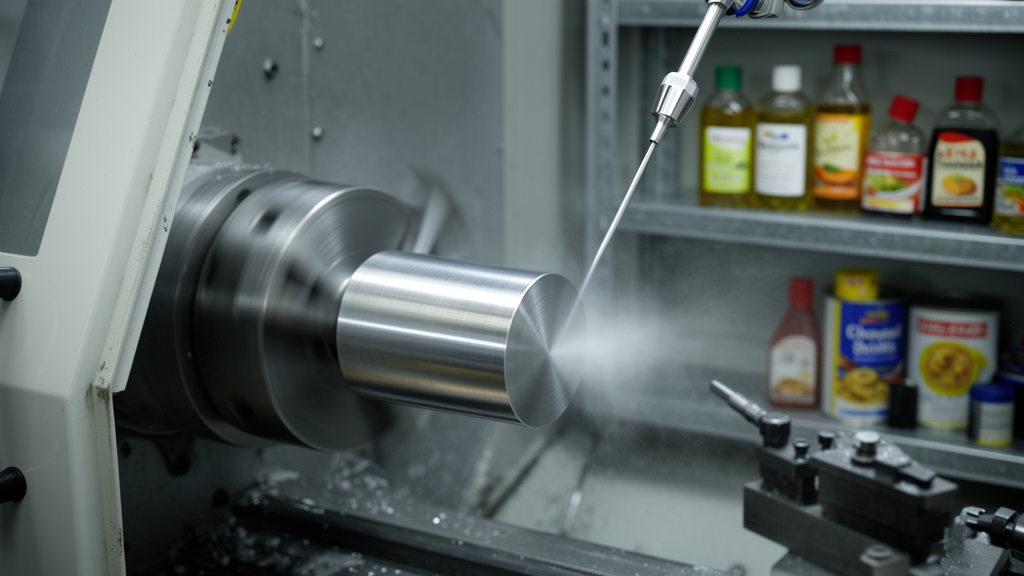
When carbon dioxide is squeezed past 74 bar and warmed above 31 degrees Celsius, it stops behaving like an ordinary gas or liquid and enters a strange middle state known as the supercritical phase. A team of French researchers at the Arts et Métiers Institute of Technology has now harnessed this exotic fluid to attack one of manufacturing’s most stubborn problems: the friction and heat that plague the machining of Ti6Al4V, the titanium alloy that holds together much of the aerospace industry. Their findings, published in Frontiers in Manufacturing Technology, suggest that cheap, sustainable additives dissolved in supercritical CO2 could rival industrial mineral oils, with ionic liquids delivering the most dramatic friction reductions of all.
The machining industry has long relied on flood coolants, minimum quantity lubrication, and cryogenic sprays such as liquid nitrogen to keep cutting tools alive and machined parts intact. These methods aim to tame the intense friction and heating that occur at the chip-tool and tool-part contact zones, where temperatures can soar high enough to soften the workpiece and destroy the tool edge. Supercritical CO2 has emerged as an intriguing alternative because it acts as a green solvent and, when delivered to the cutting zone, expands with a phase transformation that drops its temperature sharply, cooling both the tool and the part. Previous studies have shown that pairing supercritical CO2 with dissolved soybean oil roughly halved flank wear compared with emulsion flood cooling when milling compacted graphite iron, and that supercritical CO2 plus minimum quantity lubrication outperformed flood coolant in milling Ti6Al4V and turning AISI 1045 steel.
Yet supercritical CO2 alone often performs worse than flood cooling, which is why the lubricant carried within it matters so much. The research team, led by Koffi Samuel Koulekpa, set out to systematically test what happens when different lubricants are introduced into supercritical CO2 and delivered to a titanium-carbide contact under conditions mimicking real machining. They selected ionic liquids, vegetable oils, mineral oil, water, and polyethylene glycol, chosen for their solubility in supercritical CO2, their sustainable character, or their previous performances in machining-related friction analysis. The two ionic liquids tested, BMIM-PF6 and BMIM-BF4, are salts that stay liquid at room temperature and boast negligible volatility, high thermal stability, and non-flammability, making them fascinating candidates for machining applications.
To deliver these exotic mixtures, the researchers designed and built a dedicated machine that feeds CO2 from pressurized bottles, cools it to ensure a liquid phase before compression, then squeezes it to pressures up to 350 bar and heats it with four cartridges to reach the supercritical state in a mixing chamber. There, lubricants are injected at user-specified rates before the mixture sprays through a 0.25 mm round jet nozzle. For the experiments, the pressure was limited to 100 bar and the temperature set to 40 degrees Celsius, guaranteeing a supercritical state while minimizing CO2 consumption. The supercritical CO2 flowed at 0.185 kg/min, while lubricants were delivered at 1 mL/min and 4 mL/min, rates common in minimum quantity lubrication applications.
The friction tests themselves took place on a CNC lathe fitted with a Hedenqvist-type pin-on-cylinder tribometer, a setup chosen for easy and quick execution. Cylindrical carbide pins, instrumented with K-type thermocouples connected to a data acquisition system sampling at 2 kHz, pressed against a rotating Ti6Al4V bar with an initial diameter of 120 mm. The normal loads of 100 N, 250 N, and 400 N were selected based on a contact pressure of 1,300 MPa derived from finite element simulations, while sliding velocities of 20 m/min and 100 m/min covered the range of chip sliding velocities typical when machining difficult-to-cut alloys such as Ti6Al4V or Inconel 718. After each test, the workpiece surface was refreshed by a fresh machining pass to obtain a theoretical roughness of Ra 0.5 µm, and the pins were rotated by 25 degrees to expose a new contact surface.
The results revealed a striking pattern. At 20 m/min, adding lubricants to supercritical CO2 decreased friction, but the mixtures never outperformed the dry condition, with friction coefficients staying above the dry baseline for almost all loads. At 100 m/min, however, the story changed dramatically. The team observed a mean decrease of 0.1 in the apparent friction coefficient, and increasing the lubricant flow rate from 1 mL/min to 4 mL/min produced further reductions. The ionic liquids showed their lubricating prowess most clearly at 100 m/min with significant friction decreases at 4 mL/min and 400 N, demonstrating that the combined effect of lubrication by the additives and cooling from supercritical CO2 works best under the most demanding conditions.
The adhesive behavior of Ti6Al4V, notorious for sticking to counter-materials during friction, provided another revealing metric. After each test, the researchers examined the friction zone under an optical microscope and calculated the sticking area by assimilating it to an ellipse. Once again, the effects of the lubricants were clearly visible at 100 m/min. The ionic liquids, together with polyethylene glycol, led to the lowest sticking area values, with surface reductions of 54 percent and 55 percent for BF4 and PF6 respectively at the 1 mL/min rate. These values climbed to 74 percent at 4 mL/min, showing how strongly the delivery flow rate influences the protective action. The researchers attribute this to an adsorption layer that reduces direct contact between the two materials, and for the ionic liquids, to tribochemical reactions between the liquids and the tool-workpiece materials that form remarkably effective protective films.
Temperature measurements confirmed the cooling credentials of supercritical CO2. Pin temperatures dropped significantly compared with dry tests, with a maximum reduction of 80 degrees Celsius. Interestingly, no significant difference in cooling was provided by the presence of the lubricants compared with supercritical CO2 alone, suggesting that the additives’ contribution to heat removal was not activated under the tested speed conditions, possibly due to suboptimal delivery techniques or solubility issues that the team plans to investigate further.
Perhaps the most commercially significant finding concerns the cheap lubricants. Water, rapeseed oil, and sunflower oil performed similarly to the commonly used machining mineral oil when paired with supercritical CO2, and these biological alternatives are less expensive and less health-threatening than traditional emulsions. This could help develop future low-cost yet effective cooling and lubrication methods for the machining industry, a prospect with real sustainability appeal given that cryogenic minimum quantity lubrication methods have already been highlighted as superior to conventional flood coolants when considering toxicity, power consumption, and ozone depletion. The researchers caution that these lubricants would not suit applications where cleanliness is crucial, such as the biomedical and agri-food industries, but for aerospace-grade titanium machining the outlook is bright.
The study also demonstrates the fundamental need for lubrication when using supercritical CO2 in friction-related applications, since supercritical CO2 alone had almost no lubrication effect. The measured apparent friction coefficients could prove useful for supercritical CO2-assisted finite element simulations of machining processes, helping engineers model cutting operations more accurately. Solubility studies are already under investigation to find suitable supercritical conditions for better dissolving oils in supercritical CO2 and defining new efficient cutting fluids. If successful, this work could usher in a new generation of cutting fluids that combine the cooling power of an abundant, recyclable gas with the lubricating finesse of kitchen-shelf oils or laboratory-designed ionic liquids, transforming how the industry machines its most valuable alloys.
Subject of Research: Materials science and manufacturing technology
Article Title: Investigating the efficiency of mixtures based on supercritical CO2 and lubricants by friction tests under conditions similar to the machining of Ti6Al4V
Article References: Koulekpa, K. S., Benked-Dar, C., Elias-Birembaux, H., Rossi, F., & Poulachon, G. (2024). Investigating the efficiency of mixtures based on supercritical CO2 and lubricants by friction tests under conditions similar to the machining of Ti6Al4V. Frontiers in Manufacturing Technology, 4, Article 1410292. https://doi.org/10.3389/fmtec.2024.1410292
Image Credits: AI Generated
DOI: 10.3389/fmtec.2024.1410292
Keywords: Investigating, efficiency, mixtures, based, supercritical, lubricants, friction, tests, under, conditions, similar, machining
News Source: Denise Maddox. (October 17, 2026). Supercritical CO2 and kitchen-shelf lubricants could transform titanium machining. Scienmag.