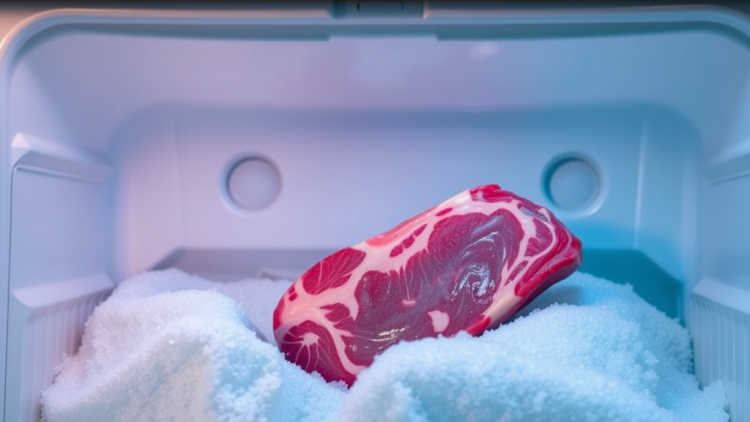
Fresh beef sold online often travels a surprisingly rough road. In the booming world of e-commerce, steaks are typically shipped in expanded polystyrene boxes packed with gel ice packs, a passive cooling system that must survive 24 to 48 hours of the so-called last mile. During summer, temperatures inside these parcels can climb to 20 to 30 degrees Celsius as the ice melts, exposing the meat to a thermal shock that accelerates oxidation, drip loss, and microbial growth. A new study published in Food Science of Animal Resources has now traced, molecule by molecule, how the choice of pre-cooling temperature before shipment determines whether that beef arrives appetizing or already in decline, and the answer challenges the intuition that colder is always better.
Researchers at Yanbian University in China worked with rump steaks from 36-month-old Yanbian Yellow Cattle, cut from the biceps femoris muscle within 24 hours of slaughter. The steaks, vacuum-packed and weighing roughly 250 grams each, were divided into four treatment groups drawn from the same carcass. One control group was held at 4 degrees Celsius. The others were rapidly frozen in a minus 30 degrees Celsius freezer until their core temperatures reached minus 0.5 degrees Celsius, representing supercooling with little or no ice formation; minus 5 degrees Celsius, representing sub-freezing with partial ice formation; or minus 18 degrees Celsius, representing deep-freezing with complete freezing. Each group was then packed with six pre-frozen gel ice packs in alternating layers, wrapped in an insulating bag, sealed inside an EPS box, and placed in an incubator at 25 degrees Celsius for 48 hours to simulate a realistic summer delivery.
Temperature logging confirmed the scenario the team wanted to reproduce. During the first 15 hours, while the ice packs melted, the core temperature of all pre-cooled groups stayed below zero. Thereafter, temperatures gradually rose, reaching between minus 1.7 and 3.3 degrees Celsius at the delivery stage depending on the treatment. Sampling continued through five days of subsequent refrigerated storage at 4 degrees Celsius, but only while total volatile basic nitrogen, a spoilage marker, remained below the strict threshold of 20 milligrams per 100 grams. The deep-frozen and sub-frozen groups crossed that limit prematurely, a first hint that their quality was deteriorating faster than the others.
Color told the most visible part of the story. Surface color is the attribute consumers weigh most heavily when buying meat, and it depends on the balance between bright red oxymyoglobin and brown metmyoglobin. At the frozen stage, the deep-frozen steaks actually looked best, showing the highest redness values and the highest lightness, the latter reflecting ice-crystal damage that pushed free water to the surface and increased light scattering. But appearances deceived. Once the parcels warmed during simulated distribution, redness in the deep-frozen group fell fastest, and its metmyoglobin content climbed to the highest level of any group during refrigerated storage. The supercooled group, by contrast, showed the slowest decline in redness, the smallest rise in lightness and yellowness, and consistently low metmyoglobin accumulation, indicating that avoiding ice formation preserved both pigment stability and the endogenous antioxidant environment that protects it.
Texture measurements reinforced the pattern. Deep-frozen steaks were initially the most tender, with a shear force of about 82.65 newtons compared with 123.56 newtons for the refrigerated control, because ice crystals physically disrupted the muscle fibers. Yet after the temperature rise of distribution, shear force in the deep-frozen and sub-frozen groups spiked sharply to 142.37 and 132.36 newtons respectively, a hardening attributed to drip loss, fiber shrinkage, and protein denaturation. Later, both groups softened excessively as structural degradation took over, with the deep-frozen group falling to roughly 53 newtons by 72 hours after delivery. The myofibril fragmentation index, a measure of proteolytic breakdown, surged in the frozen groups after distribution, consistent with freeze-thaw damage releasing lysosomal enzymes such as cathepsins, while the supercooled group showed a gradual, orderly increase reflecting normal aging.
The molecular core of the study lay in the myofibrillar proteins, the structural scaffold that governs water-holding capacity and tenderness. These proteins are acutely sensitive to reactive oxygen species: oxidation converts amino acid side chains to carbonyls, unfolds the native alpha-helical structure, exposes hydrophobic groups buried inside the molecule, and drives cross-linking and aggregation. Carbonyl content rose in all pre-cooled groups during pre-cooling itself, showing that even the phase transition imposes oxidative stress. But after distribution the groups diverged dramatically. By 72 hours after delivery, carbonyl content in the deep-frozen group had reached 2.610 nanomoles per milligram and the sub-frozen group 2.287, while the supercooled group sat at only 1.357, close to the refrigerated control.
Surface hydrophobicity, measured by bromophenol blue binding, painted the same picture of unfolding and aggregation. Deep-frozen and sub-frozen samples already showed markedly elevated hydrophobicity before shipping, and values climbed steeply for every group once distribution began. Protein solubility, meanwhile, fell fastest in the deep-frozen group, dropping from 14.043 to 8.791 over 72 hours after delivery, a rate of decline roughly 80 percent faster than the supercooled group’s. Fourier transform infrared spectroscopy of the amide I band added a structural dimension: after distribution, alpha-helix content in the deep-frozen group collapsed from 56.21 percent to 11.25 percent while beta-sheet, a conformation associated with intermolecular aggregation, jumped to 50.19 percent. The supercooled group retained far more ordered structure, with 23.34 percent alpha-helix and only 18.55 percent beta-sheet at the same stage.
Sensory panels of ten trained assessors, evaluated against ISO 8586 standards, confirmed what the instruments recorded. Scores for meat color, fat color, wetness, and firmness declined most rapidly in the deep-frozen and sub-frozen groups after distribution, and by 72 hours after delivery those groups offered little remaining quality. The supercooled steaks maintained relatively high appearance scores, stable wetness, and acceptable firmness for the longest period, translating the molecular advantages into a longer window of consumer acceptability. The pH trajectory mirrored the biochemical sequence: stable and mildly acidic early on, rising near 6.8 as endogenous proteases released alkaline nitrogen compounds, then falling again as psychrotrophic spoilage bacteria presumably produced organic acids in the later stages.
The study’s central insight is the causal chain it draws from pre-cooling state to protein stability to final quality. Deep-freezing buys a larger thermal reserve and a briefly better initial appearance, but the ice crystals it creates, followed by melting and recrystallization during the warm ride, rupture cell membranes, release pro-oxidants and proteolytic enzymes, and set off a cascade of moisture exudation, pigment oxidation, carbonylation, unfolding, and aggregation. Supercooling at minus 0.5 degrees Celsius threads a needle: it supplies enough cold reserve to blunt the thermal shock of passive distribution while sidestepping the phase transition and its physical damage entirely. For the EPS box and ice pack systems that dominate fresh meat e-commerce, the authors conclude, supercooled pre-cooling is the strategy most likely to deliver beef that still looks, feels, and tastes the way the shopper expects, and the findings offer cold-chain planners a molecularly grounded rationale for rethinking how far down the thermometer a shipment should go before it leaves the warehouse.
Subject of Research: Effects of supercooling, sub-freezing, and deep-freezing pre-cooling on beef quality and myofibrillar protein stability during EPS-based e-commerce distribution
Article Title: Effects of supercooling, sub−freezing, and deep−freezing pre−cooling on color, pH, shear force, sensory quality, and myofibrillar protein properties of beef during expanded polystyrene−based distribution
Article References: Effects of supercooling, sub−freezing, and deep−freezing pre−cooling on color, pH, shear force, sensory quality, and myofibrillar protein properties of beef during expanded polystyrene−based distribution. (n.d.). https://doi.org/10.1007/s44463-026-00083-8
Image Credits: AI Generated
DOI: 10.1007/s44463-026-00083-8
Keywords: beef, supercooling, sub-freezing, deep-freezing, pre-cooling, cold chain, e-commerce distribution, myofibrillar proteins, protein oxidation, meat color, shear force, sensory quality
Cite Scienmag News
APA MLA Chicago
Alan Morgan. (September 22, 2026). Supercooling Beats Freezing for Keeping Beef Fresh During E-Commerce Delivery. Scienmag. https://scienmag.com/supercooling-beats-freezing-for-keeping-beef-fresh-during-e-commerce-delivery/
Alan Morgan. “Supercooling Beats Freezing for Keeping Beef Fresh During E-Commerce Delivery.” Scienmag, 22 September 2026, https://scienmag.com/supercooling-beats-freezing-for-keeping-beef-fresh-during-e-commerce-delivery/. Accessed 22 September 2026.
Alan Morgan. “Supercooling Beats Freezing for Keeping Beef Fresh During E-Commerce Delivery.” Scienmag. September 22, 2026. https://scienmag.com/supercooling-beats-freezing-for-keeping-beef-fresh-during-e-commerce-delivery/
Copy citation Download RIS
Tags: beefbeef packaging and temperature controlcold chaindeep-freezinge-commerce distributione-commerce meat deliveryeffects of passive cooling systems on fresh meateffects of supercooling on microbial activity and oxidationimpact of pre-cooling temperatures on meat qualitylast mile delivery challenges for perishable foodsmeat colormicrobial growth in shipped beefmolecular analysis of meat freshnessmyofibrillar proteinsoxidation and drip loss in beef during transportationpre-coolingprotein oxidationsensory qualityshear forcesub-freezingsupercoolingSupercooling in beef preservationsupercooling vs traditional freezing for meatYanbian Yellow Cattle meat quality study