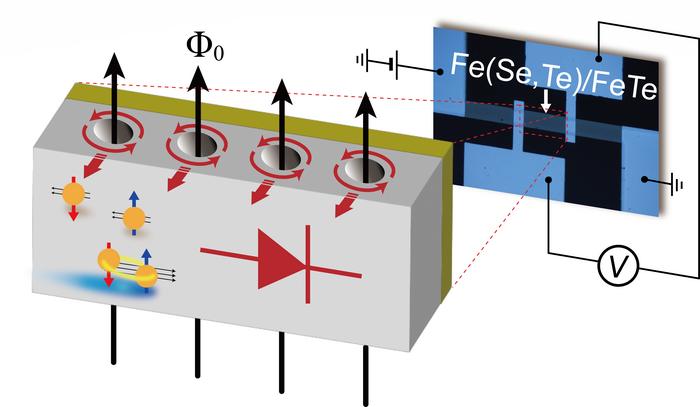
A groundbreaking development in quantum materials is poised to revolutionize the way we think about superconductivity and electronic devices. Researchers from The University of Osaka, collaborating across multiple institutions, have reported a landmark observation of the superconducting diode effect in a thin-film heterostructure composed of iron-based compounds Fe(Se,Te) and FeTe. This discovery unveils the potential for superconductors to exhibit directional current flow—rectification—traditionally a hallmark of semiconductors, thereby bridging two previously distinct electronic phenomena.
Superconductors, known for their zero electrical resistance and unparalleled efficiency, have long promised transformative advances in energy transmission and electronic devices. Despite these advantages, integrating their unique properties with the precise flow control characteristic of semiconductors has posed a formidable challenge. The so-called superconducting diode effect—where a superconductor allows current flow preferentially in one direction—has remained elusive and poorly understood until now, limiting its practical exploitation in ultra-efficient circuits and devices.
The Osaka-led research team centered their study on a heterostructure composed of iron selenide telluride (Fe(Se,Te)) layered on iron telluride (FeTe). This material choice was pivotal due to Fe(Se,Te)’s remarkable intrinsic properties, such as a relatively high superconducting transition temperature, robust critical magnetic field thresholds, and substantial critical current densities. These parameters broaden the physical conditions under which the superconducting diode effect can manifest, increasing the experimental accessibility and technological relevance of the phenomenon.
Precise experimental investigations revealed that when subjected to external magnetic fields, the heterostructure exhibited a pronounced asymmetric response in electrical current flow. Specifically, the current preferred traveling in a single direction more than the other, a hallmark of diode functionality. Fascinatingly, this rectification effect intensified with stronger magnetic fields and lower temperatures. These observations provided essential clues linking the effect to complex quantum behaviors occurring within the superconducting state.
To decipher the underlying mechanism, the team focused on the dynamics of quantum vortices within the superconductor. In type-II superconductors like Fe(Se,Te), magnetic flux penetrates the material in quantized vortex lines, each carrying a single quantum of magnetic flux. The motion and pinning of these vortices fundamentally influence superconducting properties, including critical currents and resistance. The researchers discovered that an asymmetric pinning landscape—caused by strong spin-orbit interactions at the material’s interface—induces directional differences in vortex behavior, breaking the symmetry critical for diode action.
Spin-orbit coupling, a quantum mechanical effect linking an electron’s spin and its momentum, emerged as the central player facilitating the rectification. This interaction modifies the energy landscape experienced by vortices, making it energetically favorable for them to be pinned more strongly in one direction than the other. As a consequence, the superconducting system inherently discriminates between current directions, enabling net rectification without conventional semiconductor junctions or external biasing structures.
Quantitative analyses revealed a striking linear correlation between the diode efficiency—that is, how effectively the device differentiated current directions—and the degree of vortex polarization imposed by the spin-orbit interaction. This relationship substantiated the novel understanding that vortex dynamics govern the superconducting diode effect, providing a predictive framework for future material and device design. Such insights pave the way to engineer devices with tunable rectification efficiencies by manipulating vortex pinning and spin-orbit coupling parameters.
The implications of this discovery extend beyond fundamental physics into practical applications that could reshape electronics. Traditional diodes rely on semiconductor junctions to control current flow and inherently dissipate energy due to resistance. The prospect of superconducting diodes that operate with near-zero resistance and directional control opens exciting avenues for ultra-low power electronics, faster signal processing, and novel quantum computing architectures where energy efficiency and coherence preservation are paramount.
The multidimensional experimental approach employed combined meticulous fabrication, low-temperature transport measurements, and advanced theoretical modeling. The team’s efforts culminated in a comprehensive understanding highlighting how vortex pinning asymmetry—mediated by spin texture and material heterogeneity—functions as the key physical principle enabling superconducting diode behavior. This breakthrough represents a significant leap forward in the field of condensed matter physics and materials science.
As the scientific community absorbs these findings, exciting challenges and opportunities arise. Expanding the range of materials exhibiting the vortex-induced superconducting diode effect, exploring device scalability, and integrating such devices into existing electronic architectures will be critical next steps. Furthermore, the interplay between vortex dynamics and spin phenomena may inspire new functional devices harnessing topological and quantum mechanical effects in superconductors.
Junichi Shiogai and colleagues are optimistic that their discovery will catalyze innovation in superconducting electronics and energy-efficient technologies. By delivering a clear mechanistic picture and demonstrating a robust, scalable platform, their research lays the foundation for a transformative class of devices transcending traditional semiconductor limits. The future of electronics powered by superconducting diodes, guided by vortex behavior and spin-orbit physics, is not only plausible but now within reach.
This research, titled “A scaling relation of vortex-induced rectification effects in a superconducting thin-film heterostructure,” was published in Communications Physics. The publication details and digital object identifier (DOI) provide accessibility for further technical insights and community engagement, underlining the significance and timeliness of this advancement.
Subject of Research:
Superconducting diode effect in Fe(Se,Te)/FeTe heterostructures; vortex dynamics; spin-orbit coupling in superconductors
Article Title:
A scaling relation of vortex-induced rectification effects in a superconducting thin-film heterostructure
News Publication Date:
12-May-2025
Web References:
http://dx.doi.org/10.1038/s42005-025-02118-w
Image Credits:
Junichi Shiogai
Keywords
Supercurrents, Superconductivity, Thin films, Vortices, Electromagnetic fields, Electron spin, Heterojunctions, Electric current, Magnetoresistance, Materials science
Tags: directional current flow in superconductorsenergy transmission advancementsFe(Seiron-based superconductorsquantum materials researchrectification in superconductivityresistance-free electronicssuperconducting diode effectsuperconducting diodesTe) and FeTe materialsthin-film heterostructurestransformative technologies in electronicsultra-efficient electronic devices