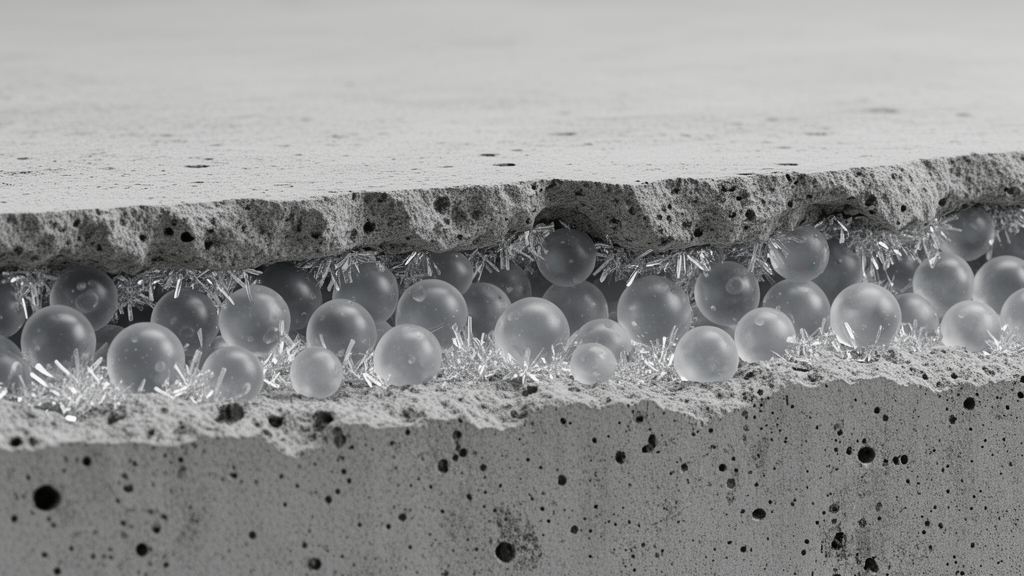
Superabsorbent polymers can absorb and subsequently release substantial quantities of water, with fluid uptake reaching several hundred times their dry mass under aqueous conditions, serving as functional internal curing reservoirs throughout the mixing, setting, and hardening stages of concrete. A comprehensive review published in the International Journal of Concrete Structures and Materials by researchers Mingliang Xing, Haomin Chen, Anhua Xu, Huaxin Chen, Suining Zheng, and Yao Sun synthesizes the multi-scale mechanisms through which these polymers govern internal moisture transport, pore refinement, volumetric stability, and mechanical performance. Modern high-performance concrete typically relies on a low water-to-cement ratio below 0.42 to attain superior strength and durability. However, hydration models indicate that cement cannot fully hydrate at water-to-cement ratios below this threshold, causing early-age self-desiccation that leads to autogenous shrinkage and macro-cracking. Because the low permeability of high-performance mixtures renders conventional external water or membrane curing ineffective beyond surface layers, internal curing with superabsorbent polymers has emerged as a targeted strategy to sustain internal relative humidity and preserve structural integrity.
The swelling and water-release mechanisms of superabsorbent polymers are governed by a coupled interaction between ionic network structure theory and solution thermodynamics. Structurally, these functional polymers possess a three-dimensional spatial network containing mobile ion pairs that prevent dissolution during volumetric expansion. When the polymer contacts water, hydrogen bonds interact with hydrophilic functional groups such as carboxyl, hydroxyl, sulfonic, and amide moieties, inducing group ionization and generating electrostatic repulsion between fixed charges that expands the polymer chain network. Simultaneously, immobile internal ions elevate the osmotic pressure difference across the hydrogel boundary, driving external fluid molecules into the polymer until dynamic equilibrium is established. From a thermodynamic perspective, swelling is driven by solvent chemical potential differences, transitioning from favorable hydrophilic sorption to hydrophobic resistance depending on the free enthalpy change. While chemisorption binds water tightly through stable hydrogen bonding that resists mechanical expulsion, physisorption entrains capillary water that is more readily released under capillary suction.
In cementitious environments, the sorption and desorption kinetics of superabsorbent polymers depend heavily on intrinsic network properties, preparation routes, and environmental conditions. Ionic polymers swell rapidly in low-ionic-strength solutions due to electrostatic repulsion, but multivalent cations such as calcium and aluminum present in cement pore solutions complex with carboxylate groups, precipitating ionic crosslinking that constricts mesh dimensions and promotes premature desorption. Polymer crosslink density acts as a primary control variable, where higher crosslink densities restrict chain mobility and lower overall fluid absorption but enhance gel stability under confining stresses. Preparation methods also direct performance, as inverse suspension and emulsion polymerization yield spherical, uniformly sized particles with predictable uptake rates compared to irregular particles produced via solution polymerization. Advanced network engineering, such as alkali-labile dual-crosslinked polymers, exploits gradual linker hydrolysis in alkaline matrices to suppress autogenous shrinkage within seven days, while organic-inorganic hybrid networks synthesized with nano-silica exhibit swelling capacities approximately 1.49 times higher than commercial polymers and achieve over 95 percent of maximum uptake within five minutes.
The presence of superabsorbent polymers fundamentally alters cement hydration thermodynamics by acting as micro-reservoirs that temporarily withdraw free water and alkaline ions from the fresh paste. Isothermal calorimetry reveals that early water uptake lowers the effective initial water-to-cement ratio, diminishing the amplitude of the principal hydration heat-flow peak and delaying its occurrence. Thermogravimetric analyses confirm that as internal relative humidity declines during hardening, the polymers gradually release entrained moisture to underhydrated cement grains, increasing the quantity of calcium silicate hydrate and calcium hydroxide formed at later ages. Proton nuclear magnetic resonance relaxometry tracks this moisture redistribution in situ without disturbing the specimens, recording a continuous decrease in transverse relaxation times that reflects the migration of fluid from polymer cavities into capillary and gel pores. When fitted to Krstulović-Dabić kinetic models, polymer incorporation modifies the nucleation and crystal growth stage while prolonging the induction period, demonstrating that controlled fluid release dampens early temperature spikes and mitigates thermal cracking risks.
Evaluating the microstructural impact of internal curing requires a multi-technique characterization approach because superabsorbent polymers exert competing influences on the pore network. Mercury intrusion porosimetry effectively tracks capillary refinement from approximately 3 nanometers to 10 micrometers, demonstrating that internal curing shifts pore size distributions away from coarse macropores toward finer gel pores. However, mercury intrusion porosimetry fails to quantify the large isolated voids left behind after polymer deswelling and can mischaracterize pores due to ink-bottle geometries or structural collapse under intrusion pressures. Consequently, researchers employ complementary three-dimensional micro-computed tomography to visualize void spatial distribution and connectivity, nitrogen adsorption-desorption isotherms showing characteristic H3 and H4 hysteresis loops to assess slit-like mesoporosity, and non-destructive electrical resistivity testing. Resistivity monitoring reflects the balance between densified paste matrix resistance and conductive void pathways, confirming that continuous late-age hydration densifies interfacial transition zones and reduces macro-scale percolation pathways.
Fresh-state workability and rheological evolution are similarly transformed by polymer incorporation, as dry particles withdraw free mixing fluid and elevate interparticle friction. Dry polymer addition typically causes immediate slump loss, whereas incorporating pre-wetted particles can preserve initial flow spread but risks particle agglomeration and reduced mixture homogeneity. Beyond static slump measurements, rheological testing demonstrates that superabsorbent polymers alter dynamic and static yield stress development, plastic viscosity, and thixotropic rebuilding over time. In highly flow-sensitive applications such as 3D concrete printing, the rapid initial uptake of free liquid accelerates structural build-up and enhances green-state shape stability, with specific retentive polymers reported to increase initial thixotropy by 49 percent and buildability by 25 percent. Nevertheless, because polymers continue to exchange liquid dynamically after mixing, mixtures proportioned to identical initial slump values cannot be considered rheologically equivalent over extended resting durations.
The mechanical performance of polymer-modified concrete reflects an intrinsic trade-off between matrix densification and void formation. Empty or collapsed polymer cavities act as structural flaws that introduce local stress concentrations, which often reduces early-age compressive and flexural strength, particularly at elevated polymer dosages or when excessive supplemental curing water is introduced. However, when particle dosage is maintained within optimal ranges, commonly between 0.2 and 0.3 percent by mass of binder, progressive water release promotes hydration around the inclusion, producing a densified interfacial transition zone that buffers structural discontinuities. Micro-mechanical studies identify a critical threshold of extra-entrained water, around 20 grams of water per gram of dry polymer in specific cement pastes; exceeding this threshold triggers premature fluid expulsion before final set, loosening local matrix density and diminishing load-bearing capacity. When appropriately tailored, the balance of refined matrix porosity and enhanced crack-bridging mechanics can preserve flexural strength and significantly elevate fracture energy, with certain optimized formulations achieving fracture energy increases exceeding 100 percent.
Superabsorbent polymers demonstrate exceptional efficacy in mitigating autogenous shrinkage, which arises from internal self-desiccation under sealed conditions. By releasing entrained water as capillary menisci form, the polymers counteract capillary pressure development and chemical shrinkage forces during the critical early setting period. In experimental evaluations, internal curing has elevated 28-day internal relative humidity from standard desiccation levels to over 89 and 93 percent across structural concretes, suppressing autogenous shrinkage by up to 87 percent. In contrast, drying shrinkage under unsealed conditions presents a more complex response: while internal water maintains humidity gradients, excessive additional internal-curing water raises the overall water-to-binder ratio and creates macrovoids that can accelerate moisture evaporation if particle distribution is uneven. Properly calibrated particle grading, such as fine powder fractions between 10 and 15 micrometers, ensures uniform moisture delivery without promoting excessive drying shrinkage.
Combining superabsorbent polymers with chemical and mineral admixtures yields distinct synergistic mechanisms that offset individual material limitations. Pairing polymers with superplasticizers counters workability loss through steric hindrance and electrostatic dispersion while delaying polymer uptake toward the hardened state. When combined with crystalline admixtures, rapid polymer swelling provides immediate physical crack sealing during crack formation, while subsequent moisture release drives continuous crystalline product precipitation and calcium silicate hydrate growth to achieve durable chemical closure. Mineral additions such as rice husk ash, rich in amorphous silica, consume calcium hydroxide generated around polymer cavities to form dense secondary hydration gels, compensating for void-induced strength losses. In alkali-activated slag and fly ash systems, despite high pore-solution alkalinity and ionic screening reducing polymer swelling capacity, internal curing successfully mitigates the intense autogenous shrinkage characteristic of alkali activation.
The multifunctional characteristics of superabsorbent polymers extend to emerging functional applications, including bioreceptive facades, thermal-energy-storage composites, and fire-spalling protection. The polymer-induced macro-void network and persistent moisture retention create hospitable microenvironments for biological colonization, supporting algal growth on architectural concrete surfaces. In photothermal storage systems, pre-wetted polymers embedded alongside conductive graphite and carbon black coatings enhance specific heat capacity and thermal buffering without catastrophic strength degradation. Under severe fire exposure, dense concretes are prone to explosive spalling from internal steam pressure; here, hybrid systems incorporating both superabsorbent polymers and polypropylene fibers construct a continuous percolation network where melting fibers and polymer cavities dissipate vapor pressures safely. The authors emphasize that future research must prioritize dynamic in situ multi-scale monitoring of morphological changes and couple ionic-transport kinetic models to optimize polymer molecular architectures for advanced civil infrastructure.
Subject of Research: Superabsorbent polymers for internal curing and moisture regulation in cement-based materials
Article Title: Moisture Regulation, Performance Influence, and Synergistic Strategies of Superabsorbent Polymers in Cement-Based Materials: A Comprehensive Review
Article References: Xing, M., Chen, H., Xu, A., Chen, H., Zheng, S., & Sun, Y. (2026). Moisture Regulation, Performance Influence, and Synergistic Strategies of Superabsorbent Polymers in Cement-Based Materials: A Comprehensive Review. International Journal of Concrete Structures and Materials, 20(1), Article 66. https://doi.org/10.1186/s40069-026-00938-w
Image Credits: AI Generated
DOI: 10.1186/s40069-026-00938-w
Keywords: superabsorbent polymers, internal curing, cement-based materials, high-performance concrete, autogenous shrinkage, drying shrinkage, pore structure refinement, low-field NMR, calorimetry, mercury intrusion porosimetry, crystalline admixtures, rice husk ash, alkali-activated materials, self-healing concrete, microstructural evolution, freeze-thaw resistance, mechanical properties
News Source: Denise Maddox. (November 21, 2026). Superabsorbent Polymers Regulate Internal Moisture and Mitigate Shrinkage in Modern Concrete. Scienmag.