New research reveals that sunscreen contamination may be less harmful to wildlife than previously thought. This study by Aaron Boyd, a PhD candidate at the University of Alberta in Edmonton, Canada, demonstrates how exposure to sunscreen is actually a low risk for small aquatic animals compared to some of the suncream’s individual chemicals.
Credit: Aaron Boyd
New research reveals that sunscreen contamination may be less harmful to wildlife than previously thought. This study by Aaron Boyd, a PhD candidate at the University of Alberta in Edmonton, Canada, demonstrates how exposure to sunscreen is actually a low risk for small aquatic animals compared to some of the suncream’s individual chemicals.
Sunscreens contain ultraviolet filters (UVFs) which have been found to be toxic to marine life such as corals, leading to the ban of some UVFs in Hawaii and Palau. If sunscreen is applied to the skin before swimming in lakes and rivers, these UVFs and other chemicals will leach into surrounding waters.
Mr Boyd’s research investigates how the chemical cocktail in sunscreen interacts to affect marine life, instead of just focusing on the UVFs and other chemicals on their own. “Researchers overwhelmingly perform studies testing the toxicity of UVFs in isolation by exposing test organisms to one chemical at a time,” says Mr Boyd. “In fact, less than 3% of aquatic toxicology studies published to date have investigated whole sunscreen mixtures, leaving a massive knowledge gap to be addressed.”
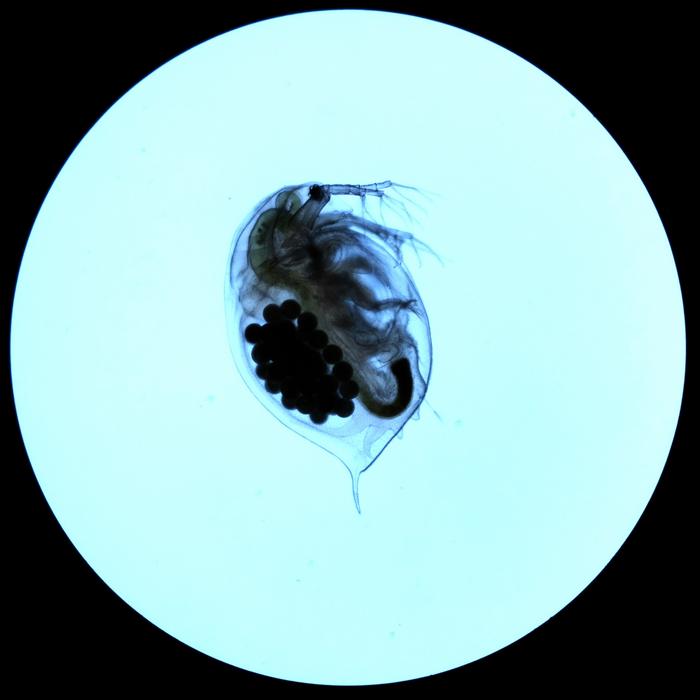
This research compared the long-term toxicity of five different sunscreen mixtures, as well as their individual UVFs, on Daphnia water fleas. Daphnia are invertebrates that are commonly found in freshwater lakes throughout the world and are a good indicator of how pollution affects aquatic life.
“We were very surprised to find that sunscreen mixtures are much less toxic to Daphnia than what would be expected based on the quantity of each UV filter present within the mixtures,” says Mr Boyd. “In fact, we found that Daphnia could survive long-term exposure to sunscreens containing octocrylene at concentrations >50x higher than what would be completely lethal to all Daphnia had they been exposed to the UVF alone.”
The rate at which new chemicals are developed and released into the environment is much faster than the rate at which scientists can proper study the consequences of contamination. “As a result,” says Mr Boyd, “it’s important that we utilize our limited research resources effectively by identifying which contaminants are likely to cause harm to the environment, and which contaminants are lower risk.”
“We found that the other components of the sunscreen mixtures reduced the toxicity to such a large extent that perhaps these chemicals are not a contamination concern in most environments, allowing for us to reallocate our limited research resources towards identifying other contaminants that could be much more concerning,” says Mr Boyd. “This potentially indicates that the vast majority of studies investigating the toxicity of individual UV filters could be overestimating the toxicity of these chemicals in aquatic environments.”
Mr Boyd still strongly recommends the use of sunscreen when spending time outdoors. “Regardless of any potential environmental toxicity of sunscreens, always wear sunscreen when going outside for an extended period of time. The threat of cancer is much more severe than the potential effects that sunscreen contamination may cause!”