


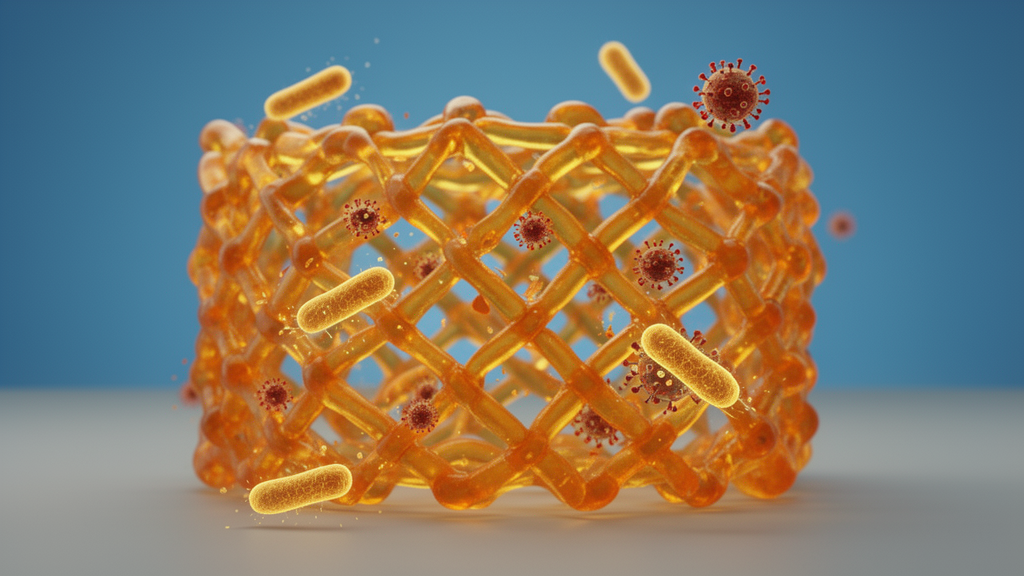
Researchers have converted elemental sulfur, an industrial byproduct produced on a megaton scale, into a dynamic polymer nanomaterial that can load, encapsulate and release therapeutic cargo while showing antibacterial and antiviral activity. The work, published in Advanced Composites and Hybrid Materials, describes a one-pot, catalyst- and solvent-free copolymerization of glycidol with elemental sulfur, yielding a family of polymers the authors call poly(glycerol-sulfur), or hPG-Sn.
The resulting polymers contain alternating polyglycerol and polysulfide segments. In aqueous media they spontaneously assemble into nanoscale networks measuring between 200 and 500 nanometers. According to the study, the polysulfide segments give the material a stimuli-responsive architecture: dynamic sulfur-sulfur bonds allow the pores of the network to open and close reversibly, a property the team exploited for drug loading and subsequent encapsulation and release.
The choice of feedstock is central to the paper’s sustainability argument. Elemental sulfur is generated in vast quantities as a byproduct of industrial processes and remains largely untapped as a building block for functional polymer synthesis. The new route valorizes this abundant, underutilized resource without requiring a catalyst or solvent, providing what the authors describe as a modular path to sulfur-containing polymers.
Antibacterial performance was demonstrated with tetracycline as a model cargo. Networks loaded with the antibiotic showed a ten-fold enhancement in antibacterial efficacy compared with the free drug, while maintaining low cytotoxicity toward human cells. The study frames this result in the context of growing antimicrobial resistance, which has intensified demand for adaptive biomaterials combining intrinsic bioactivity with controlled therapeutic delivery.
Chemical modularity is a second key feature of the platform. The polysulfide domains allow facile post-functionalization through thiol-disulfide exchange, meaning the surface chemistry of the nanoparticles can be modified after the polymer has been synthesized and assembled.
To illustrate this, the researchers functionalized the networks with 11-mercaptoundecanesulfonate, or MUS, which generated negatively charged nanoparticles of approximately 550 nanometers with a zeta potential of about minus 30 millivolts. These MUS-functionalized particles exhibited pronounced antiviral activity against herpes simplex virus, including both inhibitory effects and direct virucidal effects.
Taken together, the authors present hPG-Sn as a single polymer platform that combines sustainable sulfur utilization, dynamic and reversible pore modulation, efficient therapeutic cargo loading, and facile surface functionalization. They suggest these features highlight its potential as an adaptable nanomaterial for controlled antimicrobial and antiviral delivery.
The findings come from laboratory characterization of a newly synthesized material, and the reported antibacterial and antiviral effects are preclinical material observations rather than results from clinical testing. The article was published as an open-access paper under a version-sharing arrangement, meaning the released text is a peer-reviewed, accepted version that may be replaced by a final version of record after further edits.
As a research contribution, the study adds a catalyst-free route to sulfur-rich polymers whose disulfide chemistry enables both responsive behavior and straightforward chemical modification. Whether the platform can translate into practical antimicrobial or antiviral therapies will depend on subsequent work beyond the scope of the reported experiments.
Subject of Research: Catalyst-free copolymerization of glycidol and elemental sulfur into dynamic poly(glycerol-sulfur) nano-networks with antibacterial and antiviral activity.
Article Title: Valorization of elemental sulfur via catalyst-free polymerization into dynamic poly(glycerol-sulfur) nano-networks for antibacterial and antiviral applications
Article References: Mohammadi, Z., Nemati, M., Beyranvand, S., Mohammadifar, E., Zabihi, F., Stergiou, P. S., Mansutti, G., Abadel, L., Nie, C., Chen, R., Dimde, M., Ludwig, K., Cheng, C., Povolotsky, T. L., Haag, R., & Adeli, M. (2026). Valorization of elemental sulfur via catalyst-free polymerization into dynamic poly(glycerol-sulfur) nano-networks for antibacterial and antiviral applications. Advanced Composites and Hybrid Materials, 9(6), Article 454. https://doi.org/10.1007/s42114-026-02149-z
Image Credits: AI Generated
DOI: 10.1007/s42114-026-02149-z
Keywords: elemental sulfur, poly(glycerol-sulfur), catalyst-free polymerization, nanonetworks, disulfide bonds, drug delivery, tetracycline, antibacterial, antiviral, herpes simplex virus, sustainable polymers, thiol-disulfide exchange
News Source: Neil Sanderson. (October 29, 2026). Sulfur Byproduct Turned into Dynamic Antibacterial and Antiviral Polymer Networks. Scienmag.



