• HOME
  • NEWS
  • EXPLORE
    • CAREER
      • Companies
      • Jobs
    • EVENTS
    • iGEM
      • News
      • Team
    • PHOTOS
    • VIDEO
    • WIKI
  • BLOG
  • COMMUNITY
    • FACEBOOK
    • INSTAGRAM
    • TWITTER
Wednesday, September 23, 2026
BIOENGINEER.ORG
No Result
View All Result
  • Login
  • HOME
  • NEWS
  • EXPLORE
    • CAREER
      • Companies
      • Jobs
        • Lecturer
        • PhD Studentship
        • Postdoc
        • Research Assistant
    • EVENTS
    • iGEM
      • News
      • Team
    • PHOTOS
    • VIDEO
    • WIKI
  • BLOG
  • COMMUNITY
    • FACEBOOK
    • INSTAGRAM
    • TWITTER
  • HOME
  • NEWS
  • EXPLORE
    • CAREER
      • Companies
      • Jobs
        • Lecturer
        • PhD Studentship
        • Postdoc
        • Research Assistant
    • EVENTS
    • iGEM
      • News
      • Team
    • PHOTOS
    • VIDEO
    • WIKI
  • BLOG
  • COMMUNITY
    • FACEBOOK
    • INSTAGRAM
    • TWITTER
No Result
View All Result
Bioengineer.org
No Result
View All Result
Home NEWS Science News Health

Success tastes so sweet

Bioengineer by Bioengineer
May 7, 2019
in Health
Reading Time: 2 mins read
0
IMAGE
Share on FacebookShare on TwitterShare on LinkedinShare on RedditShare on Telegram

Neurons that encode sweetness identified in mice
IMAGE

Credit: Ken-ichiro Nakajima / National Institute for Physiological Sciences

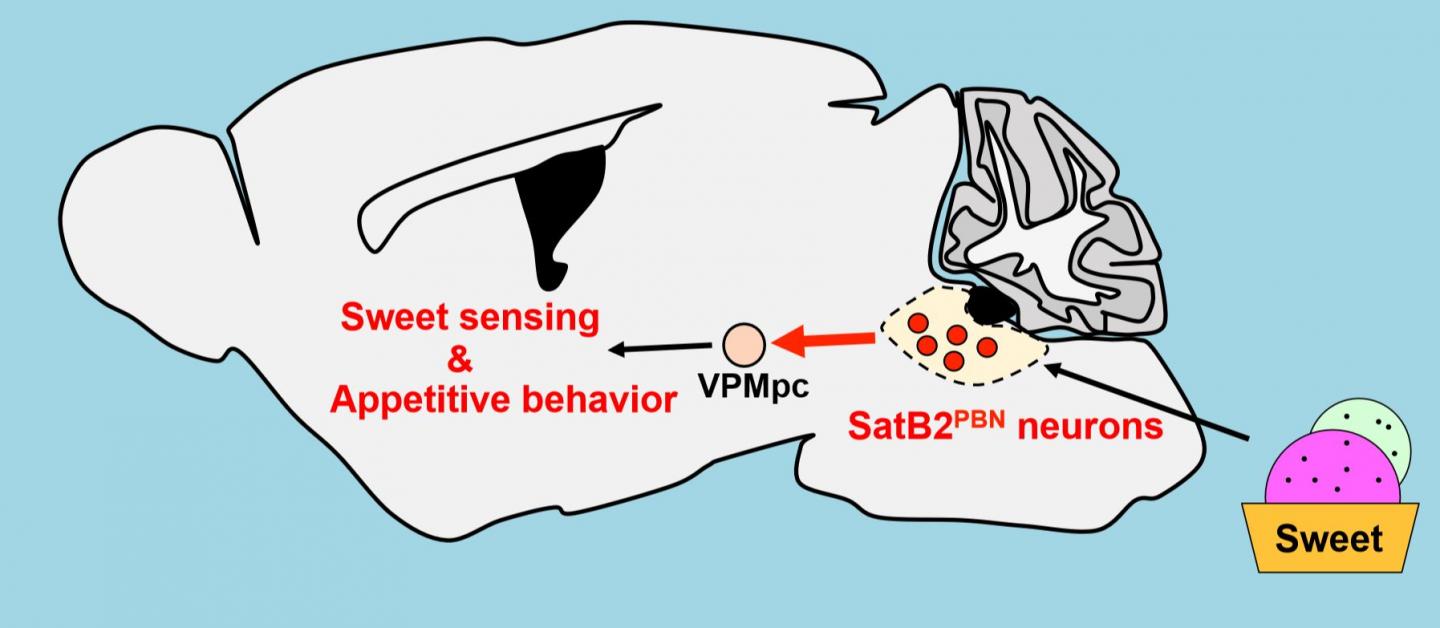
Researchers from the National Institute for Physiological Sciences in Japan identify the neurons responsible for relaying sweet taste signals to the gustatory thalamus and cortex in mice.

Okazaki, Japan – While the peripheral taste system has been extensively investigated, relatively little is known about the contribution of CNS gustatory neurons in the sensation of taste. In this new study, researchers have identified neurons in the brainstem that are responsible for encoding sweet tastes.

In mice, the parabrachial nucleus of the pons in the brainstem is a major hub that receives sensory information about hunger, satiety, and taste information and relays it to the cortex via the gustatory thalamus. One clue to the molecular properties of gustatory neurons in the parabrachial nucleus may lie in the neuronal expression of SatB2; the role of neurons in the parabrachial nucleus that possess this transcription factor has so far remained a mystery. Ken-ichiro Nakajima and his research team at the National Institute for Physiological Sciences have found that SatB2-expressing neurons in the parabrachial nucleus of mice encode sweet tastes, and those that projected to the gustatory thalamus induced appetitive lick behaviors in mice. They recently published their findings in Cell Reports.

“We’ve known about the presence of taste-responsive neurons in the parabrachial nucleus for over 40 years,” Nakajima says. “Only recently have we had the appropriate molecular markers and imaging methods to properly characterize these neurons–we used cell ablation, in vivo calcium imaging, and optogenetics to define the role of SatB2-expressing neurons is in the sensation of taste.”

Selective ablation of SatB2-expressing neurons led to the loss of normal sweet taste sensing, which was measured by licking behavior in mice, but had little impact on the sensitivities to umami, bitter, sour, and salty tastes. This indicates that SatB2-expressing neurons have selective roles in sweet taste transduction.

Furthermore, the researchers clarified the functional role of SatB2-expressing neurons. Artificial activation by optogenetics caused dramatic changes in licking behavior; mice intensively licked tasteless water as if it were the sweet-tasting solution. These findings indicated that SatB2-expressing neurons convey sweet taste-specific signals.

“Our findings indicate that different taste qualities are processed by different types of neurons, at least in the brainstem,” says lead author Ou Fu. “The next important step will be to identify a whole set of gustatory neurons, including SatB2 neurons, in the mouse parabrachial nucleus. This will allow us to understand how their assemblage forms complex flavors.”

This new work could be pivotal in characterizing taste processing at molecular and cellular levels.

###

Media Contact
Ken-ichiro Nakajima
[email protected]

Related Journal Article

http://dx.doi.org/10.1016/j.celrep.2019.04.040

Tags: BiologyCell BiologyDiet/Body WeightEating Disorders/ObesityFood/Food ScienceMolecular BiologyneurobiologyOlfactory/Taste
Share12Tweet8Share2ShareShareShare2

Related Posts

Protein Axis That Shields the Cornea Offers New Hope Against Dry Eye Pain

September 23, 2026

Steroid Ointment Beats Tacrolimus at Clearing Early Skin Lymphoma, but Relapses Loom

September 23, 2026

Hospital Safety Culture Shapes How Theatre Nurses Protect Patients and Themselves

September 23, 2026

Wealth Predicts Who Gets Hospital Care at Home, Barcelona Study Finds

September 23, 2026
Please login to join discussion

POPULAR NEWS

  • Peatland Rewetting Reshapes Mosquito Communities in Unexpected Ways, Study Finds

    29 shares
    Share 12 Tweet 7
  • NOAA Bets $100 Million on Mississippi State for New Gulf Research Powerhouse

    29 shares
    Share 12 Tweet 7
  • Scientists Discover the Gene Switch That Makes Alfalfa Flower Early

    29 shares
    Share 12 Tweet 7
  • AI Imaging Meets Flow Cytometry in Race to Detect Liver Cancer Cells in Blood

    29 shares
    Share 12 Tweet 7

About

We bring you the latest biotechnology news from best research centers and universities around the world. Check our website.

Follow us

Recent News

Peatland Rewetting Reshapes Mosquito Communities in Unexpected Ways, Study Finds

NOAA Bets $100 Million on Mississippi State for New Gulf Research Powerhouse

Scientists Discover the Gene Switch That Makes Alfalfa Flower Early

Subscribe to Blog via Email

Enter your email address to subscribe to this blog and receive notifications of new posts by email.

Join 85 other subscribers
  • Contact Us

Bioengineer.org © Copyright 2023 All Rights Reserved.

Welcome Back!

Login to your account below

Forgotten Password?

Retrieve your password

Please enter your username or email address to reset your password.

Log In
No Result
View All Result
  • Homepages
    • Home Page 1
    • Home Page 2
  • News
  • National
  • Business
  • Health
  • Lifestyle
  • Science

Bioengineer.org © Copyright 2023 All Rights Reserved.