• HOME
  • NEWS
  • EXPLORE
    • CAREER
      • Companies
      • Jobs
    • EVENTS
    • iGEM
      • News
      • Team
    • PHOTOS
    • VIDEO
    • WIKI
  • BLOG
  • COMMUNITY
    • FACEBOOK
    • INSTAGRAM
    • TWITTER
Wednesday, May 13, 2026
BIOENGINEER.ORG
No Result
View All Result
  • Login
  • HOME
  • NEWS
  • EXPLORE
    • CAREER
      • Companies
      • Jobs
        • Lecturer
        • PhD Studentship
        • Postdoc
        • Research Assistant
    • EVENTS
    • iGEM
      • News
      • Team
    • PHOTOS
    • VIDEO
    • WIKI
  • BLOG
  • COMMUNITY
    • FACEBOOK
    • INSTAGRAM
    • TWITTER
  • HOME
  • NEWS
  • EXPLORE
    • CAREER
      • Companies
      • Jobs
        • Lecturer
        • PhD Studentship
        • Postdoc
        • Research Assistant
    • EVENTS
    • iGEM
      • News
      • Team
    • PHOTOS
    • VIDEO
    • WIKI
  • BLOG
  • COMMUNITY
    • FACEBOOK
    • INSTAGRAM
    • TWITTER
No Result
View All Result
Bioengineer.org
No Result
View All Result
Home NEWS Science News Biology

Studying species interactions using remote camera traps

Bioengineer by Bioengineer
February 22, 2019
in Biology
Reading Time: 2 mins read
0
IMAGE
Share on FacebookShare on TwitterShare on LinkedinShare on RedditShare on Telegram

IMAGE

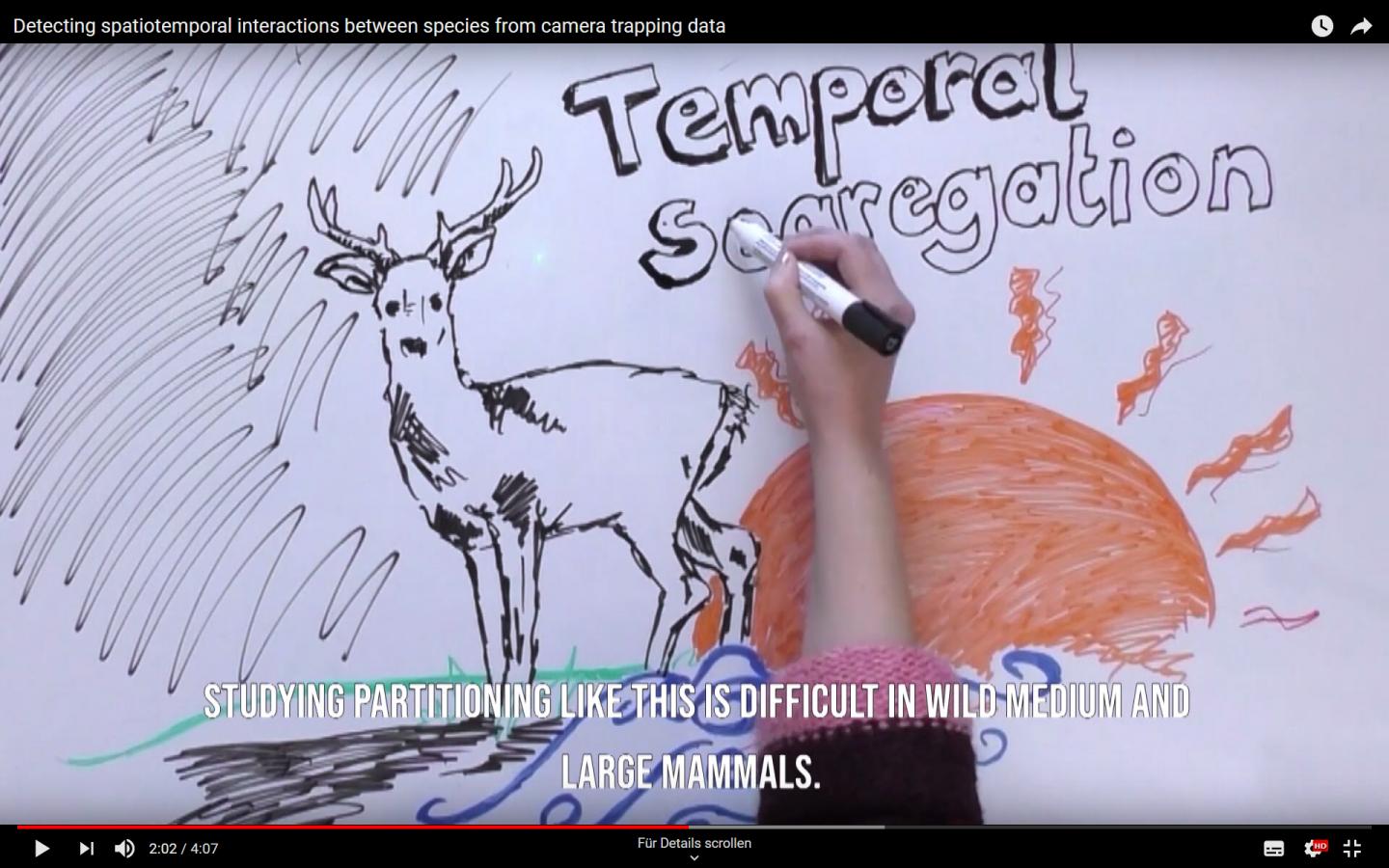
Credit: www.youtube.com/watch?v=qWQ1SXTONRA


Species are often involved in complex interactions with other species, which can affect their occurrence, abundance, feeding habits and disease transmission. Observing and studying species interactions can be difficult. To circumvent this problem, ecologists increasingly rely on remote devices such as camera traps. In a recent study carried out by researchers from the Leibniz Institute for Zoo and Wildlife Research (Leibniz-IZW) in Germany and University of California, Davis, USA, the scientists explored to what extent camera trap data are suitable to assess subtle species interactions such as avoidance in space and time. The study is published in the international journal Remote Sensing in Ecology and Conservation.

Species interact in numerous ways. In mammals, many interactions are detrimental for at least one of the species, such as cases of predation or disease transmission. In such cases, a species (say, a prey) may choose to avoid encounters with a second species (say, a predator). The researchers focussed on two situations: spatiotemporal avoidance, where the prey avoids its predator simply by going somewhere else, and temporal segregation, where the prey avoids being present in the same location as its predator by being active at times when the predator is not.

The aim of the current study was to create a framework that researchers worldwide could use to detect interactions between species based on their own camera trap data. The scientists used computer simulations to find out how camera-trap data can best be used to study such species interactions. “Identifying which statistical tool is the most sensitive was one of the main goals of our work, as we are aware how challenging it can be to collect large datasets under natural conditions, even with camera traps”, explains Dr Alexandre Courtiol, one of the leading Leibniz-IZW scientists on this project. The proposed approach should allow other scientists to determine which statistical method to use and how many records they need to best understand species interactions for their specific field study. “We show that for many realistic scenarios many records are needed to produce trustworthy results, but I am optimistic: we can achieve this by standardizing data collection and combining datasets from multiple studies. In short, we must collaborate,” Courtiol adds.

###

The journal Remote Sensing in Ecology and Conservation created a short video about this work. A fantastic example of how theoretical science can be shared with a wider audience. Click here to watch the video.

Media Contact
Alexandre Courtiol
[email protected]
49-030-516-8331

Related Journal Article

http://dx.doi.org/10.1002/rse2.107

Tags: BiodiversityBiologyEcology/EnvironmentPopulation BiologySocial/Behavioral ScienceZoology/Veterinary Science
Share12Tweet8Share2ShareShareShare2

Related Posts

Cutting-Edge Genomic Techniques Reveal Unexpected Cellular Changes in the Aging Brain — Biology

Cutting-Edge Genomic Techniques Reveal Unexpected Cellular Changes in the Aging Brain

May 12, 2026
USC Researchers Initiate Study on the Most Advanced Lab-Grown Kidney Structures — Biology

USC Researchers Initiate Study on the Most Advanced Lab-Grown Kidney Structures

May 12, 2026

Childbirth in Humans Is Not Uniquely Challenging Among Mammals, New Research Shows

May 12, 2026

From Complexity to Clarity: Unraveling the “Topological Laws” Governing Cell Death

May 11, 2026
Please login to join discussion

POPULAR NEWS

  • Research Indicates Potential Connection Between Prenatal Medication Exposure and Elevated Autism Risk

    842 shares
    Share 337 Tweet 211
  • New Study Reveals Plants Can Detect the Sound of Rain

    728 shares
    Share 290 Tweet 182
  • Salmonella Haem Blocks Macrophages, Boosts Infection

    62 shares
    Share 25 Tweet 16
  • Breastmilk Balances E. coli and Beneficial Bacteria in Infant Gut Microbiomes

    57 shares
    Share 23 Tweet 14

About

We bring you the latest biotechnology news from best research centers and universities around the world. Check our website.

Follow us

Recent News

Robust Magnetoelectric Backscatter System Boosts Bioelectronic Implants

Anti-Nogo-A Treatment Alters Spinal Cord Structure Post-Injury

Older Adults’ Views on Medication After Hospital Discharge

Subscribe to Blog via Email

Enter your email address to subscribe to this blog and receive notifications of new posts by email.

Join 82 other subscribers
  • Contact Us

Bioengineer.org © Copyright 2023 All Rights Reserved.

Welcome Back!

Login to your account below

Forgotten Password?

Retrieve your password

Please enter your username or email address to reset your password.

Log In
No Result
View All Result
  • Homepages
    • Home Page 1
    • Home Page 2
  • News
  • National
  • Business
  • Health
  • Lifestyle
  • Science

Bioengineer.org © Copyright 2023 All Rights Reserved.