

• HOME
  • NEWS
  • EXPLORE
    • CAREER
      • Companies
      • Jobs
    • EVENTS
    • iGEM
      • News
      • Team
    • PHOTOS
    • VIDEO
    • WIKI
  • BLOG
  • COMMUNITY
    • FACEBOOK
    • INSTAGRAM
    • TWITTER
Monday, July 27, 2026
BIOENGINEER.ORG
No Result
View All Result
  • Login
  • HOME
  • NEWS
  • EXPLORE
    • CAREER
      • Companies
      • Jobs
        • Lecturer
        • PhD Studentship
        • Postdoc
        • Research Assistant
    • EVENTS
    • iGEM
      • News
      • Team
    • PHOTOS
    • VIDEO
    • WIKI
  • BLOG
  • COMMUNITY
    • FACEBOOK
    • INSTAGRAM
    • TWITTER
  • HOME
  • NEWS
  • EXPLORE
    • CAREER
      • Companies
      • Jobs
        • Lecturer
        • PhD Studentship
        • Postdoc
        • Research Assistant
    • EVENTS
    • iGEM
      • News
      • Team
    • PHOTOS
    • VIDEO
    • WIKI
  • BLOG
  • COMMUNITY
    • FACEBOOK
    • INSTAGRAM
    • TWITTER
No Result
View All Result
Bioengineer.org
No Result
View All Result
Home NEWS Science News Health

Study uncovers ultrafast gene evolution driving chicken feather color diversity

Bioengineer by Bioengineer
July 27, 2026
in Health
Reading Time: 2 mins read
0
Share on FacebookShare on TwitterShare on LinkedinShare on RedditShare on Telegram

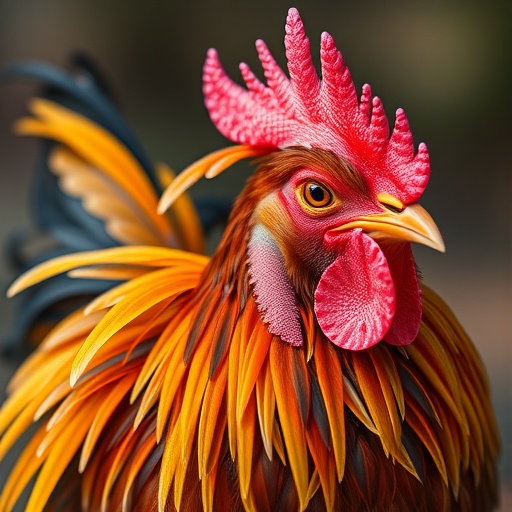
Domestic chickens have long fascinated biologists with their feather diversity—ranging from barred and speckled patterns to uniform black and crisp snowy white. For centuries, selective breeding has rapidly expanded these visible traits. Yet scientists have struggled to explain how such rich variation can arise so quickly from underlying genetic change.

A new analysis by researchers at Texas A&M University’s College of Veterinary Medicine and Biomedical Sciences points to an unexpectedly fast evolutionary mechanism centered on pigmentation. By examining more than 10,000 chicken genomes, the team detected ultrarapid evolution in MC1R, a gene known to control pigment production across vertebrates, including humans.

Rather than a single mutation mapping neatly onto a single phenotype, the study shows that multiple MC1R variants with distinct effects on protein function interact to generate color outcomes. The key insight is that evolutionary novelty can emerge through combinations of mutations, not only through isolated changes.

The researchers cataloged nine mutations within the MC1R locus. Through recombination, these variants were reshuffled into 18 distinct gene versions. Each gene combination altered MC1R activity in ways that corresponded to specific feather colors and pattern classes, expanding the phenotypic spectrum far beyond what would be expected from one-to-one mutation effects.

This combinatorial model reframes “fast evolution” as a process of accumulation plus rearrangement. In other words, selection can quickly enrich multiple mutations in a population, while recombination continually constructs new functional alleles by mixing them across the same gene.

As Dr. Leif Andersson of Texas A&M explains, the result is like moving from simple arithmetic to multiplicative outcomes: if two mutation sites contribute variation, recombination can generate more combinations than adding mutations would suggest. Here, multiple interacting sites effectively amplify diversity over short evolutionary windows.

The work also highlights the power of large genomic datasets. A broad survey of MC1R diversity makes it possible to infer evolutionary dynamics that would remain hidden in smaller samples, providing a “complete picture” of variation at that locus.

Beyond feather plumage, the findings offer a general lesson about how biodiversity may evolve throughout the animal kingdom. The next step, the authors suggest, is to test how common this reshuffling mechanism is across genomes and species—whether in different genomic regions or under different evolutionary regimes.

Subject of Research: Animals
Article Title: Ultrarapid MC1R protein and associated plumage color evolution in the domestic chicken
News Publication Date: 10-Jun-2026
Web References: https://www.pnas.org/doi/10.1073/pnas.2605288123
References: 10.1073/pnas.260528812
Image Credits:
Keywords: Genetics; Feather evolution; Evolutionary biology; Evolution


Share12Tweet7Share2ShareShareShare1

Related Posts

Stuffed Toys Release PFAS into Saliva, Raising Oral Exposure Concerns

July 27, 2026

OTUB1 Suppresses Autophagy-Dependent Ferroptosis in Liver Cancer by Stabilizing p62

July 27, 2026

Lessons from history guide the future of AI in medical decision-making

July 27, 2026

New Insights Into Ionizing Radiation Exposure and Parkinson’s Disease Risk

July 27, 2026

POPULAR NEWS

  • Stuffed Toys Release PFAS into Saliva, Raising Oral Exposure Concerns

    29 shares
    Share 12 Tweet 7
  • Energy use from food consumption can reveal poverty in rural Chinese homes

    29 shares
    Share 12 Tweet 7
  • OTUB1 Suppresses Autophagy-Dependent Ferroptosis in Liver Cancer by Stabilizing p62

    29 shares
    Share 12 Tweet 7
  • Mental Disorder-Related Deaths Among U.S. Adolescents Rise, 1999–2023

    29 shares
    Share 12 Tweet 7

About

We bring you the latest biotechnology news from best research centers and universities around the world. Check our website.

Follow us

Recent News

Stuffed Toys Release PFAS into Saliva, Raising Oral Exposure Concerns

Energy use from food consumption can reveal poverty in rural Chinese homes

OTUB1 Suppresses Autophagy-Dependent Ferroptosis in Liver Cancer by Stabilizing p62

Subscribe to Blog via Email

Enter your email address to subscribe to this blog and receive notifications of new posts by email.

Join 85 other subscribers
  • Contact Us

Bioengineer.org © Copyright 2023 All Rights Reserved.

Welcome Back!

Login to your account below

Forgotten Password?

Retrieve your password

Please enter your username or email address to reset your password.

Log In
No Result
View All Result
  • Homepages
    • Home Page 1
    • Home Page 2
  • News
  • National
  • Business
  • Health
  • Lifestyle
  • Science

Bioengineer.org © Copyright 2023 All Rights Reserved.
