• HOME
  • NEWS
  • EXPLORE
    • CAREER
      • Companies
      • Jobs
    • EVENTS
    • iGEM
      • News
      • Team
    • PHOTOS
    • VIDEO
    • WIKI
  • BLOG
  • COMMUNITY
    • FACEBOOK
    • INSTAGRAM
    • TWITTER
Thursday, April 16, 2026
BIOENGINEER.ORG
No Result
View All Result
  • Login
  • HOME
  • NEWS
  • EXPLORE
    • CAREER
      • Companies
      • Jobs
        • Lecturer
        • PhD Studentship
        • Postdoc
        • Research Assistant
    • EVENTS
    • iGEM
      • News
      • Team
    • PHOTOS
    • VIDEO
    • WIKI
  • BLOG
  • COMMUNITY
    • FACEBOOK
    • INSTAGRAM
    • TWITTER
  • HOME
  • NEWS
  • EXPLORE
    • CAREER
      • Companies
      • Jobs
        • Lecturer
        • PhD Studentship
        • Postdoc
        • Research Assistant
    • EVENTS
    • iGEM
      • News
      • Team
    • PHOTOS
    • VIDEO
    • WIKI
  • BLOG
  • COMMUNITY
    • FACEBOOK
    • INSTAGRAM
    • TWITTER
No Result
View All Result
Bioengineer.org
No Result
View All Result
Home NEWS Science News

Study suggests measurable impact of colorectal cancer screening program

Bioengineer by Bioengineer
November 30, 2017
in Science News
Reading Time: 2 mins read
0
Share on FacebookShare on TwitterShare on LinkedinShare on RedditShare on Telegram
IMAGE

Credit: American Cancer Society

A new study suggests that an American Cancer Society (ACS) program has been effective in promoting improvements in colorectal cancer screening rates in federally qualified health centers (FQHCs). The study appears early online in the American Journal of Preventive Medicine, and the authors say it has implications for broader public health efforts to increase cancer prevention and screening.

In 2013, ACS initiated the Community Health Advocates Implementing Nationwide Grants for Empowerment and Equity (CHANGE) grant program, which was designed to reduce breast and colorectal cancer screening disparities by building community capacity to implement evidence-based interventions proven to increase cancer screening rates. Funding is awarded to FQHC partners, with technical assistance provided by ACS field staff.

Funded FQHCs were required to implement at least one provider-oriented strategy (provider assessment and feedback or provider reminder/recall systems) and at least one client-oriented strategy (education, client reminders, or navigation). Most grantees (88.4%) implemented three to five intervention strategies throughout their funding period.

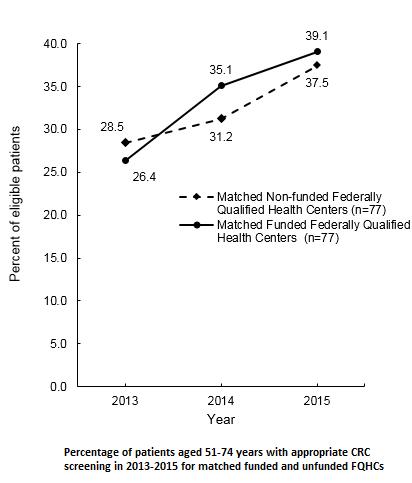
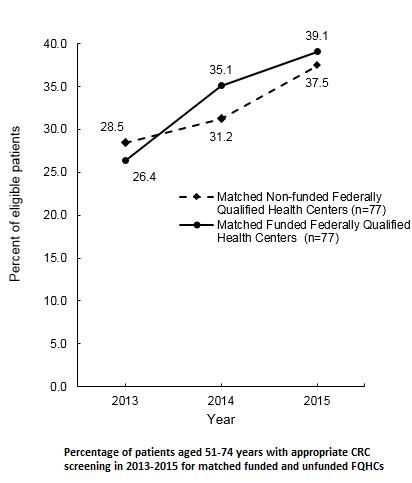
Investigators compared screening rates of FQHCs funded by CHANGE grants to those of matched controls. At the start of the study period, colorectal cancer screening rates were low across the board, with funded FQHCs lagging nonfunded FQHCs (26.4% vs 30.4%).

In the first year (2013-2014), funded FQHCs increased their CRC screening rates significantly more than nonfunded FQHCs. Funded FQHCs increased by 8.7% (from 26.4% to 35.1%) while nonfunded FQHCs increased by 2.7% (from 28.5% to 31.2%). Across the three years, increases were 12.7% (from 26.4% to 39.1%) and 9.0% (from 28.5% to 37.5%), respectively. The difference in change rates between groups across the 3 years was not significant.

"Even in the absence of the ACS grant funds, many FQHCs increased their CRC screening rates substantially during the 3-year period," write the authors. "The 80% by 2018 CRC campaign is a national initiative that serves as a catalyst for concentrated focus on CRC screening and may have contributed to an overall increase in CRC screening rates."

The authors write: "Funding that results in targeted, intensive efforts supported by technical assistance and accountability for data and reporting, can result in improved system policies and practices that, in turn, can increase screening rates among uninsured and underserved populations."

###

Article: Evaluation of Colorectal Cancer Screening in Federally Qualified Health Centers, Am J Prev Med 2017; DOI 10.1016/j.amepre.2017.10.007.

Media Contact

David Sampson
[email protected]
@ACSNews

http://www.cancer.org

Original Source

http://pressroom.cancer.org/RiehmanCHANGE2017 http://dx.doi.org/10.1016/j.amepre.2017.10.007

Share12Tweet8Share2ShareShareShare2

Related Posts

Biosynthetic Insights into Hypocrealean Biocontrol Fungi

April 16, 2026
UCD Scientists Unveil Novel Cellular ‘Courier System’ for Transferring Vital Biological Messages

UCD Scientists Unveil Novel Cellular ‘Courier System’ for Transferring Vital Biological Messages

April 16, 2026

Unveiling Fundamental Limits in Spontaneous Brillouin Noise

April 16, 2026

Researchers Identify Early Marker of Most Common Oesophageal Cancer, Opening Door to Earlier Detection

April 16, 2026
Please login to join discussion

POPULAR NEWS

  • Scientists Investigate Possible Connection Between COVID-19 and Increased Lung Cancer Risk

    61 shares
    Share 24 Tweet 15
  • Boosting Breast Cancer Risk Prediction with Genetics

    47 shares
    Share 19 Tweet 12
  • Popular Anti-Aging Compound Linked to Damage in Corpus Callosum, Study Finds

    45 shares
    Share 18 Tweet 11
  • NSF funds machine-learning research at UNO and UNL to study energy requirements of walking in older adults

    96 shares
    Share 38 Tweet 24

About

We bring you the latest biotechnology news from best research centers and universities around the world. Check our website.

Follow us

Recent News

Biosynthetic Insights into Hypocrealean Biocontrol Fungi

UCD Scientists Unveil Novel Cellular ‘Courier System’ for Transferring Vital Biological Messages

Unveiling Fundamental Limits in Spontaneous Brillouin Noise

Subscribe to Blog via Email

Enter your email address to subscribe to this blog and receive notifications of new posts by email.

Join 79 other subscribers
  • Contact Us

Bioengineer.org © Copyright 2023 All Rights Reserved.

Welcome Back!

Login to your account below

Forgotten Password?

Retrieve your password

Please enter your username or email address to reset your password.

Log In
No Result
View All Result
  • Homepages
    • Home Page 1
    • Home Page 2
  • News
  • National
  • Business
  • Health
  • Lifestyle
  • Science

Bioengineer.org © Copyright 2023 All Rights Reserved.