

• HOME
  • NEWS
  • EXPLORE
    • CAREER
      • Companies
      • Jobs
    • EVENTS
    • iGEM
      • News
      • Team
    • PHOTOS
    • VIDEO
    • WIKI
  • BLOG
  • COMMUNITY
    • FACEBOOK
    • INSTAGRAM
    • TWITTER
Tuesday, February 3, 2026
BIOENGINEER.ORG
No Result
View All Result
  • Login
  • HOME
  • NEWS
  • EXPLORE
    • CAREER
      • Companies
      • Jobs
        • Lecturer
        • PhD Studentship
        • Postdoc
        • Research Assistant
    • EVENTS
    • iGEM
      • News
      • Team
    • PHOTOS
    • VIDEO
    • WIKI
  • BLOG
  • COMMUNITY
    • FACEBOOK
    • INSTAGRAM
    • TWITTER
  • HOME
  • NEWS
  • EXPLORE
    • CAREER
      • Companies
      • Jobs
        • Lecturer
        • PhD Studentship
        • Postdoc
        • Research Assistant
    • EVENTS
    • iGEM
      • News
      • Team
    • PHOTOS
    • VIDEO
    • WIKI
  • BLOG
  • COMMUNITY
    • FACEBOOK
    • INSTAGRAM
    • TWITTER
No Result
View All Result
Bioengineer.org
No Result
View All Result
Home NEWS Science News Health

Study suggests increased risk of restraint use in black patients in the emergency setting

Bioengineer by Bioengineer
November 2, 2020
in Health
Reading Time: 2 mins read
0
IMAGE
Share on FacebookShare on TwitterShare on LinkedinShare on RedditShare on Telegram

IMAGE

Credit: KIRSTY CHALLEN, B.SC., MBCHB, MRES, PH.D., LANCASHIRE TEACHING HOSPITALS, UNITED KINGDOM

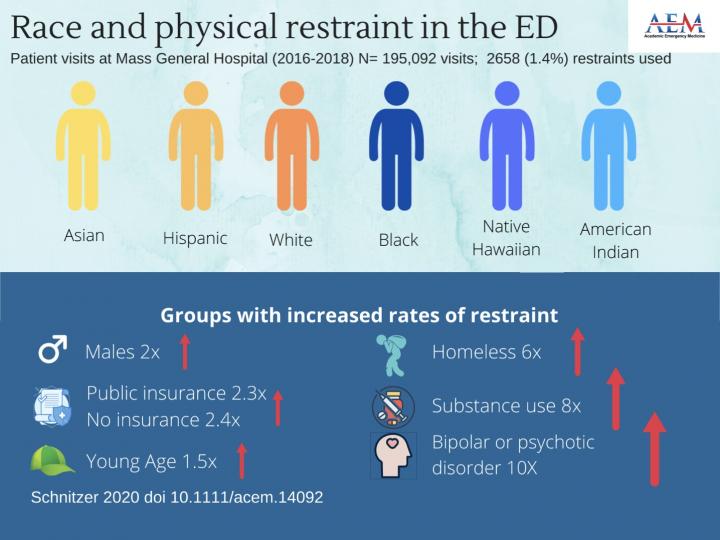
DES PLAINES, IL — A study published in the most recent issue of Academic Emergency Medicine (AEM), journal showed an increased risk of restraint use in Black patients compared with white patients in the emergency setting. The risk was not increased in other races or Hispanic/Latino ethnicity.

The lead author of the single-center study is Dr. Kristina Schnitzer MD, a psychiatrist in the Schizophrenia Clinical and Research Program at Massachusetts General Hospital and an instructor at Harvard Medical School. The findings of the study are discussed with two of the authors in episode 43 of AEM Early Access, a FOAMed podcast collaboration between the Academic Emergency Medicine Journal and Brown Emergency Medicine.

The increased risk of restraint was present in Black patients after controlling for other variables, including repeated visits, using a specialized regression technique. Concerning data also showed that 7-8 percent of all patients with psychosis or bipolar disorder, and six percent of all homeless patients were restrained. The study also identifies that there is an increased risk of patients to be restrained who are on public insurance or uninsured.

The study results warrant a careful examination of current practices and potential biases in utilization of restraint in emergency settings.

###

ABOUT ACADEMIC EMERGENCY MEDICINE

Academic Emergency Medicine, the monthly journal of Society for Academic Emergency Medicine, features the best in peer-reviewed, cutting-edge original research relevant to the practice and investigation of emergency care. The above study is published open access and can be downloaded by following the DOI link: 10.1111/acem.14092. Journalists wishing to interview the authors may contact Stacey Roseen at [email protected].

ABOUT THE SOCIETY FOR ACADEMIC EMERGENCY MEDICINE

SAEM is a 501(c)(3) not-for-profit organization dedicated to the improvement of care of the acutely ill and injured patient by leading the advancement of academic emergency medicine through education and research, advocacy, and professional development. To learn more, visit saem.org.

Media Contact
Stacey Roseen
[email protected]

Related Journal Article

http://dx.doi.org/10.1111/acem.14092

Tags: Critical Care/Emergency MedicineGuidelines/Treaties/AgreementsHealth Care Systems/ServicesHealth ProfessionalsHomelessnessMedical/Scientific EthicsMedicine/HealthMinoritiesPublic HealthTrauma/Injury
Share12Tweet8Share2ShareShareShare2

Related Posts

Pharmacogenomics Enhances Transplant Outcomes: Recent Insights

February 3, 2026

Probes Uncover Dynamics of Gαs Protein Signaling

February 3, 2026

Skin-to-Skin Care Benefits Infants with Kidney Failure

February 3, 2026

Why Undernutrition Policies Fail in Mozambique

February 3, 2026
Please login to join discussion

POPULAR NEWS

  • Enhancing Spiritual Care Education in Nursing Programs

    158 shares
    Share 63 Tweet 40
  • Robotic Ureteral Reconstruction: A Novel Approach

    81 shares
    Share 32 Tweet 20
  • Digital Privacy: Health Data Control in Incarceration

    63 shares
    Share 25 Tweet 16
  • Study Reveals Lipid Accumulation in ME/CFS Cells

    57 shares
    Share 23 Tweet 14

About

We bring you the latest biotechnology news from best research centers and universities around the world. Check our website.

Follow us

Recent News

Pharmacogenomics Enhances Transplant Outcomes: Recent Insights

Probes Uncover Dynamics of Gαs Protein Signaling

Skin-to-Skin Care Benefits Infants with Kidney Failure

Subscribe to Blog via Email

Enter your email address to subscribe to this blog and receive notifications of new posts by email.

Join 73 other subscribers
  • Contact Us

Bioengineer.org © Copyright 2023 All Rights Reserved.

Welcome Back!

Login to your account below

Forgotten Password?

Retrieve your password

Please enter your username or email address to reset your password.

Log In
No Result
View All Result
  • Homepages
    • Home Page 1
    • Home Page 2
  • News
  • National
  • Business
  • Health
  • Lifestyle
  • Science

Bioengineer.org © Copyright 2023 All Rights Reserved.


