COLUMBUS, Ohio – Acute spinal cord injury (SCI) patients lose body weight and muscle mass, despite being on a high-calorie diet while in the intensive care unit. Their muscle wasting is substantial and extends beyond what can explained by inactivity or denervation (loss of nerve supply) alone.
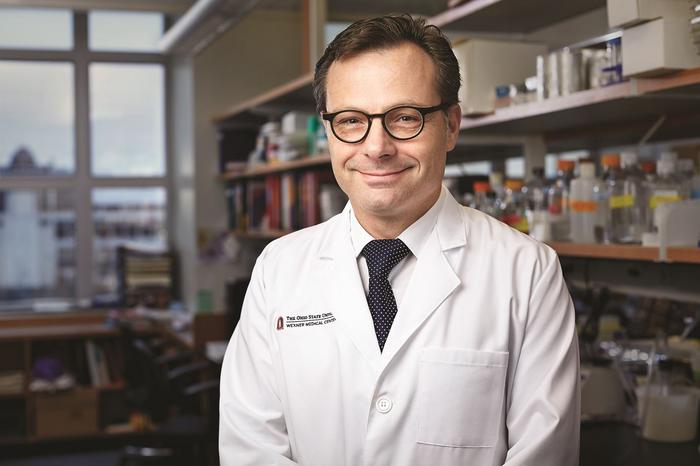
Credit: The Ohio State University Wexner Medical Center
COLUMBUS, Ohio – Acute spinal cord injury (SCI) patients lose body weight and muscle mass, despite being on a high-calorie diet while in the intensive care unit. Their muscle wasting is substantial and extends beyond what can explained by inactivity or denervation (loss of nerve supply) alone.
Research led by The Ohio State University Wexner Medical Center and College of Medicine published in the journal Science Translational Medicine sheds new light and decodes early muscle loss after SCI to provide an unprecedent first understanding that muscle wasting is:
- rapid and severe
- a systemic phenomenon
- glucocorticoid dependent
Researchers found that the severity of this SCI-induced systemic muscle wasting depends on location of the spinal cord injury (lesion level). More precisely, it depends on whether the adrenal gland becomes denervated after high thoracic injury (above T5), or not (after low thoracic injury).
These findings have direct clinical ramifications.
“Patients with a low body mass index (BMI) have a much higher risk to die shortly after suffering a spinal cord injury. With a better understanding of this muscle wasting and aggravated weight loss, we hope to explore new ways to reduce deaths in this fragile patient population,” said Jan Schwab, MD, PHD, the William E. Hunt & Charlotte M. Curtis Chair and a professor of neurology and neurosciences at the Ohio State College of Medicine.
Researchers found that systemic muscle loss is worsened when the adrenal glands become deprived of central nervous system control resulting in a skewed hormonal (endocrine) tone. When this happens, hypercortisolism (excess cortisol release) often develops after the spinal cord injury.
“This hypercortisolism then acts on specific receptors in the muscle of the entire body to cause muscle loss. Interfering with this pathway could rescue muscle tissue and improve the response to rehabilitation,” said first author Markus Harrigan, a member of Schwab’s research lab and Ohio State’s dual-degree MD-PhD Medical Scientist Training Program as well as a Ruth L. Kirschstein Individual NIH-Research Fellow.
This research also provides new insights on how to maintain muscle integrity while reducing the risk to develop higher degree pressure ulcers that often plague these patients, Harrigan said. The study builds on previous Ohio State research into the effects of SCI on the immune system that undermine immune system function, enhance infection susceptibility and contribute to infectious complications.
“We now start to understand how an injury of the spinal cord leads to spinal cord disease affecting the entire body,” said Schwab, who is also medical director of the Belford Center for Spinal Cord Injury and a Scholar of the Chronic Brain Injury Initiative at Ohio State. “Our future research will search for ways to block these complications and protect the adrenal gland from receiving ‘false’ autonomic nervous system information originating from the spinal cord below the lesion site.”
Ohio State scientists collaborated with researchers in Berlin, Germany, along with Nationwide Children’s Hospital in Columbus, Ohio, and the University of Missouri.
This research is supported by funding from the National Institutes of Health (NIH)/National Institute of Neurological Disorders and Stroke grant F31NS117124; The Ohio State University Center for Muscle Health and Neuromuscular Disorders grant; NIH/National Institute of Neurological Disorders and Stroke grant 5R35NS111582; NIH/ National Institute of Disability, Independent Living and 855 Rehabilitation Research grant 90SI5020; NIH/National Institute of Neurological Disorders and Stroke grant R01NS118200; Craig H. Neilsen Foundation grant 596764; European Union Era Net – Neuron Program, SILENCE grant 01EW170A; Wings for Life Spinal Cord Research Foundation grant, and the William E. Hunt and Charlotte M. Curtis Endowment.
# # #
Note to reporters: More information, including a copy of the paper, can be found online at the Science Translational Medicine press package at https://www.eurekalert.org/press/medpak/.
Journal
Science Translational Medicine
DOI
10.1126/scitranslmed.adh2156
Method of Research
Experimental study
Subject of Research
Animals
Article Title
Lesion-level dependent systemic muscle wasting after spinal cord injury is mediated by glucocorticoid signaling in mice
Article Publication Date
20-Dec-2023
COI Statement
The authors have no competing interests to declare.