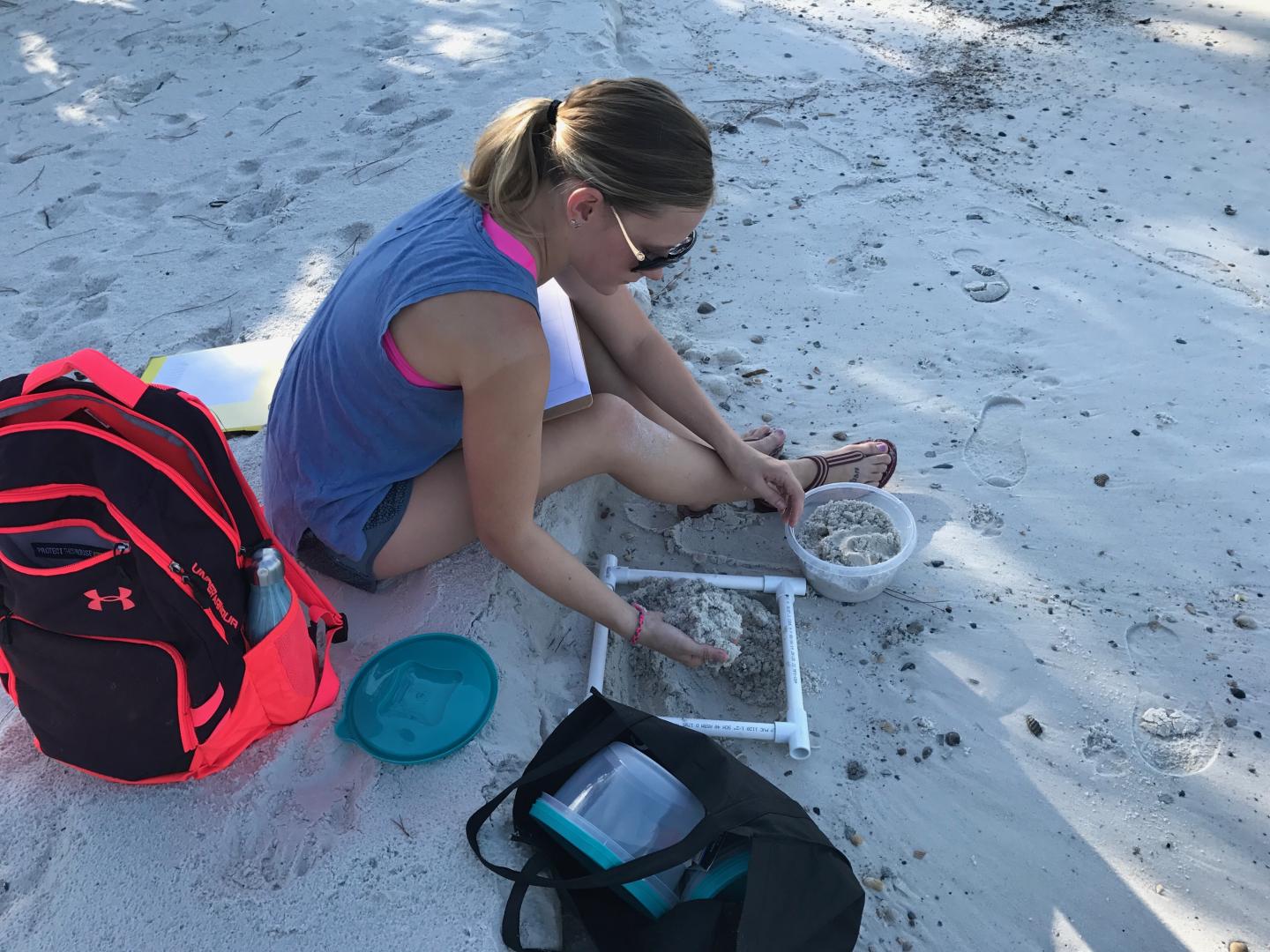
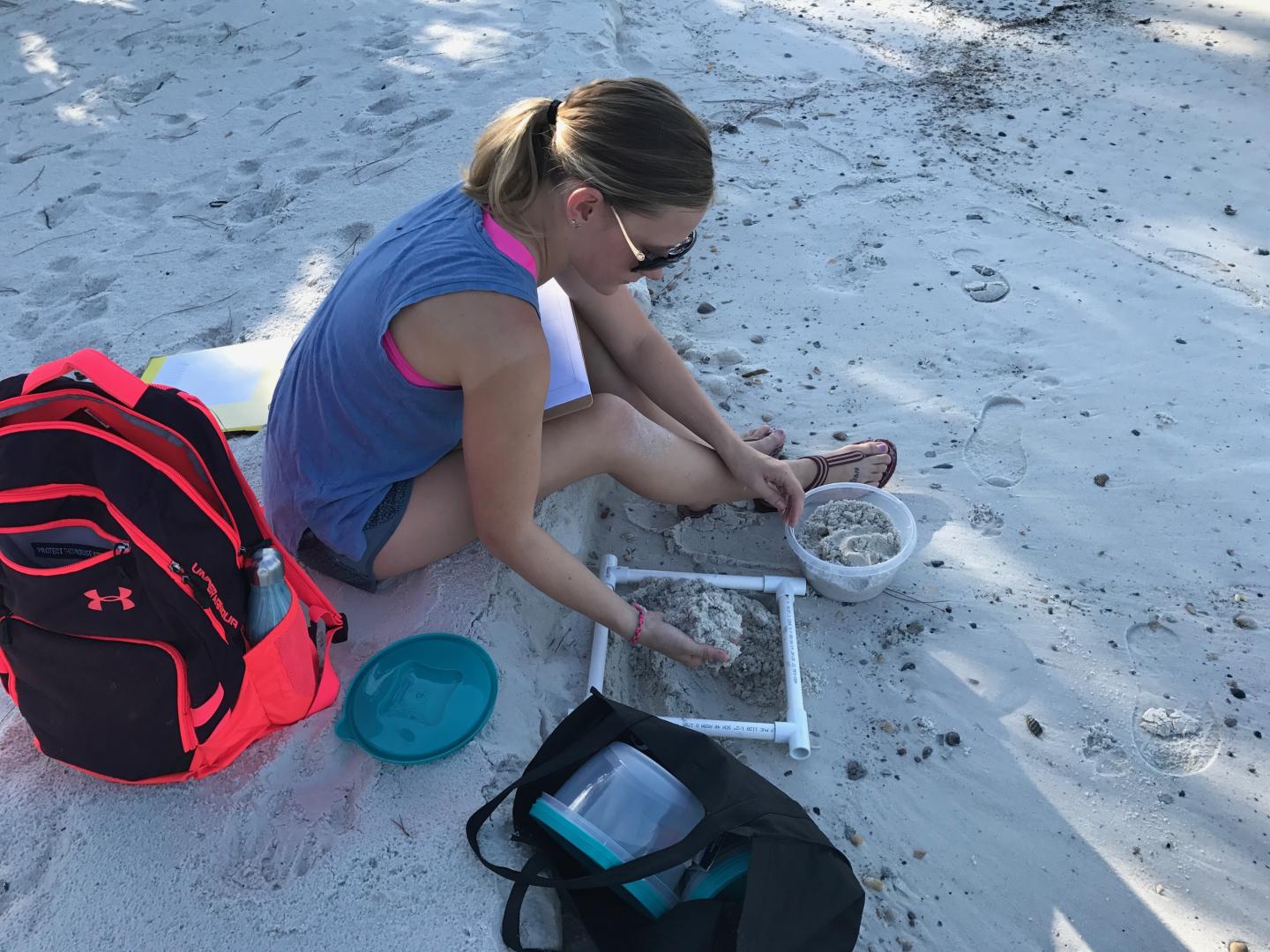
Credit: Victoria Beckwith
TALLAHASSEE, Fla. — Plastic is famous for its unyielding durability, making it perfect for consumer products but a unique and persistent menace to the natural environment.
For the loggerhead sea turtles that nest on the once-pristine beaches bounding the Gulf of Mexico, millimeters-thick pieces of broken down plastic — called microplastics — pose a particularly urgent threat.
A new study from Florida State University researchers shows that increasing microplastic accumulation along the Gulf's beaches could alter the composition of shoreline sand and jeopardize the turtles' sensitive incubation environments.
Their findings were published in the journal Marine Pollution Bulletin.
"With increasing populations, higher demand for resources and more use of plastic, we're having a lot more plastic and microplastic appearing as marine debris," said the study's coauthor Mariana Fuentes, assistant professor of Earth, Ocean and Atmospheric Science (EOAS). "In these coastal areas, we're seeing significantly more pollution."
For the study, EOAS student researcher Valencia Beckwith surveyed the Northern Gulf of Mexico Loggerhead Recovery Unit's 10 most important loggerhead turtle nesting sites in Florida.
Sand samples collected throughout the region revealed that microplastics were present at every site. More alarming, the highest concentrations of microplastics were found consistently in the dunes, where sea turtles tend to nest.
Plastic has a tendency to retain large amounts of heat in response to comparably moderate increases in temperature. If enough plastic is present in a sandy environment, the area could experience measurable temperature increases.
This dynamic is of particular concern in sea turtle nests, Fuentes said. For marine turtle eggs, incubation temperature is destiny.
"Sea turtles have temperature dependent sex determination, which means their sex is determined by the sand temperature," Fuentes said. "Changes in incubation temperatures might modify the sex ratios produced on these nesting beaches, but at this stage we don't know how much microplastic is needed to see those changes."
In subsequent research, Beckwith and Fuentes plan to expand upon these findings and investigate the specific ways that microplastic might alter the temperature profile of the sediment on important nesting beaches.
"The first step was to see whether sea turtles are exposed to microplastics," she said. "Next we'll explore its potential impacts."
Earth's oceans have long been blighted by pollution, and vulnerable species like sea turtles have borne the brunt of decades of irresponsible waste. But Fuentes remains optimistic about the future. She said that shifting attitudes could translate into positive changes in policy and behavior.
"There is a lot of hope," Fuentes said. "We're beginning to see more and more initiatives providing incentives to discourage the use of plastics. I see my students making those changes every day. It's up to everyone."
###
Media Contact
Zack Boehm
[email protected]
850-645-1504
@floridastate
http://www.fsu.edu
Original Source
http://news.fsu.edu/news/science-technology/2018/05/01/study-shows-sea-turtle-nesting-beaches-threatened-by-microplastic-pollution/ http://dx.doi.org/10.1016/j.marpolbul.2018.04.001