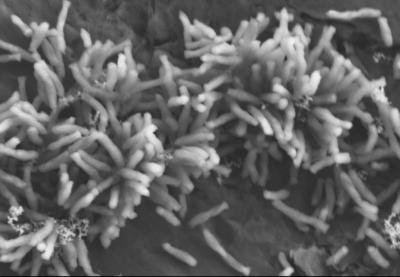
Credit: Image courtesy Bose laboratory, Washington University
New research from Washington University in St. Louis explains the cellular processes that allow a sun-loving microbe to “eat” electricity — transferring electrons to fix carbon dioxide to fuel its growth.
Led by Arpita Bose, assistant professor of biology in Arts & Sciences, and Michael Guzman, a PhD candidate in her laboratory, a Washington University team showed how a naturally occurring strain of Rhodopseudomonas palustris takes up electrons from conductive substances like metal oxides or rust. The work is described in a March 22 paper in the journal Nature Communications.
The study builds on Bose’s previous discovery that R. palustris TIE-1 can consume electrons from rust proxies like poised electrodes, a process called extracellular electron uptake. R. palustris is phototrophic, which means that it uses energy from light to carry out certain metabolic processes. The new research explains the cellular sinks where this microbe dumps the electrons it eats from electricity.
“It clearly shows for the first time how this activity — the ability for the organism to eat electricity — is connected to carbon dioxide fixation,” said Bose, a Packard Fellow who studies microbial metabolisms and their influence on biogeochemical cycling.
This mechanistic knowledge can help inform efforts to harness the microbe’s natural ability for sustainable energy storage or other bioenergy applications — a potential that has caught the attention of the Department of Energy and Department of Defense.
“R. palustris strains can be found in wild and exotic places like a rusty bridge in Woods Hole, Massachusetts where TIE-1 was isolated from,” Bose said. “Really, you can find these organisms everywhere. This suggests that extracellular electron uptake might be very common.”
Guzman added: “The main challenge is that it’s an anaerobe, so you need to grow it in an environment that doesn’t have oxygen in order for it to harvest light energy. But the flip side to that is that those challenges are met with a lot of versatility in this organism that a lot of other organisms don’t have.”
In their new paper, the researchers showed that the electrons from electricity enter into proteins in the membrane that are important for photosynthesis. Surprisingly, when they deleted the microbe’s ability to fix carbon dioxide, they observed a 90 percent reduction in its ability to consume electricity.
“It really wants to fix carbon dioxide using this system,” Bose said. “If you take it away — this innate ability — it just doesn’t want to take up electrons at all.”
She said that the reaction is similar in some ways to a rechargeable battery.
“The microbe uses electricity to charge its redox pool, storing up the electrons and making it highly reduced,” Bose said. “To discharge it, the cell reduces carbon dioxide. The energy for all this comes from sunlight. The whole process keeps repeating itself, allowing the cell to make biomolecules with nothing more than electricity, carbon dioxide and sunlight.”
An all-Washington University team overcame a number of technical hurdles to complete this study. Mark Meacham from the McKelvey School of Engineering helped to design and fabricate the microfluidic devices that allowed the researchers to hone in on the activities that were taking place in cells as the bacteria fed from electricity sources. The team also relied on support from collaborators including David Fike in the earth and planetary sciences department, who helped Bose and Guzman to use secondary ion mass spectrometry to determine how the microbe uses carbon dioxide.
The new research answers basic science questions and provides plenty of opportunity for future bioenergy applications.
“For a long time, people have known that microbes can interact with analogues of electrodes in the environment — that is, minerals that are also charged,” Guzman said. “But no one really appreciated how this process could also be done by photoautotrophs, such as these types of organisms that fix their own carbon and use light to make energy. This research fills a poorly understood gap in the field.”
Bose’s lab is working on using these microbes to make bioplastics and biofuels.
“We hope that this ability to combine electricity and light to reduce carbon dioxide might be used to help find sustainable solutions to the energy crisis,” Bose said.
###
Media Contact
Talia Ogliore
[email protected]
Original Source
https:/
Related Journal Article
http://dx.