• HOME
  • NEWS
  • EXPLORE
    • CAREER
      • Companies
      • Jobs
    • EVENTS
    • iGEM
      • News
      • Team
    • PHOTOS
    • VIDEO
    • WIKI
  • BLOG
  • COMMUNITY
    • FACEBOOK
    • INSTAGRAM
    • TWITTER
Friday, December 19, 2025
BIOENGINEER.ORG
No Result
View All Result
  • Login
  • HOME
  • NEWS
  • EXPLORE
    • CAREER
      • Companies
      • Jobs
        • Lecturer
        • PhD Studentship
        • Postdoc
        • Research Assistant
    • EVENTS
    • iGEM
      • News
      • Team
    • PHOTOS
    • VIDEO
    • WIKI
  • BLOG
  • COMMUNITY
    • FACEBOOK
    • INSTAGRAM
    • TWITTER
  • HOME
  • NEWS
  • EXPLORE
    • CAREER
      • Companies
      • Jobs
        • Lecturer
        • PhD Studentship
        • Postdoc
        • Research Assistant
    • EVENTS
    • iGEM
      • News
      • Team
    • PHOTOS
    • VIDEO
    • WIKI
  • BLOG
  • COMMUNITY
    • FACEBOOK
    • INSTAGRAM
    • TWITTER
No Result
View All Result
Bioengineer.org
No Result
View All Result
Home NEWS Science News Biology

Study shows first evidence bacterial-induced apoptosis in algae

Bioengineer by Bioengineer
March 21, 2019
in Biology
Reading Time: 2 mins read
0
IMAGE
Share on FacebookShare on TwitterShare on LinkedinShare on RedditShare on Telegram

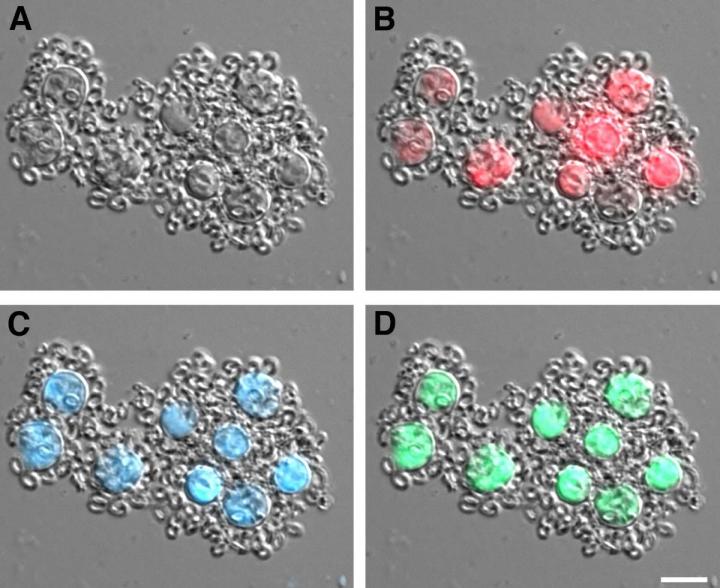
University of Alberta microbiologists demonstrate apoptosis via bacterial pathogens in single-celled algae.
IMAGE

Credit: Anna Bramucci, University of Alberta

A new study by UAlberta biologists shows the first evidence of apoptosis, or programmed cell death in algae. The outcomes have broad-reaching implications, from the development of targeted antibiotics to the production of biofuels in industry.

“It sounds odd, but programmed cell death is important to all large organisms. For any cells to differentiate, they have to be able to kill cells. For example, if you injure yourself, your scab is formed with these killed-off cells,” explained Rebecca Case, associate professor in UAlberta’s Department of Biological Sciences. “Here at the single-cell level, we’ve found that small molecules are passed from bacteria into the host algae. By doing that, the bacteria are able to tell the algae to kill itself.”

Until now, programmed cell death, also known as apoptosis, was thought to only occur in large, multicellular organisms such as animals and humans. This research shows that bacteria that live on single-cellular algae can cause programmed cell death. “It is the first documentation of true apoptosis via bacterial pathogens in microorganisms like algae,” said Case, who conducted the work with PhD graduate Anna Bramucci.

One potential application of this research is in drug discovery and development. Unlike traditional antibiotics, which kill all bacteria, this research can be applied to develop drugs with a more fine-tuned approach, turning individual bacteria or cells on and off. Previously Cas and colleagues have used this approach to find antibiotics that are effective at concentrations up to 1,000 times lower than traditional antibiotics.

“In interactions like these that occur in close proximity you can find molecules that are effective in very small concentrations,” said Case. “Going forward, that’s what we want–really potent molecules.”

Another area of interest is in natural fuels derived from living matter, called biofuels. “Algae can also be used to create lipids for biofuels,” explained Case. “If we can better understand their life cycles, we can find ways to keep them alive for longer, to produce more fuel for industry.”

###

The paper, “Phaeobacter inhibens induces apoptosis-like programmed cell death in calcifying Emiliania huxleyi,” was published in Scientific Reports (doi: 10.1038/s41598-018-36847-6).

Media Contact
Andrew Lyle
[email protected]

Related Journal Article

http://dx.doi.org/10.1038/s41598-018-36847-6

Tags: BacteriologyBiologyCell BiologyMicrobiology
Share12Tweet8Share2ShareShareShare2

Related Posts

BBX Gene Family Boosts Anthocyanin in Eggplant

BBX Gene Family Boosts Anthocyanin in Eggplant

December 19, 2025
Lactylation Insights Reveal Fat Deposit Regulation in Pigs

Lactylation Insights Reveal Fat Deposit Regulation in Pigs

December 18, 2025

Lanthipeptides Linked to Genetic Exchange in Prokaryotes

December 18, 2025

Comparing LEGU-1 and LGMN Interactions with Proton Pump Inhibitors

December 18, 2025
Please login to join discussion

POPULAR NEWS

  • Nurses’ Views on Online Learning: Effects on Performance

    Nurses’ Views on Online Learning: Effects on Performance

    70 shares
    Share 28 Tweet 18
  • NSF funds machine-learning research at UNO and UNL to study energy requirements of walking in older adults

    70 shares
    Share 28 Tweet 18
  • Unraveling Levofloxacin’s Impact on Brain Function

    53 shares
    Share 21 Tweet 13
  • MoCK2 Kinase Shapes Mitochondrial Dynamics in Rice Fungal Pathogen

    72 shares
    Share 29 Tweet 18

About

We bring you the latest biotechnology news from best research centers and universities around the world. Check our website.

Follow us

Recent News

Measles Vaccine Uptake in Young Children in Ethiopia

Exploring Digitalization in German Palliative Care

Embracing Death: Geriatric Patients’ Perspectives Explored

Subscribe to Blog via Email

Enter your email address to subscribe to this blog and receive notifications of new posts by email.

Join 70 other subscribers
  • Contact Us

Bioengineer.org © Copyright 2023 All Rights Reserved.

Welcome Back!

Login to your account below

Forgotten Password?

Retrieve your password

Please enter your username or email address to reset your password.

Log In
No Result
View All Result
  • Homepages
    • Home Page 1
    • Home Page 2
  • News
  • National
  • Business
  • Health
  • Lifestyle
  • Science

Bioengineer.org © Copyright 2023 All Rights Reserved.