• HOME
  • NEWS
  • EXPLORE
    • CAREER
      • Companies
      • Jobs
    • EVENTS
    • iGEM
      • News
      • Team
    • PHOTOS
    • VIDEO
    • WIKI
  • BLOG
  • COMMUNITY
    • FACEBOOK
    • INSTAGRAM
    • TWITTER
Monday, October 5, 2026
BIOENGINEER.ORG
No Result
View All Result
  • Login
  • HOME
  • NEWS
  • EXPLORE
    • CAREER
      • Companies
      • Jobs
        • Lecturer
        • PhD Studentship
        • Postdoc
        • Research Assistant
    • EVENTS
    • iGEM
      • News
      • Team
    • PHOTOS
    • VIDEO
    • WIKI
  • BLOG
  • COMMUNITY
    • FACEBOOK
    • INSTAGRAM
    • TWITTER
No Result
View All Result
Bioengineer.org
No Result
View All Result
Home NEWS Science News Biology

Study shines new light on how Salmonella ‘die’ at low temperatures

Bioengineer by Bioengineer
February 9, 2018
in Biology
Reading Time: 2 mins read
0
Share on FacebookShare on TwitterShare on LinkedinShare on RedditShare on Telegram
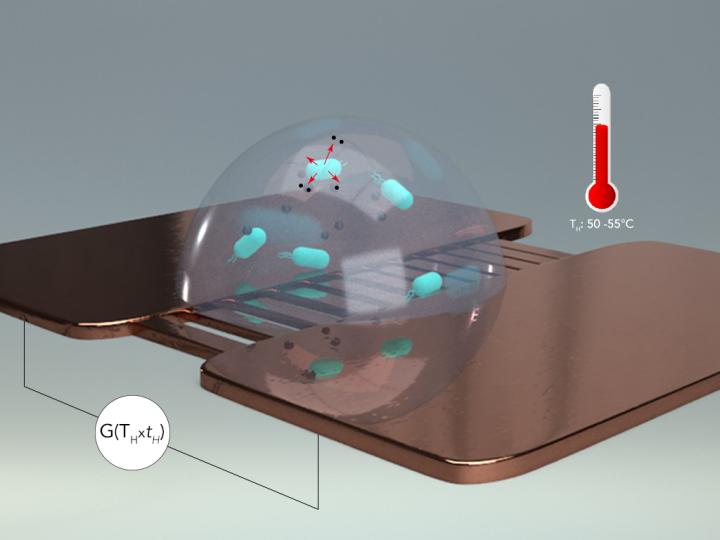
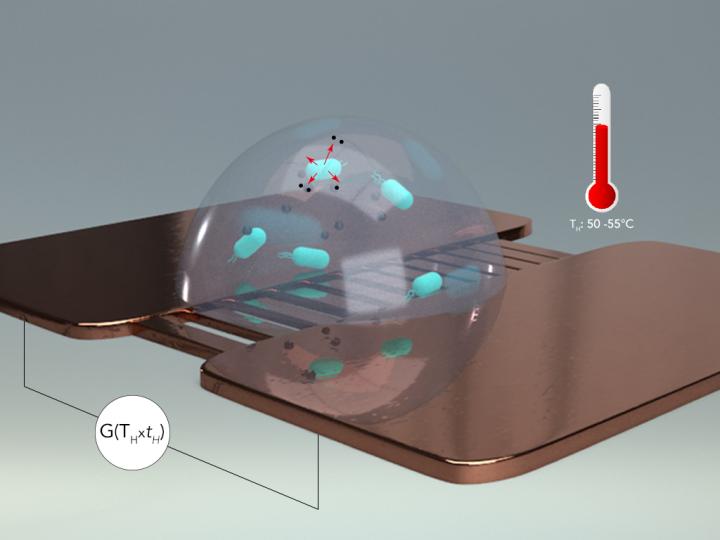
IMAGE

Credit: Jennifer McCann / Penn State

The most economical way to kill bacteria that cause common food-borne illnesses — mostly caused by Salmonella enterica — is heat, but, the mechanisms that kill Salmonella at lower temperatures were not fully understood until now, according to a team of researchers.

Bacteria can develop ways to cope with heat shock, so it is important to develop a complete understanding of how heat kills them, the researchers said.

Using droplet-based electrical sensors she developed while a doctoral student at Purdue University, Aida Ebrahimi, assistant professor of electrical engineering, Penn State, determined that mild heat stress at temperatures around 120 degrees Fahrenheit damages the bacteria's cell wall without rupturing them.

"We had a hypothesis that the Salmonella bacterium might die due to leakage of the cell wall," Ebrahimi said. "If you heat them, the lipids that make up the cell wall vibrate. As the cell wall weakens, it can allow small molecules to leak out. Because these small molecules are mostly ionic, we expected a change of the electrical conductance."

In order to prove their hypothesis, the team developed a sensor that was sensitive to the changes in electrical conductance of the growth medium. As the bacteria's cell wall lost integrity, charged molecules were ejected from the cells into the solution containing the bacteria, and consequently the electrical conductivity of the solution changed.

The researchers conducted multiple experiments using both wild-type and heat-resistant Salmonella bacteria and correlated the electrical results with fluorescence measurement and standard microbiology protocols. The modified bacteria required higher energy to make the cell membranes permeable enough to leak small molecules. The team also studied heating time and heating method, either a slower ramp-up of heat or a sudden pulse of heat, and found that pulsed heat was more effective at killing bacteria.

The authors of the paper appearing in the current issue of in Biophysical Journal then developed an analytical model based on their experiments that correlated membrane damage, cytoplasmic leakage and cell death. By better understanding the mechanisms of bacterial death at elevated temperatures, these findings can potentially improve food safety strategies and provide more efficient ways to deactivate bacteria using shorter duration of heating at lower temperatures.

"We know how high temperatures kill bacteria," Ebrahimi said. "But we wanted to find out why Salmonella died at lower temperatures. There are benefits to using lower temperatures, such as saving energy and retaining better nutritional quality, compared to food heated to high temperatures. But more importantly, bacteria can develop resistance to heat shock, so it is important to know how they respond to heat shock."

###

Ebrahimi's coauthors on the paper, "Analyzing Thermal Stability of Cell Membrane of Salmonella using Time-Multiplexed Impedance Sensing," are Lazlo Csonka and Muhammad Alam, Purdue University.

The National Science Foundation and a Bilsland Fellowship Award supported this work.

Media Contact

A'ndrea Elyse Messer
[email protected]
814-865-9481
@penn_state

http://live.psu.edu

Share13Tweet7Share2ShareShareShare1

Related Posts

Ribosomes Are Not All Alike: Review Maps the Rise of Specialized Protein Factories

Ribosomes Are Not All Alike: Review Maps the Rise of Specialized Protein Factories

October 5, 2026
Head Lice in Thai Schools Carry Mutations Linked to Pyrethroid Resistance

Head Lice in Thai Schools Carry Mutations Linked to Pyrethroid Resistance

October 5, 2026

Gut Bacteria Recipe Turns Ordinary Liberica Coffee Into Award-Winning Specialty Beans

October 5, 2026

AI Scientist Runs Its Own Biology Lab and Makes New Discoveries in Yeast

October 5, 2026
Please login to join discussion

POPULAR NEWS

  • Alloys That Shrink Their Own Grains: New PIX Mechanism Refines Metals With Heat Alone

    Alloys That Shrink Their Own Grains: New PIX Mechanism Refines Metals With Heat Alone

    29 shares
    Share 12 Tweet 7
  • Endurance Exercise Reshapes the Liver in Males and Females Through Distinct Molecular Routes

    29 shares
    Share 12 Tweet 7
  • Single Transcription Factor PU.1 Rapidly Converts Fibroblasts into Macrophage-Lineage Cells

    29 shares
    Share 12 Tweet 7
  • New Scale Measures How Ready Nurse Educators Really Are for the AI Era

    29 shares
    Share 12 Tweet 7

About

We bring you the latest biotechnology news from best research centers and universities around the world. Check our website.

Follow us

Recent News

Alloys That Shrink Their Own Grains: New PIX Mechanism Refines Metals With Heat Alone

Endurance Exercise Reshapes the Liver in Males and Females Through Distinct Molecular Routes

Single Transcription Factor PU.1 Rapidly Converts Fibroblasts into Macrophage-Lineage Cells

Subscribe to Blog via Email

Success! An email was just sent to confirm your subscription. Please find the email now and click 'Confirm' to start subscribing.

Join 85 other subscribers
  • Contact Us

Bioengineer.org © Copyright 2023 All Rights Reserved.

Welcome Back!

Login to your account below

Forgotten Password?

Retrieve your password

Please enter your username or email address to reset your password.

Log In
No Result
View All Result
  • Homepages
    • Home Page 1
    • Home Page 2
  • News
  • National
  • Business
  • Health
  • Lifestyle
  • Science

Bioengineer.org © Copyright 2023 All Rights Reserved.