Credit: Douglas Levere / University at Buffalo
BUFFALO, N.Y. — The Arctic is warming faster than the rest of the globe, and as it does, it's predicted to get wetter. But why? What mechanisms might drive these changes?
A new study looks to history for answers, examining what happened in the region during a period of warming some 8,000 years ago. The research finds evidence that in this ancient time, western Greenland became more humid, a trend that's often linked to increased precipitation. The study further shows that two different climactic processes may have contributed to this elevated humidity. The processes are:
- As the Arctic heats up, sea ice melts, exposing regional waters to sun, air and increased evaporation.
- As the planet warms, humidity increases more in regions closer to the equator. This creates an imbalance in global humidity, and eventually, moist air from lower latitudes is drawn into the drier Arctic.
"We used geologic evidence to determine that both of these processes likely contributed to an increase in humidity in western Greenland when the region warmed rapidly 8,000 years ago," says lead researcher Elizabeth Thomas, PhD, assistant professor of geology in the University at Buffalo College of Arts and Sciences. "As such, both processes could be at play again today, contributing to possible future increases in Arctic humidity, and ultimately, precipitation."
"We don't have long or detailed written records of Arctic precipitation, so we don't fully understand how precipitation might increase in response to warming," she says. It's an important area of study, she adds, because, "precipitation in the Arctic has complex interactions with climate, and it also impacts plant communities and affects how fast glaciers may shrink."
The study was published this month in Geophysical Research Letters by a team of scientists from UB, the University of Massachusetts and Northern Arizona University. The research was funded by the National Science Foundation.
Clues in lakebed mud
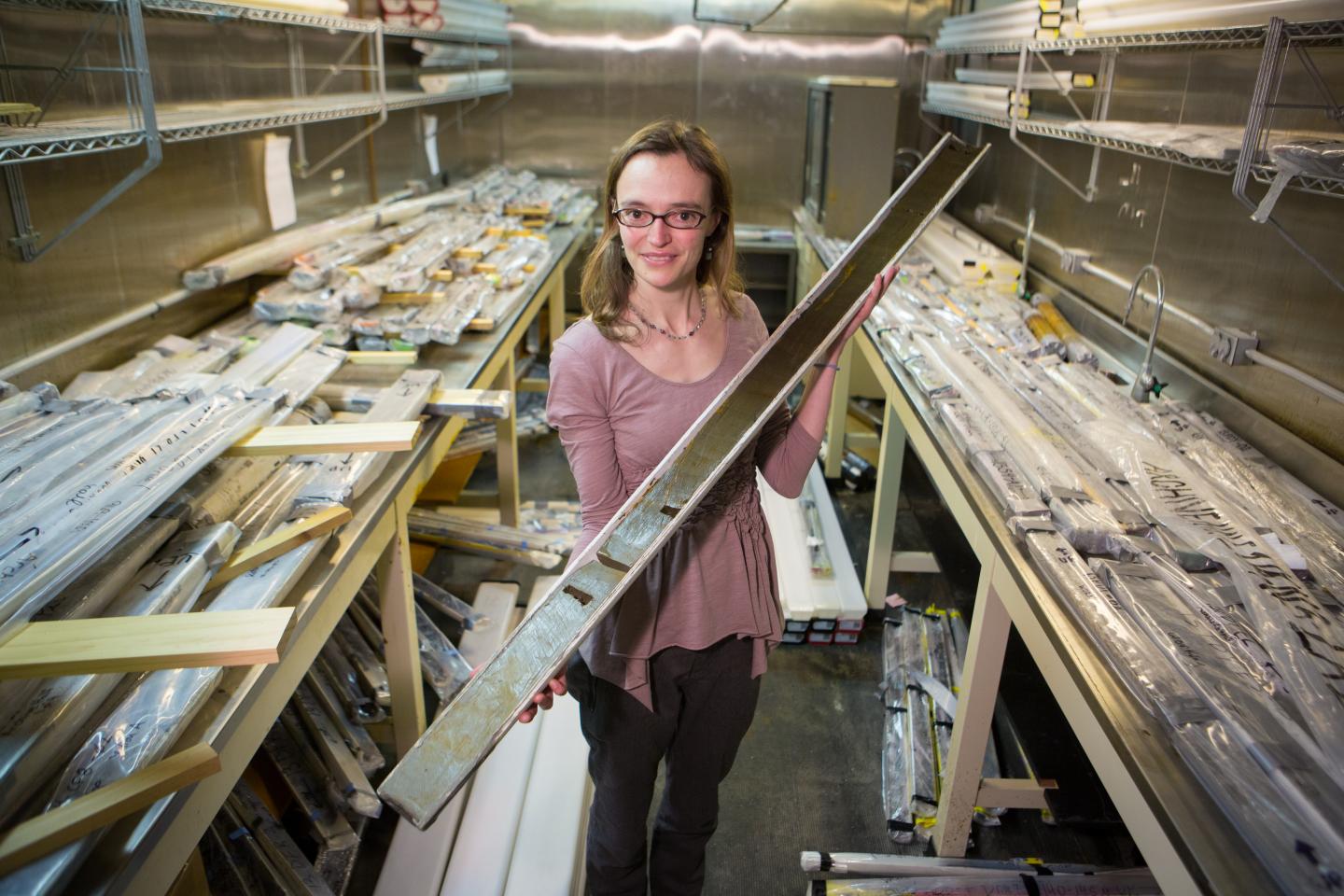
To learn about the climate history of western Greenland, scientists analyzed lakebed mud dating back thousands of years. This sediment contains organic matter — such as ancient leaf waxes, and compounds produced by bacteria — that reveal information about the region's climatic past.
As Thomas explains, when it comes to leaf waxes, weather influences the chemical content of these waxes in ways that scientists can trace. Specifically, leaf waxes contain small amounts of a rare form of hydrogen called deuterium, and the concentration of deuterium can go up or down in response to factors such as humidity and precipitation patterns. (One example: In Arctic leaf waxes, deuterium concentrations fluctuate depending on whether precipitation originated locally or from clouds that traveled long distances from low latitudes to arrive in the region).
Chemicals called branched glycerol dialkyl glycerol tetraethers (GDGTs), produced by bacteria, also hold clues about past climate. The composition of these compounds varies depending on the temperature of the surrounding environment at the time they were produced. As a result, scientists can use branched GDGTs to reconstruct prehistoric temperature trends, Thomas says.
These chemical indicators enabled Thomas' team to investigate ancient humidity and precipitation trends in western Greenland as the region warmed some 8,000 years ago. The new research was based on leaf waxes and branched GDGTs found in a sediment sample that the team extracted from the bottom of Sikuiui Lake in western Greenland.
"These chemical indicators are fairly new tools, and they enable us to research ancient climate in ways that were not possible before," Thomas says. "We can use these tools to investigate how humidity fluctuated in a region thousands of years ago, or whether storms in an area originated locally or far away. This is important because understanding what happened in ancient times can provide us with insight into what might happen today as the climate changes."
###
Media Contact
Charlotte Hsu
[email protected]
716-645-4655
@UBNewsSource
http://www.buffalo.edu
Original Source
http://www.buffalo.edu/news/releases/2018/10/055.html http://dx.doi.org/10.1029/2018GL079517