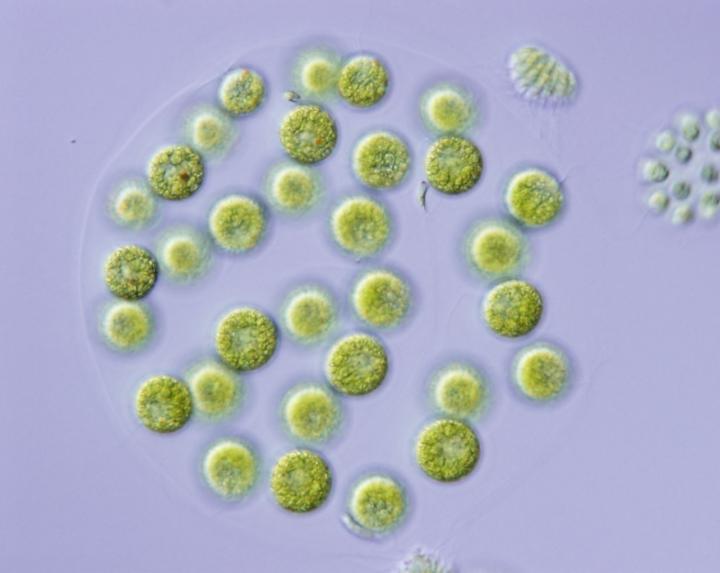
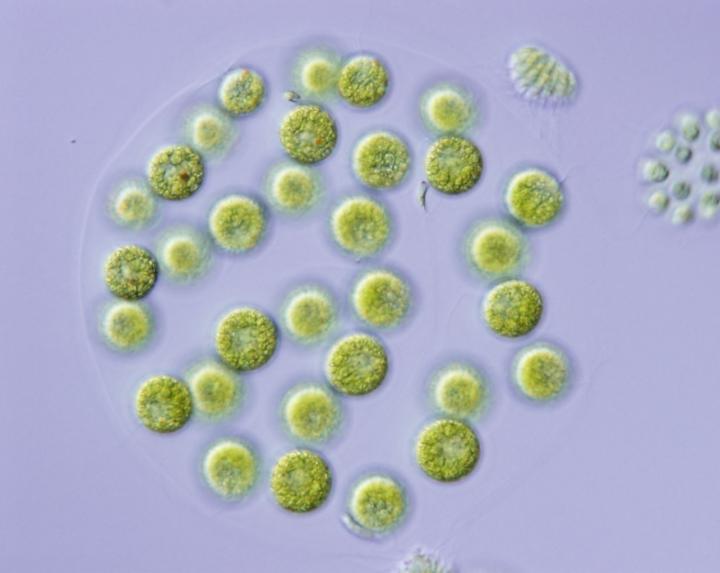
Credit: Hiroko Kawai-Toyooka, University of Tokyo.
ST. LOUIS, MO, March 8, 2018 – A new study published in the journal Communications Biology has shed light on the earliest stages in the evolution of male-female differentiation and sex chromosomes–and found the genetic origins of the two sexes to be unexpectedly modest.
James Umen, Ph.D., member, Enterprise Rent-a-Car Institute for Renewable Fuels and Joseph Varner Distinguished Investigator at the Donald Danforth Plant Science Center was part of a research team led by Dr. Hisayoshi Nozaki at the University of Tokyo who have been investigating the evolution of male and female sexes in a group of freshwater photosynthetic protists called volvocine green algae, a group that is well-known to scientists for capturing early stages in the evolution of sexes and multicellularity. Previous studies in animals and plants identified a general trend of expansion and differentiation between male and female sex chromosomes, often leading to large genetic differences between them; but these studies could not capture the earliest stages of evolution where distinct sperm and egg cell types first evolved from a simpler ancestral mating system with equal-sized gametes, known as isogamy.
The research team focused on two especially informative and closely-related multicellular volvocine species from the genera Yamagishiella and Eudorina which bracket the transition from isogamy to male/female sexes. While 32-celled Yamagishiella and Eudorina colonies look very similar to each other, the former is isogamous while the latter produces small male gametes and large female gametes. The team used high-throughput genome sequencing of the chromosomal regions that specify mating type in Yamagishiella and male-female differentiation in Eudorina, and then compared these regions.
While evolutionary theory predicted an expansion and/or increased genetic complexity of the sex determining region associated with the evolution of sexes in Eudorina, the results of the study showed the opposite, with Eudorina having the most diminutive and genetically least complex sex-determining region found to date found among all volvocine species. In essence, the major difference between males and females in Eudorina could be reduced to the presence or absence of a single gene called MID that resides in a tiny chromosomal region.
"This new study punches a hole in the idea that increased genetic complexity of sex chromosomes accompanied the origin of sexes," said Umen. "Moreover, the work also has practical implications since it expands our understanding of how to identify mating types and sexes in new species of algae that we might want to breed as crops for improved traits relating to biofuel or biotechnology applications."
###
About The Donald Danforth Plant Science Center
Founded in 1998, the Donald Danforth Plant Science Center is a not-for-profit research institute with a mission to improve the human condition through plant science. Research, education and outreach aim to have impact at the nexus of food security and the environment, and position the St. Louis region as a world center for plant science. The Center's work is funded through competitive grants from many sources, including the National Institutes of Health, U.S. Department of Energy, National Science Foundation, and the Bill & Melinda Gates Foundation. Follow us on Twitter at @DanforthCenter.
Media Contact
Melanie Bernds
[email protected]
314-587-1647
Original Source
https://www.danforthcenter.org/news-media/news-releases http://dx.doi.org/10.1038/s42003-018-0019-5