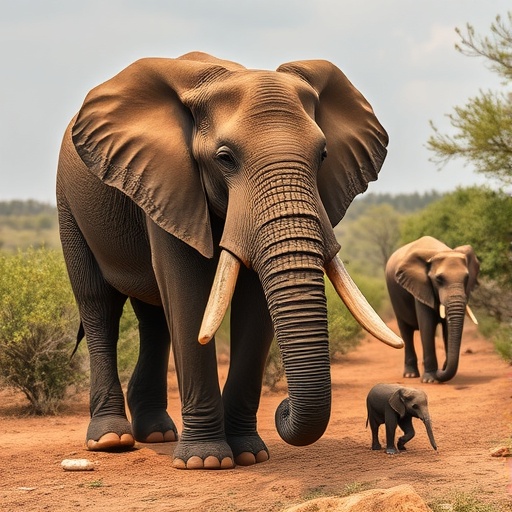
For many years, ecologists have hypothesized that the removal or extinction of a key species within an ecosystem could trigger a domino effect of declines and collapses across various interconnected species. This theory, known as coextinction, has largely remained a concept supported by models and indirect evidence—until now. Groundbreaking new research led by doctoral student Finote Gijsman at Princeton University, alongside co-author Professor Todd Palmer from the University of Florida, provides compelling real-world evidence demonstrating how the extinction of a keystone species precipitates cascading biodiversity losses and functional degradation in ecosystems.
The research focuses on the role of African elephants as a keystone species for dung beetle communities inhabiting Kenya’s expansive savannas. These large mammals not only shape the physical environment through their activities but also serve as ecological infrastructure through their waste products. When elephants were experimentally removed from selected landscapes, populations of dung beetles—an indispensable group of decomposers—dramatically declined, causing significant reverberations in the ecological processes these insects govern.
African elephants produce astonishing quantities of dung daily, feeding for up to 18 hours and consuming close to 300 pounds of vegetation each day. Their massive fecal deposits create a unique and abundant resource, attracting dung beetles that rely upon it to complete their life cycles. The study reveals that elephant dung attracts substantially more species and individuals of dung beetles than the feces of any other large herbivore in the ecosystem, highlighting the species’ central role in sustaining beetle biodiversity and, consequently, key ecosystem functions.
This research builds upon a monumental, 15-year ecological experiment at the Mpala Research Center in Kenya, known as the UHURU project. This controlled, long-term study employs a design where large fenced plots selectively exclude mammals by size: some plots exclude the largest herbivores like elephants and giraffes, others remove smaller animals, and control plots remain open. This experimental setup simulates the natural pattern of large mammal extinctions, which are often the first to decline due to their extensive home ranges and vulnerability to human pressures.
Findings from UHURU demonstrate that the absence of elephants results in a profound 67% reduction in dung beetle abundance and a 23% decline in the number of beetle species present. This loss of species tracked almost perfectly with computational models predicting coextinction patterns following the removal of the largest mammals. Intriguingly, further exclusion of other large herbivores beyond elephants caused almost no additional beetle decline, underscoring the singular importance of elephants for maintaining dung beetle biodiversity.
The consequences extend beyond beetle populations to the ecological services these insects underpin. Dung beetles play essential roles in nutrient cycling, seed dispersal, soil aeration, and parasite suppression. The absence of elephants and subsequent beetle collapse slowed dung decomposition rates and diminished seed dispersal efficacy. These shifts degrade soil fertility and increase parasite loads, undermining savanna ecosystem health and resilience.
This study reframes conservation priorities by demonstrating that elephants’ value transcends their own species preservation. Rather than being solely charismatic megafauna worthy of protection for their intrinsic qualities, elephants function as an ecological cornerstone, subsidizing a community of insects that provide indispensable ecosystem services. The economic ramifications of these services are substantial; comparable dung beetle-mediated benefits to cattle industries in the U.S. and U.K. are estimated to reach approximately $1.6 billion annually by 2026, emphasizing the global importance of conserving such keystone species.
Large mammals like elephants face heightened extinction risks compared to smaller animals due to their vast spatial requirements, slower reproductive rates, and conflicts with expanding human infrastructure. As their populations dwindle, the cascading effects on dependent species and ecosystem functions become more likely and more severe. The UHURU experiment’s long-term, controlled approach offers an unparalleled glimpse into these dynamics, revealing patterns that short-term studies could easily overlook.
The tightly coupled network between elephants and dung beetles exemplifies a broader ecological principle: ecosystems are intricate webs of interdependence, where the removal of a single pivotal node can unravel entire communities. This coextinction phenomenon highlights the fragility of biodiversity and the imperative to safeguard keystone species to maintain ecosystem integrity. By integrating empirical data, controlled experiments, and network modeling, this study sets a new standard for how ecologists can quantify and predict biodiversity loss.
Ultimately, this research not only offers a vivid illustration of ecological theory in action but also strengthens the rationale for ecosystem-based conservation strategies. Protecting elephants yields direct benefits that propagate through biotic networks, sustaining functions critical to both wildlife and human livelihoods. Conservation initiatives must therefore extend beyond charismatic species protection to consider the broader ecological infrastructure these species uphold.
In essence, the survival of elephants is inseparable from the fate of myriad other species and the complex ecological processes they collectively enable. By protecting these giants, we preserve the living networks vital for maintaining the balance and productivity of African savannas, with implications that extend globally. This landmark study redefines how we understand species interdependencies and the profound costs of extinction—not just for ecosystems but for human economies and well-being.
Subject of Research: Ecological impacts of African elephant extinction on dung beetle biodiversity and ecosystem functions
Article Title: Importance of elephants for dung beetle biodiversity and ecosystem functions
News Publication Date: 28-May-2026
Web References: 10.1126/science.aeb7062
Keywords: Conservation biology, ecosystem functions, coextinction, keystone species, dung beetles, African elephants, savanna ecology, biodiversity loss, long-term ecological experiment, nutrient cycling
Tags: African elephant ecological infrastructureAfrican savanna biodiversitycascading biodiversity lossdung beetle ecological roledung beetle population dynamicsecological functional degradationecosystem coextinction effectselephant population declinekeystone species ecosystem serviceskeystone species extinction impactsavanna ecosystem interdependencewildlife conservation and ecosystem health