• HOME
  • NEWS
  • EXPLORE
    • CAREER
      • Companies
      • Jobs
    • EVENTS
    • iGEM
      • News
      • Team
    • PHOTOS
    • VIDEO
    • WIKI
  • BLOG
  • COMMUNITY
    • FACEBOOK
    • INSTAGRAM
    • TWITTER
Wednesday, May 20, 2026
BIOENGINEER.ORG
No Result
View All Result
  • Login
  • HOME
  • NEWS
  • EXPLORE
    • CAREER
      • Companies
      • Jobs
        • Lecturer
        • PhD Studentship
        • Postdoc
        • Research Assistant
    • EVENTS
    • iGEM
      • News
      • Team
    • PHOTOS
    • VIDEO
    • WIKI
  • BLOG
  • COMMUNITY
    • FACEBOOK
    • INSTAGRAM
    • TWITTER
  • HOME
  • NEWS
  • EXPLORE
    • CAREER
      • Companies
      • Jobs
        • Lecturer
        • PhD Studentship
        • Postdoc
        • Research Assistant
    • EVENTS
    • iGEM
      • News
      • Team
    • PHOTOS
    • VIDEO
    • WIKI
  • BLOG
  • COMMUNITY
    • FACEBOOK
    • INSTAGRAM
    • TWITTER
No Result
View All Result
Bioengineer.org
No Result
View All Result
Home NEWS Science News Chemistry

Study puts spin into quantum technologies

Bioengineer by Bioengineer
February 24, 2020
in Chemistry
Reading Time: 3 mins read
0
IMAGE
Share on FacebookShare on TwitterShare on LinkedinShare on RedditShare on Telegram

The ability to control the spin of atom-like impurities in 2D material hexagonal boron-nitride demonstrated
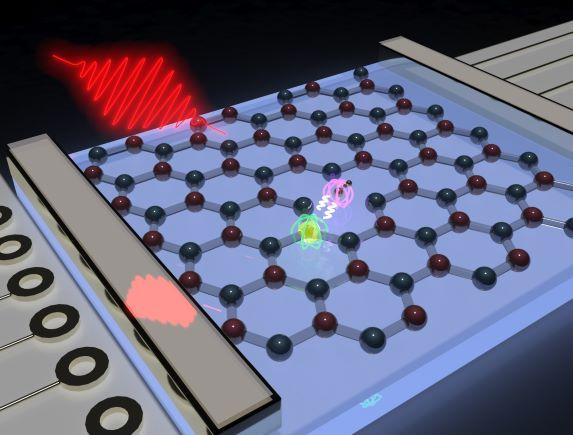
IMAGE

Credit: Dr M. Kianinia


A team of international scientists investigating how to control the spin of atom-like impurities in 2D materials have observed the dependence of the atom’s energy on an external magnetic field for the first time.

The results of the study, published in Nature Materials, will be of interest to both academic and industry research groups working on the development of future quantum applications, the researchers say.

Scientists from the University of Technology Sydney (UTS), the University of Würzburg, the Kazan Federal University and the Universidade Federal de Minas Gerais, demonstrated the ability to control the spin of atom-like impurities in 2D material hexagonal boron-nitride. By combining laser and microwave excitation the researchers were able to change the spin states, for example “up” to “down”, of atom-like impurities hosted in the material and show the dependence of their energy on an external magnetic field.

This is the first time that the phenomenon has been observed in a material that is made of a single sheet of atoms like graphene. The researchers say that this newly demonstrated quantum spin-optical properties, combined with the ease of integrating with other 2D materials and devices, establishes hexagonal boron-nitride as an intriguing candidate for advanced quantum technology hardware.

“2D atomic crystals are currently some of the most studied materials in condensed matter physics and materials science,” says UTS physicist Dr Mehran Kianinia, a co-author of the study.

“Their physics is intriguing from a fundamental point of view, but beyond that, we can think of stacking different 2D crystals to create completely new materials, heterostructures and devices with specific designer properties,” he says.

UTS researcher, Dr Carlo Bradac, a senior co-author of the study says that in addition to adding another unique property, to an already impressive range of properties for a 2D material, the discovery has enormous potential for the field of quantum sensing.

“What really excites me is the potential [in the context of quantum sensing]. These spins are sensitive to their immediate surroundings. Unlike 3D solids, where the atom-like system can be as far as a few nanometres from the object to sense, here the controllable spin is right at the surface. Our hope is to use these individual spins as tiny sensors and map, with unprecedented spatial resolution, variations in temperature, as well as magnetic and electric fields onto variations in spin” Dr Bradac says.

“Imagine, for instance, being able to measure minuscule magnetic fields with sensors as small as single atoms. The possibilities are far reaching and range from nuclear magnetic resonance spectroscopy for nanoscale medical diagnostic and material chemistry to GPS-free navigation using the Earth’s magnetic field,” he says.

However quantum-based nanoscale magnetometry is “just one area where controlling single spins in solids is useful” says senior author of the study UTS Professor Igor Aharonovich.

“Beyond quantum sensing, many quantum computing and quantum communication applications rely on our ability to control the spin-state–zero, one and anything in between–of single atom-like systems in solid host materials. This allows us to encode, store and transfer information in the form of quantum bits or qubits,” he says.

###

Media Contact
Marea Martlew
[email protected]

Related Journal Article

http://dx.doi.org/10.1038/s41563-020-0619-6

Tags: Chemistry/Physics/Materials SciencesNanotechnology/Micromachines
Share12Tweet8Share2ShareShareShare2

Related Posts

Advancing In Vivo and In Situ Monitoring: Science Bulletin Highlights Host-Based Antifouling Gold Nanotube Sensor for Selective Detection of Mechanically Sensitive Serotonin Release in Intestinal Mucosa — Chemistry

Advancing In Vivo and In Situ Monitoring: Science Bulletin Highlights Host-Based Antifouling Gold Nanotube Sensor for Selective Detection of Mechanically Sensitive Serotonin Release in Intestinal Mucosa

May 20, 2026
How Magnetic Orientation Could Influence the Building Blocks of Life — Chemistry

How Magnetic Orientation Could Influence the Building Blocks of Life

May 20, 2026

Breaking a 200-Year-Old Belief: Novel Surface Design Achieves Two Distinct Wetting States on One Substrate

May 20, 2026

Unveiling Sound Waves: Scientists Discover Hidden Behaviors in Acoustic Phenomena

May 20, 2026
Please login to join discussion

POPULAR NEWS

  • blank

    New Study Reveals Plants Can Detect the Sound of Rain

    733 shares
    Share 292 Tweet 183
  • Research Indicates Potential Connection Between Prenatal Medication Exposure and Elevated Autism Risk

    846 shares
    Share 338 Tweet 212
  • ESMO 2025: mRNA COVID Vaccines Enhance Efficacy of Cancer Immunotherapy

    298 shares
    Share 119 Tweet 75
  • Breastmilk Balances E. coli and Beneficial Bacteria in Infant Gut Microbiomes

    58 shares
    Share 23 Tweet 15

About

We bring you the latest biotechnology news from best research centers and universities around the world. Check our website.

Follow us

Recent News

CCHFV GP38 and GP85 Bind Cell-Surface Glycosaminoglycans

Machine Learning Reveals Drivers of Elderly Care Use

Detecting DSCP Traffic Manipulation and Network Impact

Subscribe to Blog via Email

Enter your email address to subscribe to this blog and receive notifications of new posts by email.

Join 82 other subscribers
  • Contact Us

Bioengineer.org © Copyright 2023 All Rights Reserved.

Welcome Back!

Login to your account below

Forgotten Password?

Retrieve your password

Please enter your username or email address to reset your password.

Log In
No Result
View All Result
  • Homepages
    • Home Page 1
    • Home Page 2
  • News
  • National
  • Business
  • Health
  • Lifestyle
  • Science

Bioengineer.org © Copyright 2023 All Rights Reserved.