• HOME
  • NEWS
  • EXPLORE
    • CAREER
      • Companies
      • Jobs
    • EVENTS
    • iGEM
      • News
      • Team
    • PHOTOS
    • VIDEO
    • WIKI
  • BLOG
  • COMMUNITY
    • FACEBOOK
    • INSTAGRAM
    • TWITTER
Tuesday, October 20, 2026
BIOENGINEER.ORG
No Result
View All Result
  • Login
  • HOME
  • NEWS
  • EXPLORE
    • CAREER
      • Companies
      • Jobs
        • Lecturer
        • PhD Studentship
        • Postdoc
        • Research Assistant
    • EVENTS
    • iGEM
      • News
      • Team
    • PHOTOS
    • VIDEO
    • WIKI
  • BLOG
  • COMMUNITY
    • FACEBOOK
    • INSTAGRAM
    • TWITTER
No Result
View All Result
Bioengineer.org
No Result
View All Result
Home NEWS Science News Agriculture

Study identifies seven Olour mango half-sib progenies with promising dwarfing traits

by
October 20, 2026
in Agriculture
Reading Time: 2 mins read
0
Study identifies seven Olour mango half-sib progenies with promising dwarfing traits

Scientists Identify Seven Dwarf Mango Rootstock Candidates for High-Density Orchards

Share on FacebookShare on TwitterShare on LinkedinShare on RedditShare on Telegram

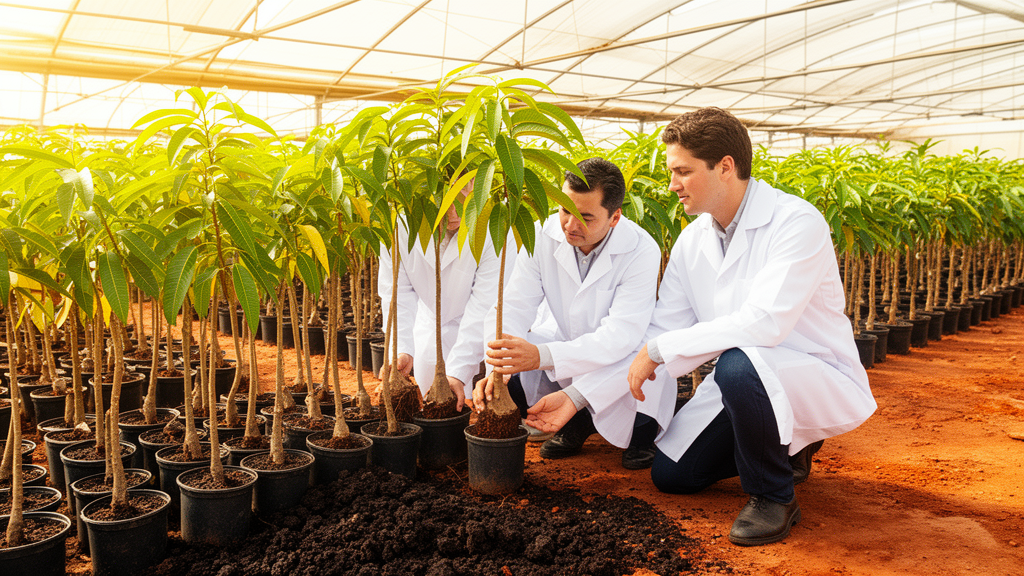
A study of 28 half-sib progenies from the Olour mango rootstock identified seven progenies—OP-17–01, OP-17–10, OP-17–19, OP-17–34, OP-17–40, OP-17–47 and OP-17–58—with promising dwarfing traits. The researchers evaluated the progenies through an integrated assessment of morphological, physiological and biochemical characteristics, then used correlation analysis, principal component analysis and hierarchical clustering to examine variation and group the plants by vigour. The study is reported here from the supplied article abstract, which does not provide the full experimental methods and results.

The seven selected progenies had lower plant heights of 1.02–1.64 m, compared with 2.01 m for the Olour parental genotype. Their stem girth ranged from 49.56 to 70.81 mm, versus 93.56 mm in the parent, while internodal length ranged from 1.82 to 2.55 cm, compared with 3.45 cm. The selected plants also had higher fresh- and dry-weight bark-to-wood ratios than the parent, apart from the specific exceptions reported for OP-17–58 on a fresh-weight basis and OP-17–40 and OP-17–58 on a dry-weight basis. These measured differences formed the basis for classifying the seven progenies as promising dwarf phenotypes.

Physiological and biochemical measurements also distinguished the selected group. The promising progenies recorded photosynthetic rates of 4.49–5.46 μmol CO2 m−2 s−1, compared with 6.29 μmol CO2 m−2 s−1 for Olour, along with lower stomatal density and decreased chlorophyll levels. The abstract reports lower transpiration rates and higher levels of total phenolics, flavonoids and antioxidant capacity in the selected progenies, with the stated compound-level exceptions. Positive associations were found between plant height, stem girth, internodal length and chlorophyll content. Bark-to-wood ratio, total phenolics, flavonoids and total antioxidant capacity were negatively associated with vigour, indicating statistical relationships rather than demonstrated causes of dwarfing.

Multivariate analysis showed moderate to high variation among the half-sib progenies. The first four principal components accounted for 76.1% of the total variation, with the first component explaining 45.86%. Two-way hierarchical clustering separated the progenies into dwarf, semi-vigorous and vigorous groups and placed the same seven selected progenies in the dwarf cluster. The authors identified reduced height, shorter internodes, lower stem girth, higher bark-to-wood ratio, and elevated phenolics and antioxidant capacity as traits associated with dwarfing. However, the abstract does not establish the effects of these plants on orchard yield, fruit quality, climate resilience or scion growth, nor does it report multi-site field validation. The selected progenies are therefore promising candidates for further rootstock evaluation and genetic research, not yet proven replacements for established mango rootstocks.

Subject of Research: Evaluation of dwarfing traits among 28 Olour mango half-sib progenies

Article Title: Dissecting dwarfness in half-sib progenies of Olour mango through morpho-physiological and biochemical characterization

Article References: Shivam, Singh, K., Prakash, J., Singh, S. K., Hussain, Z., Lama, A., Sharma, N., Shukoor, A., Dedhia, L., Singh, A., Pradhan, S., Kuldeep, & Raghav, D. (2026). Dissecting dwarfness in half-sib progenies of Olour mango through morpho-physiological and biochemical characterization. BMC Plant Biology. https://doi.org/10.1186/s12870-026-09801-2

Image Credits: AI Generated

DOI: 10.1186/s12870-026-09801-2

Keywords: Olour mango, mango rootstocks, half-sib progenies, plant dwarfing, morphological traits, physiological traits, biochemical traits, principal component analysis, hierarchical clustering, Dissecting, dwarfness, half-sib

News Source: Alan Morgan. (October 20, 2026). Study identifies seven Olour mango half-sib progenies with promising dwarfing traits. Scienmag.

Tags: biochemical traitsDissectingdwarfnesshalf-sibhalf-sib progenieshierarchical clusteringmango rootstocksmorphological traitsOlour mangoPhysiological Traitsplant dwarfingprincipal component analysis
Share12Tweet7Share2ShareShareShare1

Related Posts

Six-month factorial trial links neem treatment and rack storage to better white yam quality

Six-month factorial trial links neem treatment and rack storage to better white yam quality

October 20, 2026
Rice PML3 knockout study links Golgi manganese disruption to changes in young tissues

Rice PML3 knockout study links Golgi manganese disruption to changes in young tissues

October 20, 2026

FsMP co-transformation achieves 95% leaf transformation in optimized Forsythia hairy-root protocol

October 20, 2026

Agronomic performance and leaf-morphological evaluation of basil (Ocimum basilicum L.) germplasm under the environmental conditions of Adana

October 20, 2026

POPULAR NEWS

  • StrokeTime maps cellular responses across the mouse brain’s stroke timeline

    StrokeTime maps cellular responses across the mouse brain’s stroke timeline

    29 shares
    Share 12 Tweet 7
  • Review examines amino acid transporters as metabolic vulnerabilities in liver cancer

    29 shares
    Share 12 Tweet 7
  • Retrospective cohort reports frequent subsequent CRE infection after rectal colonization in adult ICU patients

    29 shares
    Share 12 Tweet 7
  • Study identifies seven Olour mango half-sib progenies with promising dwarfing traits

    29 shares
    Share 12 Tweet 7

About

We bring you the latest biotechnology news from best research centers and universities around the world. Check our website.

Follow us

Recent News

StrokeTime maps cellular responses across the mouse brain’s stroke timeline

Review examines amino acid transporters as metabolic vulnerabilities in liver cancer

Retrospective cohort reports frequent subsequent CRE infection after rectal colonization in adult ICU patients

Subscribe to Blog via Email

Enter your email address to subscribe to this blog and receive notifications of new posts by email.

Join 85 other subscribers
  • Contact Us

Bioengineer.org © Copyright 2023 All Rights Reserved.

Welcome Back!

Login to your account below

Forgotten Password?

Retrieve your password

Please enter your username or email address to reset your password.

Log In
No Result
View All Result
  • Homepages
    • Home Page 1
    • Home Page 2
  • News
  • National
  • Business
  • Health
  • Lifestyle
  • Science

Bioengineer.org © Copyright 2023 All Rights Reserved.