

• HOME
  • NEWS
  • EXPLORE
    • CAREER
      • Companies
      • Jobs
    • EVENTS
    • iGEM
      • News
      • Team
    • PHOTOS
    • VIDEO
    • WIKI
  • BLOG
  • COMMUNITY
    • FACEBOOK
    • INSTAGRAM
    • TWITTER
Tuesday, September 1, 2026
BIOENGINEER.ORG
No Result
View All Result
  • Login
  • HOME
  • NEWS
  • EXPLORE
    • CAREER
      • Companies
      • Jobs
        • Lecturer
        • PhD Studentship
        • Postdoc
        • Research Assistant
    • EVENTS
    • iGEM
      • News
      • Team
    • PHOTOS
    • VIDEO
    • WIKI
  • BLOG
  • COMMUNITY
    • FACEBOOK
    • INSTAGRAM
    • TWITTER
  • HOME
  • NEWS
  • EXPLORE
    • CAREER
      • Companies
      • Jobs
        • Lecturer
        • PhD Studentship
        • Postdoc
        • Research Assistant
    • EVENTS
    • iGEM
      • News
      • Team
    • PHOTOS
    • VIDEO
    • WIKI
  • BLOG
  • COMMUNITY
    • FACEBOOK
    • INSTAGRAM
    • TWITTER
No Result
View All Result
Bioengineer.org
No Result
View All Result
Home NEWS Science News Technology

Study identifies Europe’s most critical wetlands for climate action

Bioengineer by Bioengineer
July 15, 2026
in Technology
Reading Time: 2 mins read
0
Study identifies Europe’s most critical wetlands for climate action
Share on FacebookShare on TwitterShare on LinkedinShare on RedditShare on Telegram

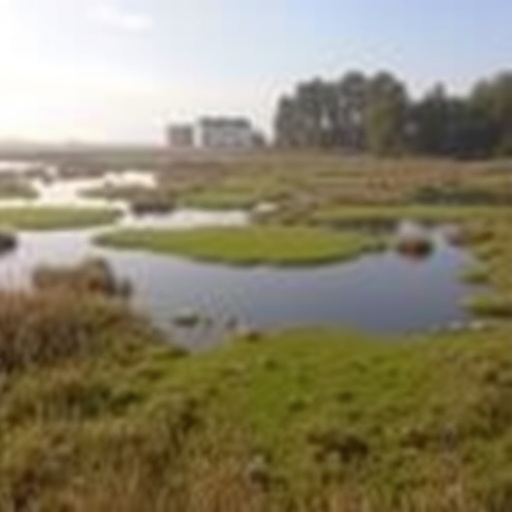
Europe’s wetlands—once widespread across the continent—have long supported wildlife, protected plants, and sustained human communities. But centuries of drainage, agriculture, and extraction have dramatically altered these ecosystems. Today, half of Europe’s wetlands are gone, and the loss is not only cultural or ecological: wetlands are among nature’s most powerful carbon sinks. When they are disturbed, however, they can flip from storing carbon to releasing greenhouse gases.

A new study published in Nature addresses a major obstacle to climate-aware restoration policy: the absence of a continent-wide, high-resolution picture of where wetlands are, what types they are, and how disturbed they have become. Led by researchers at the Global Wetland Center at the University of Copenhagen, the work aims to make wetland restoration targets measurable and actionable across Europe.

“To meet wetland restoration targets, we need a high-resolution map showing their extent, the different types, and what is disturbing them today,” says lead author Gyula Máté Kovács. He emphasizes that without such insight, it is difficult to assess wetlands’ true climate impact—especially where restoration potential is greatest.

Using 10-meter satellite imagery and machine learning, the team produced an open-access digital product called European Wetland Types. The map classifies six categories of natural and semi-natural wetlands across 38 European countries, enabling consistent, cross-border comparisons of wetland extent and condition.

The researchers highlight that Europe’s wetlands are highly fragmented. Roughly 27–33% occur in contiguous areas smaller than 25 hectares, and 7–11% are found in patches under 1 hectare. Because many existing datasets are too coarse, the smallest wetlands may be systematically missed—reducing the accuracy of restoration planning and carbon risk assessments.

Across the mapped region, about one fifth of wetlands are highly affected by human activity. Inland marshes emerge as among the most disturbed, while peatlands are flagged as a top priority for climate benefits due to their strong capacity to store soil carbon.

However, the stakes extend beyond biodiversity. The study estimates that up to five billion tonnes of CO₂-equivalent soil carbon may have been released compared with a scenario where these wetlands remained undisturbed—an amount comparable to roughly 1.5 years of total EU CO₂ emissions.

Built to support implementation of the EU Nature Restoration Law, the map helps member states identify restoration candidates and estimate likely climate outcomes. By harmonizing how wetlands are defined across countries, it also allows EU institutions to evaluate reporting on a comparable basis.

The team is now extending the approach to develop a global version of the map, with the goal of improving worldwide estimates of greenhouse gas emissions from wetlands and guiding restoration strategies at larger scales.

Subject of Research: Wetland distribution, fragmentation, condition, and restoration potential across Europe
Article Title: Highly fragmented European wetlands with uneven restoration needs
News Publication Date: 15-Jul-2026
Web References: https://doi.org/10.1038/s41586-026-10760-9 ; https://ee-gmkovacs.projects.earthengine.app/view/european-wetland-types
References: Nature (2026), study DOI: 10.1038/s41586-026-10760-9
Image Credits: Not provided

Keywords

Wetlands, peatlands, satellite mapping, machine learning, carbon sinks, greenhouse gas emissions, EU Nature Restoration Law, biodiversity restoration, habitat fragmentation, 10m resolution

Tags: carbon sink ecosystemsClimate Change MitigationEuropean biodiversity preservationEuropean wetland ecosystemshigh-resolution environmental mappingmachine learning in environmental sciencenature-based climate solutionsSatellite imagery for wetlandsWetland conservation in EuropeWetland disturbance and degradationWetland restoration mappingWetland type classification


Share12Tweet7Share2ShareShareShare1

Related Posts

Design, fabrication and characterization of a wearable Fiber Bragg grating sensor for cardiorespiratory monitoring using finger plethysmography

Design, fabrication and characterization of a wearable Fiber Bragg grating sensor for cardiorespiratory monitoring using finger plethysmography

August 31, 2026
KAIST opens the era of industrial-scale microbial foods, proposing growth strategies for the next-generation protein market

KAIST opens the era of industrial-scale microbial foods, proposing growth strategies for the next-generation protein market

August 31, 2026

Dissipation in the broadband and ultrastrong coupling regimes of cavity quantum electrodynamics: an ab initio quantized quasinormal mode approach

August 31, 2026

Wind-Induced Electric Power Interruption: A Review of Risk Source, Risk Exposure, and Risk Mitigation

August 31, 2026

POPULAR NEWS

  • β-Sitosterol from Ipomoea carnea Jacq. As a promising anti-inflammatory agent: Evidence from in silico modeling and in vitro validation

    29 shares
    Share 12 Tweet 7
  • Design, fabrication and characterization of a wearable Fiber Bragg grating sensor for cardiorespiratory monitoring using finger plethysmography

    29 shares
    Share 12 Tweet 7
  • KAIST opens the era of industrial-scale microbial foods, proposing growth strategies for the next-generation protein market

    29 shares
    Share 12 Tweet 7
  • Virologist awarded $2 million NIH grant to investigate how virus-infected cells live and die

    29 shares
    Share 12 Tweet 7

About

We bring you the latest biotechnology news from best research centers and universities around the world. Check our website.

Follow us

Recent News

β-Sitosterol from Ipomoea carnea Jacq. As a promising anti-inflammatory agent: Evidence from in silico modeling and in vitro validation

Design, fabrication and characterization of a wearable Fiber Bragg grating sensor for cardiorespiratory monitoring using finger plethysmography

KAIST opens the era of industrial-scale microbial foods, proposing growth strategies for the next-generation protein market

Subscribe to Blog via Email

Enter your email address to subscribe to this blog and receive notifications of new posts by email.

Join 85 other subscribers
  • Contact Us

Bioengineer.org © Copyright 2023 All Rights Reserved.

Welcome Back!

Login to your account below

Forgotten Password?

Retrieve your password

Please enter your username or email address to reset your password.

Log In
No Result
View All Result
  • Homepages
    • Home Page 1
    • Home Page 2
  • News
  • National
  • Business
  • Health
  • Lifestyle
  • Science

Bioengineer.org © Copyright 2023 All Rights Reserved.
