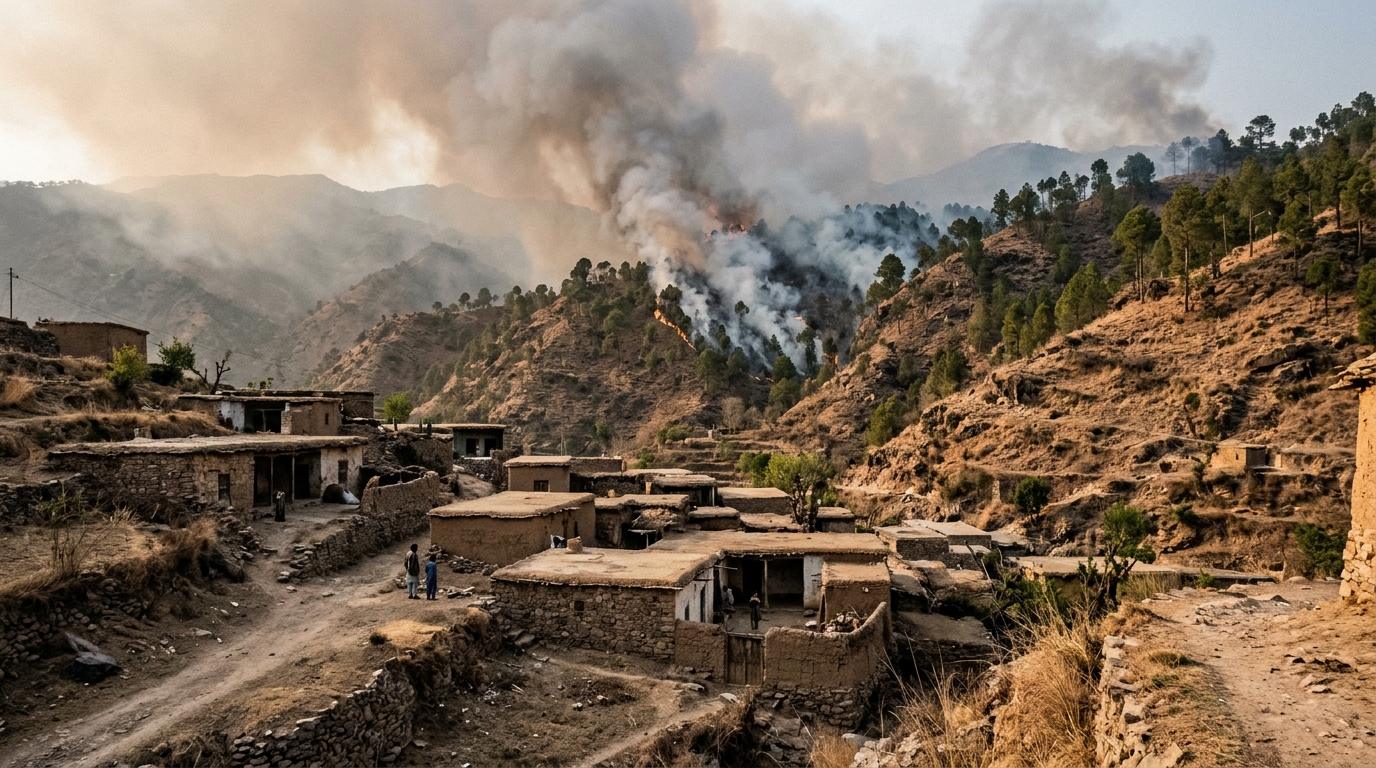
A provincial-scale assessment of wildfire patterns across Pakistan has revealed that severe fire risk is driven as much by local social vulnerability and institutional deficits as by physical fire activity. By coupling twenty-two years of satellite active-fire observations with detailed socioeconomic and institutional data from the national census, researchers demonstrated that provinces with relatively few fire detections can face severe disaster risk if their communities lack resources, infrastructure, and emergency services. The investigation established that biophysical hazard metrics alone fail to capture the true human and ecological perils of landscape fires, illustrating how limited adaptive capacity actively amplifies wildfire impacts in under-resourced regions.
Wildfire analyses in developing nations have traditionally focused on biophysical elements, such as weather conditions, fuel loads, elevation, slope, and topographic aspect. While these conventional models effectively simulate physical fire behavior and ignition probabilities, they omit the human dimensions that dictate whether a blaze causes manageable damage or triggers a humanitarian disaster. The researchers addressed this gap by evaluating Pakistan’s four primary administrative provinces: Punjab, Sindh, Khyber Pakhtunkhwa, and Balochistan. Together, these administrative units encompass approximately 796,095 square kilometers across diverse ecological zones, ranging from alpine conifer stands to arid plateaus, riverine bela forests, and coastal mangroves, while operating under provincial authorities that hold primary jurisdiction over forestry and disaster management.
To capture the physical fire hazard across the landscape, the research team analyzed longitudinal observations from 2001 through 2022 collected by the Moderate Resolution Imaging Spectroradiometer sensors aboard NASA’s Terra and Aqua satellites. The researchers extracted active-fire detections with a detection confidence of at least sixty percent from the MCD14ML Collection 6.1 dataset. Two primary metrics were computed: fire radiative power, which is measured in megawatts and acts as a direct proxy for combustion intensity, and provincial fire counts, defined as the total number of detected fire pixels. Because an individual fire can trigger multiple pixel detections over consecutive satellite passes, the count serves as a measure of pixel detections rather than a count of discrete ignitions.
The study derived its socioeconomic and institutional measures from tabular data compiled by the Pakistan Bureau of Statistics, relying on the 2017 Population and Housing Census and the Pakistan Social and Living Standards Measurement surveys. The investigation constructed a continuous vulnerability index by applying min-max normalization to five key indicators: illiteracy rate, disability rate, female population share, gender-disaggregated unemployment, and per capita income. Per capita income was inverted so that higher values consistently indicated lower vulnerability. Equal weighting was applied across all five indicators to calculate the arithmetic mean, avoiding subjective weighting decisions and accommodating the small provincial sample size.
To complement this continuous metric, the researchers developed a categorical vulnerability profile based on an explicit sixty-percent threshold rule. Individual indicator values were classified into three ordinal categories—low, medium, and high—using natural breaks classification across the four provincial distributions. Under this decision rule, a province was designated as having high vulnerability only if at least three of the five indicators scored in the highest category. Although the female population proportion showed little variation across provinces, ranging from 47.84 percent to 48.98 percent, it was retained due to established mobility constraints during emergencies, while illiteracy, unemployment, and disability rates provided substantial discrimination between provinces.
Institutional resilience was quantified through an adaptive capacity profile spanning four functional domains: healthcare, education, information and communication technology, and institutional presence. Healthcare capacity incorporated the per capita availability of hospitals, basic health units, physicians, and inpatient beds; education captured primary schools, secondary schools, colleges, and universities; information and communication technology measured mobile subscriptions, internet access, and household device ownership; and the institutional domain tracked police stations, post offices, bank branches, and administrative facilities. All raw counts were normalized to rates per 100,000 residents before min-max normalization, and the resulting arithmetic mean was categorized into low, medium, and high capacity tertiles.
The physical fire hazard index, combining normalized fire radiative power and fire counts, produced sharp contrasts across provincial borders. Punjab recorded 46,480 fire detections between 2001 and 2022, accounting for seventy-three percent of the national total, driven largely by seasonal postharvest burning of wheat and rice crop residue across the Indus Plain. However, Punjab’s fires exhibited a relatively mild mean fire radiative power of 15.14 megawatts. Sindh recorded 9,614 fire detections with a mean intensity of 17.23 megawatts, while Khyber Pakhtunkhwa recorded 6,083 detections with a mean intensity of 17.93 megawatts, yielding fire hazard index scores of 0.26 and 0.28, which were categorized as low hazard.
Balochistan displayed an inverse pattern, registering only 1,444 fire detections over the twenty-two-year record—just 2.3 percent of the national total—yet recording the country’s highest fire intensity with a mean fire radiative power of 21.33 megawatts. This placed Balochistan and Punjab into the medium fire hazard category with identical composite scores of 0.50. In Balochistan, this low-frequency, high-intensity fire regime poses existential threats to ancient, slow-growing woodlands, including UNESCO-recognized Ziarat juniper stands that are over 5,000 years old and the Chilghoza pine forests of the Sulaiman Range, which lack the ability to resprout after severe crown fires and rely entirely on fragile seed germination.
Socioeconomic vulnerability scores further accentuated regional differences. Sindh recorded the lowest continuous vulnerability score at 0.11, bolstered by a higher per capita income of 1,748 US dollars and an unemployment rate of 5.79 percent. Punjab scored 0.54 and Balochistan reached 0.60, both landing in the medium category, though driven by contrasting drivers: Punjab’s vulnerability was shaped by elevated disability rates of 3.51 percent and unemployment of 10.46 percent, whereas Balochistan was dominated by extreme illiteracy reaching sixty percent alongside a per capita income of 1,106 US dollars. Khyber Pakhtunkhwa recorded the highest continuous vulnerability score at 0.72, categorized as high, driven by moderately elevated disadvantages across multiple measures.
The adaptive capacity evaluations revealed substantial interprovincial disparities, reflecting what the authors described as institutional desertification across remote mountain districts. Sindh achieved the highest adaptive capacity score of 0.89, driven by high scores in healthcare and communications infrastructure, followed by Punjab at 0.71, supported by dense educational and administrative networks. Khyber Pakhtunkhwa recorded an intermediate score of 0.53. In contrast, Balochistan exhibited an adaptive capacity score of just 0.15, scoring zero in the educational, communication, and institutional domains due to an acute absence of public service facilities, health clinics, and paved road networks in remote forested districts.
When these components were integrated through a nonlinear risk matrix based on the difference between ordinal vulnerability and adaptive capacity scores, Balochistan emerged as the sole province classified as very high risk. The convergence of high categorical vulnerability, an adaptive capacity score of 0.15, and intense crown fires produced extreme overall risk despite having the fewest total fires. Khyber Pakhtunkhwa was classified as high risk due to the amplifying effect of medium vulnerability paired with medium adaptive capacity, while Punjab was designated as medium risk because its high adaptive capacity buffered its moderate vulnerability. Sindh emerged as low risk, proving to be the most resilient province.
Robustness tests supported these provincial classifications against alternative methodological parameters. Sensitivity analyses varying the categorical vulnerability threshold from fifty to seventy-five percent showed that Balochistan maintained its high vulnerability designation up to a sixty-percent threshold, shifting to medium only at sixty-five percent or higher, while all other provincial classifications remained unchanged. Sequential leave-one-out testing of the adaptive capacity domains demonstrated that Balochistan’s score remained within the low-capacity boundary across all iterations, ranging from 0.00 to 0.20, confirming that its low capacity reflects pervasive multi-sector deficiencies rather than an anomaly in any single domain.
The authors noted several important operational limitations to their analytical framework. The socioeconomic baseline relies on the 2017 national census, which, while the most comprehensive provincial-level dataset available, does not reflect structural shifts captured in subsequent enumerations. Furthermore, the one-kilometer spatial resolution of MODIS sensors cannot detect low-temperature understory fires, and provincial aggregates can mask intra-provincial variations between urban centers and isolated rural communities. The researchers highlighted the necessity of out-of-sample predictive testing on post-2022 fire events and recommended incorporating finer-resolution sensors, such as VIIRS, to refine future wildfire risk governance in data-scarce regions.
Subject of Research: Provincial wildfire risk assessment combining satellite hazard data, social vulnerability, and adaptive capacity in Pakistan
Article Title: Who is really at risk? Integrating social vulnerability and adaptive capacity into wildfire risk assessment in Pakistan
Article References: Kanwal, R., & Weiguo, S. (2026). Who is really at risk? Integrating social vulnerability and adaptive capacity into wildfire risk assessment in Pakistan. Fire Ecology, 22(1), Article 122. https://doi.org/10.1186/s42408-026-00569-2
Image Credits: AI Generated
DOI: 10.1186/s42408-026-00569-2
Keywords: wildfire risk, Pakistan, social vulnerability, adaptive capacity, MODIS fire data, fire radiative power, disaster risk reduction, Balochistan, Khyber Pakhtunkhwa, environmental governance, really, risk
News Source: Drew Townsend. (November 9, 2026). Study Finds Pakistan Wildfire Risk Stems Largely From Social Vulnerability. Scienmag.