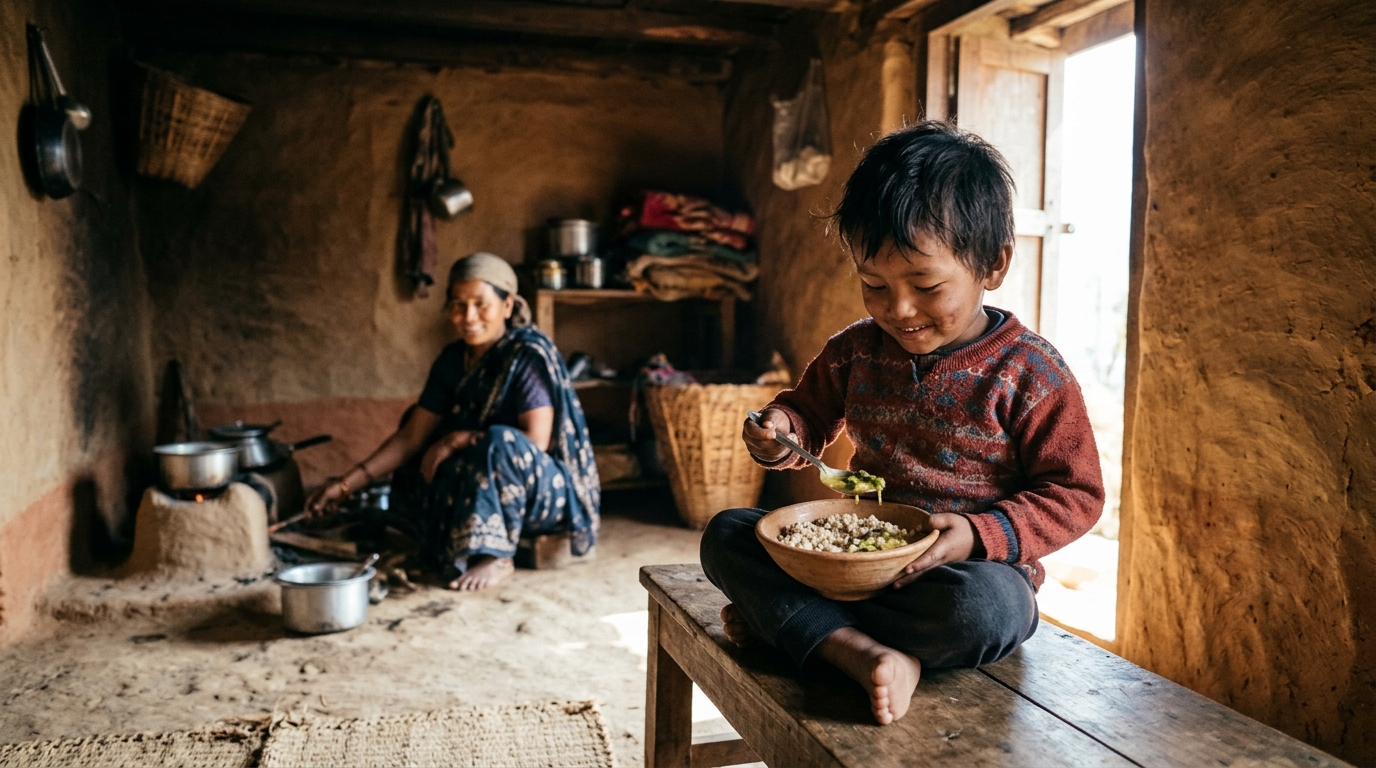
A community-based comparative cross-sectional investigation conducted in rural West Bengal, India, found no statistically significant adjusted associations between paternal labour migration and undernutrition among children aged 0 to 59 months. Researchers Moslem Hossain and Sanjit Sarkar evaluated whether fathers leaving home for work correlated with altered nutritional status in young offspring, measuring three core indicators: stunting, underweight, and wasting. Although paternal migration is hypothesized to shift household resources and domestic caregiving dynamics, evidence evaluating its relationship with early childhood physical development in rural Indian localities has remained scarce.
The field research focused on rural communities across Cooch Behar district, evaluating mother-child pairs to assess nutritional conditions in households with and without migrant fathers. Paternal labour migration can alter the socio-economic context of the family through income transfers or remittances, while simultaneously modifying daily parental care arrangements and household burdens. Because empirical observations among very young children across rural settings have been limited, the investigators designed a comparative community survey to measure whether children of migrant fathers experienced different patterns of growth deficits compared to their peers from non-migrant households.
To carry out the evaluation, the researchers enrolled 384 mother-child pairs from 24 villages surveyed between October 2022 and February 2023. The surveyed cohort was evenly split, comprising 192 paternal migrant households and 192 non-migrant households. Growth outcomes were categorized strictly according to the 2006 World Health Organization Child Growth Standards, identifying stunting through height-for-age, underweight through weight-for-age, and wasting through weight-for-height metrics. To estimate prevalence ratios across comparative cohorts, the authors utilized modified Poisson regression models with village-clustered robust standard errors, applying sequential adjustments for child, geographic, parental, social, and household characteristics.
Data screening revealed substantial differences in the availability of valid anthropometric records across the cohort. Valid z-scores were obtained for 283 children for height-for-age, 375 children for weight-for-age, and 262 children for weight-for-height. Within this observed sample, overall undernutrition prevalences reached 33.2 percent for stunting, 10.9 percent for underweight, and 18.3 percent for wasting. The authors supplemented their primary outcome-specific regressions with a common-sample analysis of children who possessed all three valid anthropometric markers, as well as extreme-case bounds to assess the influence of excluded height-based records.
Primary adjusted prevalence ratios comparing children from migrant households with those from non-migrant households were 1.18 with a 95 percent confidence interval of 0.83 to 1.68 for stunting, 1.75 with a 95 percent confidence interval of 0.98 to 3.13 for underweight, and 0.99 with a 95 percent confidence interval of 0.60 to 1.66 for wasting. None of these primary comparisons crossed the conventional 5 percent threshold of statistical significance. When evaluating the restricted common sample of 237 children with complete valid indicators, the adjusted prevalence ratios were 1.42 for stunting, 1.43 for underweight, and 1.01 for wasting, while broader adjustment models further attenuated the underweight prevalence ratio to 1.32.
The study authors emphasized that the observed data demand cautious interpretation due to notable methodological constraints. In particular, plausibility screening resulted in the exclusion of 26.3 percent of height-for-age z-score records and 31.8 percent of weight-for-height z-score records, indicating severe measurement errors in field-collected height metrics that substantially restricted the reliability of the stunting and wasting analyses. Furthermore, the elevated initial underweight estimate occurred alongside a small event count and attenuated under broader adjustment. The researchers concluded that future investigations should adopt prospective longitudinal designs incorporating repeated quality-controlled anthropometry while directly tracking migration duration, remittances, caregiving practices, and dietary consumption.
Subject of Research: Paternal labour migration and early childhood undernutrition in rural India
Article Title: Association between paternal labour migration and undernutrition among children aged 0 to 59 months in rural West Bengal India: a community based comparative cross-sectional study
Article References: Hossain, M., & Sarkar, S. (2026). Association between paternal labour migration and undernutrition among children aged 0 to 59 months in rural West Bengal India: a community based comparative cross-sectional study. Journal of Health, Population and Nutrition. https://doi.org/10.1186/s41043-026-01506-4
Image Credits: AI Generated
DOI: 10.1186/s41043-026-01506-4
Keywords: paternal labour migration, child undernutrition, stunting, wasting, underweight, rural West Bengal, Cooch Behar, cross-sectional study, WHO child growth standards, modified Poisson regression, prevalence ratios, anthropometry, height-for-age z-scores, weight-for-age z-scores, weight-for-height z-scores, public health nutrition
News Source: Ophelia Keating. (November 27, 2026). Study Finds No Significant Link Between Paternal Migration and Child Undernutrition. Scienmag.