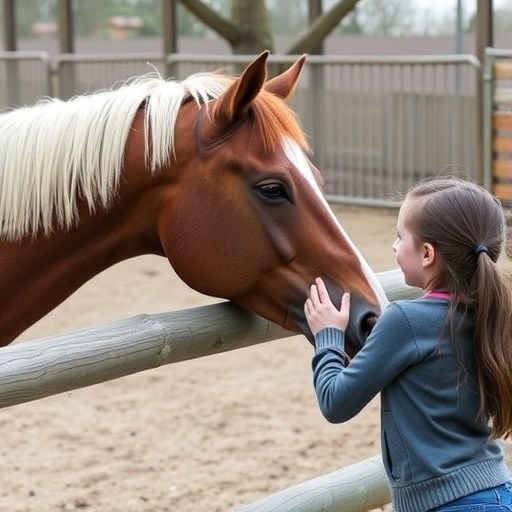
In the heart of Gothenburg, Sweden, a groundbreaking study has revealed new insights into the stress responses of Gotland Russ horses, commonly found in the Children’s Zoo at Slottsskogen animal park. Researchers from the University of Gothenburg have deployed advanced heart rate monitoring technology to assess the physiological impact of human interaction and environmental stimuli on these resilient equines, overturning long-held assumptions about their stress levels amidst bustling crowds.
For years, animal welfare experts have grappled with the challenge of accurately gauging animal stress in environments teeming with human visitors. Behavioral observations, while valuable, often leave ambiguity about the internal states of animals. Addressing this gap, the research team led by Isidora Dundjerovic turned to physiological metrics, leveraging heart rate data as an objective indicator of stress. The Gotland Russ horses, renowned for their adaptability and historical cohabitation with humans, served as ideal subjects for this inquiry.
Heart rate variability is widely acknowledged as an effective proxy for autonomic nervous system responses. Stress triggers a cascade of physiological changes, most notably an increase in heart rate driven by adrenaline release. The team equipped eight horses with state-of-the-art heart rate monitors that recorded data continuously during rest and activity periods. These baseline measurements allowed researchers to distinguish between normal exertion-induced increases and stress-induced elevations with precision.
During routine feeding sessions amidst eager children petting the horses, the animals exhibited heart rates only marginally above their resting averages. The mean resting heart rate hovered around 42.5 beats per minute, while light exercise elevated it to approximately 85 beats per minute. Intriguingly, interaction with visitors resulted in heart rates averaging just 51 beats per minute, underscoring the horses’ remarkable tolerance for close human contact in a controlled environment.
However, this tranquil scenario shifted dramatically in response to mechanical noise intrusion. An excavator operating near the paddock caused a significant spike in heart rates, with horses swiftly moving away from the source of distress. This acute physiological stress response underscores the sensitivity of Gotland Russ horses to unfamiliar and potentially threatening stimuli, emphasizing the importance of managing noise pollution within zoological settings to safeguard animal welfare.
Somewhat surprisingly, other common urban sounds such as barking dogs and passing vehicles elicited no significant change in heart rate. This resilience may reflect habituation resulting from long-term exposure to non-threatening background noises, or an evolved capacity to filter benign stimuli from actual stressors. Such findings have compelling implications for designing zoo environments and schedules that minimize unnecessary stress for resident animals.
The implications extend beyond mere academic interest. Zoos and animal parks serve as conservation and educational hubs, highlighting the imperative of ensuring optimal welfare for their inhabitants. This research furnishes empirical evidence supporting the capacity of Gotland Russ horses to coexist harmoniously amidst moderate human interaction, reinforcing current husbandry practices while signaling caution against uncontrolled environmental disruptions.
Looking ahead, the research team intends to expand their physiological monitoring to other activities, notably pony riding, which traditionally raises questions about animal stress and welfare. By systematically quantifying stress markers during such interactions, the study aims to inform best practices that optimize animal wellbeing without compromising public engagement and educational value.
The project exemplifies the fruitful intersection of veterinary science, ethology, and technology, illuminating pathways to enhance animal care standards in captivity. By integrating heart rate monitoring with behavioral observations, researchers can craft a nuanced understanding of how animals perceive and respond to their environments, promoting welfare-oriented modifications tailored to species-specific sensitivities.
Linda Thelin, a zoologist at the animal park, lauded the collaboration, emphasizing the importance of not overlooking subclinical stress manifestations. This vigilance is vital as hidden indicators of distress may persist without overt behavioral signals, adversely affecting long-term health and reproductive success. The study’s rigorous methodological framework sets a precedent for continuous welfare evaluation.
In broader terms, the research contributes to an evolving paradigm in zoo management that privileges ethical stewardship rooted in scientific rigor. It challenges caretakers to transcend traditional assessment tools and embrace multidisciplinary strategies that address the complexities of animal sentience and wellbeing.
Overall, these findings carry profound ramifications for animal husbandry in urban zoos and animal parks worldwide. They underscore the necessity of balancing visitor experience with the intrinsic needs of animals, advocating for environments that foster psychological and physiological equilibrium. As heart rate monitoring technologies become more accessible, their integration could revolutionize welfare practices across diverse settings.
The University of Gothenburg’s pioneering work with Gotland Russ horses exemplifies how cutting-edge research informs compassionate care, ensuring that animals flourish not merely survive in human-managed habitats. This study marks a pivotal step toward unraveling the intricate dynamics of animal stress in human-centric environments, laying the foundation for enlightened future interventions.
Subject of Research: Animals
Article Title: Heart Rate as an Indicator of Stress in Gotland’s Russ Horses
News Publication Date: 1-Jun-2026
Web References: http://dx.doi.org/10.1002/zoo.70052
References: Zoo Biology
Image Credits: Pamela Ericsson
Keywords: animal welfare, Gotland Russ horses, heart rate monitoring, stress indicators, zoo management, human-animal interaction, noise pollution, physiological stress, animal behavior, veterinary science, conservation, animal husbandry
Tags: animal welfare in children’s zoosbehavioral responses in zoo animalsequine adaptation to human presenceGotland Russ horses stress studyheart rate monitoring in horsesheart rate variability and stresshuman-animal interaction effectsimpact of petting on horse behaviorphysiological stress indicators in equinesstress assessment using heart rateUniversity of Gothenburg animal researchzoo animal stress physiology