


Credit: KIRSTY CHALLEN, B.SC., MBCHB, MRES, PH.D., LANCASHIRE TEACHING HOSPITALS, UNITED KINGDOM
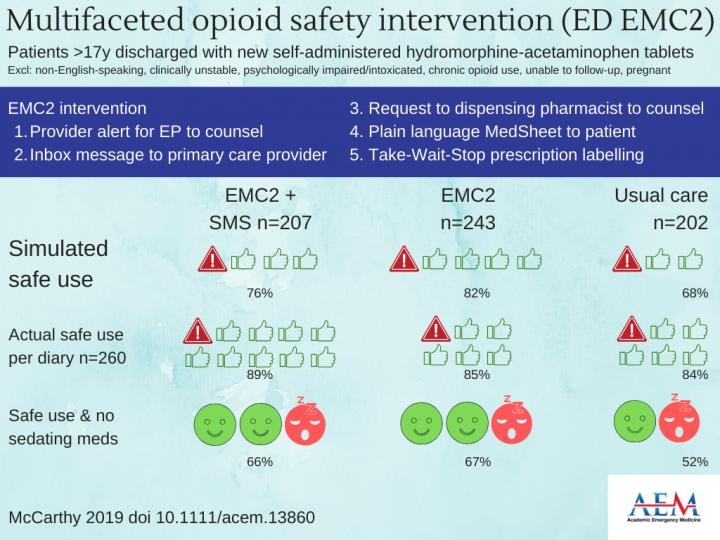
DES PLAINES, IL — A study to evaluate the effect of an Electronic Medication Complete Communication (EMC2) Opioid Strategy on patients’ safe use of and knowledge about opioids found that the EMC2 tools improved demonstrated safe dosing, but these benefits did not translate into actual use based on medication dairies. The study findings are published in the December 2019 issue of Academic Emergency Medicine (AEM), a journal of the Society for Academic Emergency Medicine (SAEM).
The lead author of the study is Danielle M. McCarthy MD, MS, vice chair for research in the department of emergency medicine and associate professor of emergency medicine, Feinberg School of Medicine, Northwestern University, Chicago, IL.
The investigators implemented the best practices effort of “take, stop, wait” prescribing language, together with the added boost of text messaging, to educate patients on how to reduce overuse of opioids. Intervention improved demonstrated safe dosing of opioids, and the text-messaging intervention resulted in improved patient knowledge, however there was no influence of the intervention on actual safe medication use among the portion of the sample returning medication diaries.
The findings support the notion that possessing knowledge about medication risks is likely necessary but not sufficient to ensure safe use, as medication-taking behaviors are often influenced by complex factors (e.g. health literacy, self-efficacy, and attitudes) in addition to knowledge.
The authors suggest that future emergency department interventions may opt to focus on post-discharge communication as the greatest increases in knowledge in this sample were among patients receiving the text-messaging portion of the intervention.
Jason Haukoos, MD, professor of emergency medicine and director of emergency medicine research at the University of Colorado School of Medicine Anschutz Medical Campus, commented:
“The work performed by this investigative team as part of the ED EMC2 pragmatic clinical trial advances our thinking about best practices of opioid prescribing from the emergency department. Critical to combating the opioid epidemic, integration of an electronic multi-faceted intervention aimed at physicians, pharmacists, and patients, as studied in this trial, may improve the safe use of opioids. Although challenged by the single centered approach, the results are compelling and should now be extended as part of a larger, multi-centered initiative.”
###
ABOUT ACADEMIC EMERGENCY MEDICINE
Academic Emergency Medicine, the monthly journal of Society for Academic Emergency Medicine, features the best in peer-reviewed, cutting-edge original research relevant to the practice and investigation of emergency care. The above study is published open access and can be downloaded by following the DOI link: 10.1111/acem.13860. Journalists wishing to interview the authors may contact Stacey Roseen at [email protected].
ABOUT THE SOCIETY FOR ACADEMIC EMERGENCY MEDICINE
SAEM is a 501(c)(3) not-for-profit organization dedicated to the improvement of care of the acutely ill and injured patient by leading the advancement of academic emergency medicine through education and research, advocacy, and professional development. To learn more, visit saem.org.
Media Contact
Stacey Roseen
[email protected]
708-606-7120
Related Journal Article
http://dx.



