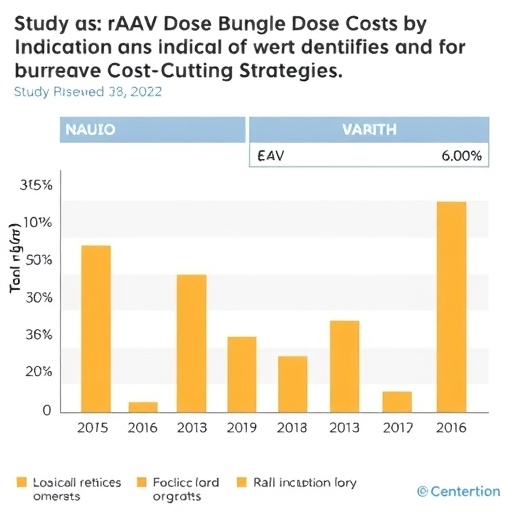
Viral gene therapy’s manufacturing economics are being reshaped by a new indication-by-indication analysis of recombinant AAV (rAAV) costs and capacity needs. The study evaluates six leading targets—RPE65 retinal dystrophy, age-related macular degeneration (AMD), hemophilia A, hemophilia B, spinal muscular atrophy (SMA), and Duchenne muscular dystrophy (DMD)—using prevalence-based patient estimates and indication-specific dose assumptions. The result is a striking spread in annual vector demand: from 8.0×10^13 vg for RPE65 retinal dystrophy to 7.6×10^19 vg for hemophilia A, spanning more than six orders of magnitude.
To translate demand into production reality, the authors model the number of batches required worldwide under distinct manufacturing scales (50 L vs 2000 L) and three process scenarios. These include a benchmark process with minimal optimization, a fully optimized transient-transfection workflow incorporating DOE1+DOE2 improvements, and an intensified perfusion-based approach. Harvest titers are reported as 6.0×10^10 vg/mL (benchmark), 8.8×10^11 vg/mL (optimized), and 9.4×10^11 vg/mL (intensified perfusion).
Although 2000 L batches reduce the total batch count relative to 50 L, the most important lever is process performance. Optimization and intensification further shrink batch numbers across all indications. For ultra-rare conditions such as RPE65-associated dystrophy, even smaller-scale capacity may suffice early on. Conversely, high-demand disorders in the low-to-mid 10^19 vg range—particularly hemophilias and neuromuscular diseases—require large-scale production plus advanced process strategies to keep annual batch counts manageable.
Crucially, the model links technical gains to economics. Scale-up and process optimization/intensification each lower cost per dose by roughly 6–12-fold, and combined effects drive a 70–150-fold reduction overall. Under optimized and intensified conditions, therapy costs can fall from million-dollar levels to the low hundreds of thousands, with SMA and DMD projected at approximately $50k–$80k per dose.
The authors also highlight a supply-chain planning risk: the analysis is prevalence-driven, representing a “maximum demand” phase. As adoption matures, demand may shift toward incidence-based treatment, potentially causing underutilization of large facilities. In that scenario, smaller or modular manufacturing platforms could become more cost-effective than peak-demand designs.
A further limitation is that the cost framework uses a standardized approach grounded largely in publicly available data and US/European market benchmarks. Regional variations—labor, facility economics, logistics, and regulatory overhead—could materially change absolute cost of goods, especially in emerging markets. Nevertheless, the authors argue the relative trends across platform and process strategies should remain robust.
Overall, the work frames a practical roadmap: align process intensification and large-scale capacity with high-vector indications, while maintaining strategic flexibility for future incidence-driven demand. For now, neuromuscular therapies appear poised to benefit most from the optimization-and-perfusion playbook.
Subject of Research: rAAV production cost analysis (indication-specific demand, batch requirements, and cost-reduction strategies)
Article Title: rAAV production cost analysis: Indication-specific cost per dose and reduction strategies.
Article References: Park, M.T., Matuszek, D., Andaluz, A. et al. Gene Ther (2026). https://doi.org/10.1038/s41434-026-00631-3
Image Credits: AI Generated
DOI: 21 July 2026
Keywords: (Not provided)
Tags: capacity planning for ultra-rare vs high-demand indicationscost-cutting strategies in gene therapygene therapygene therapy manufacturing scaleimpact of manufacturing scale on vector demandindication-specific vector demandperfusion-based manufacturing approachesprocess optimization in vector productionrecombinant AAV manufacturing coststransient transfection workflow improvementsvector yield and harvest titersviral vector dose estimation