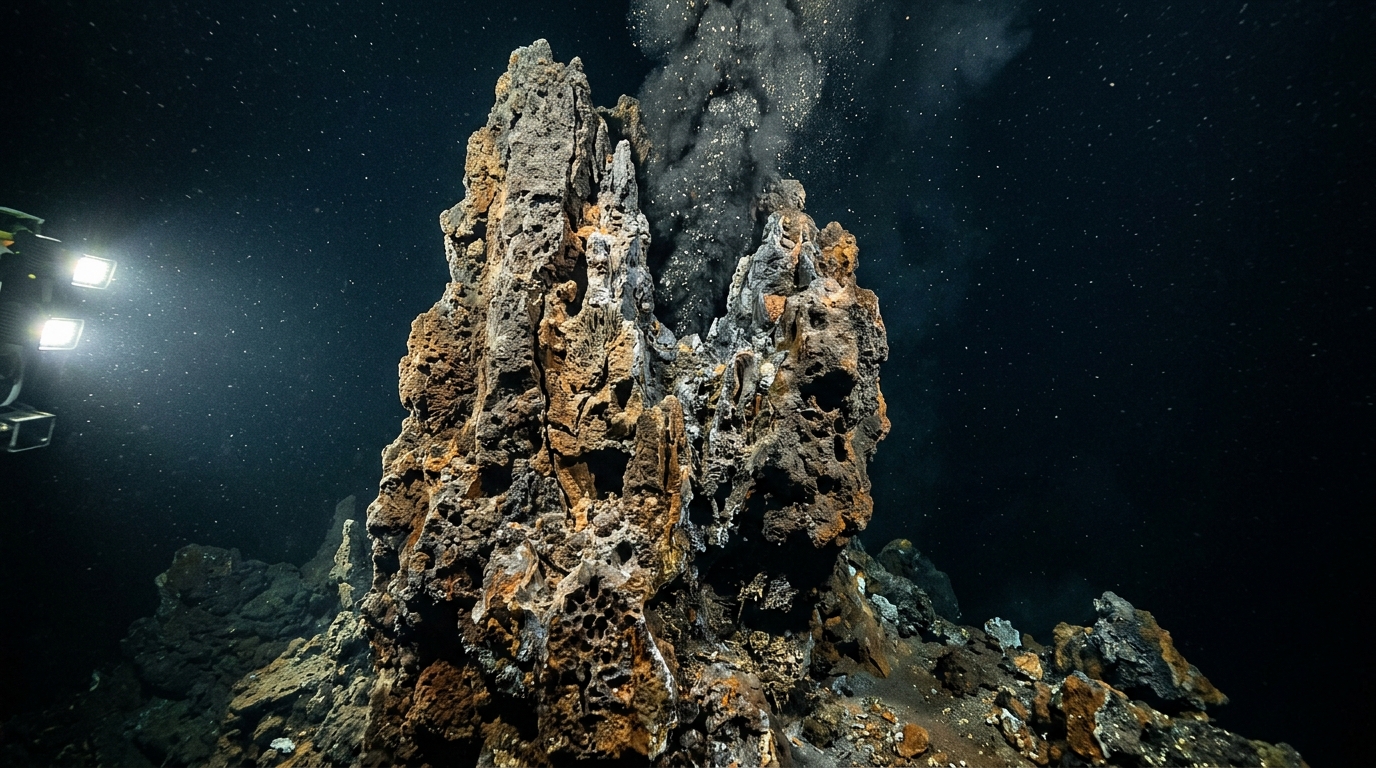
A perspective analysis published in Discover Life by researcher Arthur Doucette evaluates how recent advances in comparative phylogenomics, early Solar System geophysics, and planetary geochemistry impose quantitative constraints on the prevailing model of terrestrial abiogenesis. For more than half a century, the standard scientific model has presupposed that self-replicating chemical systems assembled spontaneously on the early Earth and subsequently underwent gradual Darwinian refinement to generate the Last Universal Common Ancestor, commonly designated as LUCA. However, genomic reconstructions conducted by Moody and colleagues in 2023 dated LUCA to approximately 4.2 billion years ago, representing a chronological shock to origin-of-life frameworks. Because the solidification of Earth’s crust is constrained to approximately 4.5 billion years ago, this dating leaves an interval of only a few hundred million years for abiotic chemistry to transition through prebiotic replicators into highly integrated cellular organisms. The analysis demonstrates that reconciling this compressed chronological window with the biochemical maturity inferred for LUCA strains the plausibility of an exclusively terrestrial origin.
The central difficulty highlighted in the analysis concerns the sheer degree of biological maturity documented in phylogenetic reconstructions of LUCA. Rather than exhibiting features typical of a primitive or primordial replicator, LUCA possessed a genome encoding an estimated 2,000 to 2,700 proteins, encompassing an energy-conserving membrane system, a multi-component DNA replication apparatus, and an intact transcription and translation machinery operating with the canonical genetic code. Independent reconstructions of early prokaryotic clades and standard molecular-clock rate estimates indicate that the slow accumulation of genomic complexity and the deep divergences required to assemble such a sophisticated metabolic and genomic repertoire would normally unfold over timescales comparable to, or exceeding, the entire habitable window available on early Earth. By the time surface conditions on Earth first settled into a state capable of supporting life, LUCA appears strikingly late relative to its inferred physiological complexity, raising fundamental questions about whether existing terrestrial chemical pathways could plausibly generate such elaborate cellular systems within the tightly bounded interval.
Geophysical and geochemical analyses further compress this available chronological window by establishing strict limits on when Earth actually became habitable. Recent geochemical models and reports from the University of Bern demonstrate that pre-impact Earth was a hot, dry, and volatile-poor planetary body lacking persistent surface liquid water. The onset of stable surface environments was governed by the giant Moon-forming collision with Theia, estimated to have occurred roughly 4.45 billion years ago. Rather than adding volatiles gradually over extended eras, the Theia event delivered Earth’s foundational hydrological inventory, depositing one ocean mass upon the surface and sequestering at least three additional ocean masses within hydrous mineral phases at mantle transition-zone depths near 700 kilometers. Because classical ocean-based prebiotic chemistry could not operate prior to this impact and subsequent global cooling, the maximum window between the stabilization of a hydrosphere and the appearance of LUCA was restricted to roughly 200 to 300 million years, and likely considerably less under dynamic post-impact conditions.
Compounding this temporal compression is the genomic discovery that LUCA was already equipped with sophisticated, multi-component antiviral defense systems. As established in the genomic reconstructions by Moody and colleagues, LUCA’s inherited proteome included restriction-modification complexes capable of enzymatically distinguishing self-DNA from foreign genetic sequences, diverse nuclease families dedicated to degrading invading nucleic acids, and proto-CRISPR modules providing adaptive immune memory. Because viruses inherently rely upon pre-existing host cellular replication machinery to replicate and diversify, the presence of these defensive complexes demonstrates that an active evolutionary arms race between viral predators and cellular hosts was already fully established prior to LUCA. This evolutionary requirement demands the existence of an earlier ancestral cellular lineage, termed LUCA-1, which lacked advanced antiviral mechanisms. When reconciled with established molecular-clock rates for viral genomic diversification, this pre-LUCA viral-host coevolution requires an extended biological history that must have originated long before the formation of Earth’s stable surface oceans.
The study also articulates the theoretical barrier presented by the Mutual Dependency Paradox in modern cellular systems. In biological organisms, core cellular operations rely upon tightly integrated molecular networks wherein multiple complex components are mutually dependent upon one another for their synthesis and functional activity. A quintessential manifestation of this interdependency is observed in the relationship between the genetic transcription and translation apparatus. Ribosomes are fundamentally required to translate the genetic sequences encoding cellular proteins, including the exact polymerases and enzymes responsible for transcribing RNA and replicating the genome. Concurrently, the ribosomal proteins, structural components, and necessary translation factors are themselves encoded within the genomic sequence and require an existing translation system to be produced. While this structural coupling does not prove that gradual evolutionary assembly is impossible, the physical necessity of coordinating the simultaneous emergence of interacting components significantly increases the minimum duration required for functional biochemical systems to arise, intensifying the temporal compression problem.
Beyond terrestrial geophysics, the perspective introduces Mars as an independent upper-bound constraint on inner Solar System biological timelines. Over five decades of planetary exploration, data from orbital platforms including Mariner 9, Viking, Mars Global Surveyor, and the Mars Reconnaissance Orbiter have revealed extensive fluvial channels, delta structures, shoreline signatures, and sedimentary lacustrine deposits indicative of long-lived aqueous activity. Surface rover explorations have progressively confirmed sustained habitability: Spirit identified sulfate-rich evaporites formed by aqueous alteration, Opportunity detected hematite concretions and stratified sedimentary layers, Curiosity discovered an ancient neutral-pH freshwater lake in Gale Crater possessing chemical redox gradients capable of sustaining chemolithoautotrophic metabolism, and Perseverance documented prolonged deltaic sedimentation within Jezero Crater. Because Mars is smaller than Earth and cooled more rapidly, it achieved stable habitable environments earlier in Solar System history, providing a parallel geological setting during the exact epoch in which life emerged on Earth.
Robotic missions on Mars have gathered a cumulative series of candidate biosignatures across geographically distributed environments. In 1976, the Viking Labeled Release experiment recorded the rapid evolution of radiolabeled gas following nutrient addition to soil samples, a response consistent with biological metabolic activity, although contemporaneous gas chromatography-mass spectrometry instruments detected no organics under pyrolytic heating. Decades later, the Phoenix lander revealed that Martian regolith contains perchlorates, chemicals that thermally decompose organic molecules during pyrolytic extraction, suggesting that Viking’s null organic result may have stemmed from instrument-induced combustion. Subsequently, Curiosity detected complex organic matter and long-chain alkane distributions in Gale Crater mudstones whose concentrations are difficult to reconcile with purely abiotic synthesis pathways. More recently, Perseverance identified organic compounds in all drilled core samples, microbially plausible textured nodules, and distinctive leopard spot alteration morphologies for which abiotic mechanisms remain unestablished, forming an observational pattern strongly suggestive of ancient biological activity.
If future Mars sample-return missions confirm that any of these candidates represent genuine biogenic traces, the probabilistic viability of independent terrestrial abiogenesis becomes exceedingly difficult to sustain mathematically. In statistical terms, if the probability of abiogenesis occurring independently on a single habitable planet within a narrow window of 100 million to one billion years is designated as a small value, p, then the probability that life arose independently on both Earth and Mars within that overlapping interval scales as p squared. Conversely, under a panspermia framework where life emerges once and is physically distributed between planetary bodies via impact ejecta, the relevant probability scales linearly with p. For small probability values, dual independent scenarios scaling with p squared are mathematically disfavored by a full factor of p relative to single-origin models. Furthermore, if Martian life is confirmed to share the canonical genetic code, DNA storage, and ribosomal architectures, independent parallel evolution under divergent geochemical environments becomes virtually untenable.
To evaluate the physical feasibility of panspermia, Doucette reviews dynamical and biological mechanisms governing material transport across the early Solar System. The inner planets underwent intense meteoritic bombardment throughout the Hadean era, spanning the Moon-forming collision at roughly 4.45 billion years ago through the Late Heavy Bombardment between 3.8 and 4.1 billion years ago, which facilitated massive interplanetary ejecta exchange. Direct astronomical detections of interstellar interlopers like 1I/’Oumuamua and 2I/Borisov further demonstrate that physical material exchange operates across interstellar distances. Biologically, extensive empirical evidence refutes the assumption that microorganisms cannot survive interplanetary transfer. Viable bacteria and archaea entering cryptobiotic dormant states characterized by arrested metabolism and enhanced DNA stabilization routinely survive extreme desiccation, vacuum, and ionizing radiation. Viable bacterial cultures have been empirically recovered from 700,000-year-old Antarctic ice, multi-hundred-thousand-year-old Siberian permafrost, and isolated deep subsurface environments, demonstrating that cryogenic preservation across typical ejecta transit intervals of 100,000 to one million years is biologically viable.
Synthesizing these interrelated lines of evidence, the perspective concludes that the initial appearance of complex cellular life in the inner Solar System is best understood not as an insular terrestrial invention, but as an arrival event. The basal diversification of life on Earth exhibits non-homologous bioenergetic strategies, including methanogenesis, sulfur reduction, and phototrophy, which are difficult to reconcile with a singular, rapid local emergence within a restricted post-Theia hydrosphere. Instead, these metabolic architectures point to a mature biological ecosystem that had already diversified prior to Earth’s habitability window, with LUCA representing a late-stage survivor rather than the primary progenitor of cellular biology. The author emphasizes that this model does not explain the original, ultimate origin of life, but shifts the central empirical question from how life assembled locally on Earth to identifying where, when, and under what cosmic environments life first emerged and successfully navigated planetary transfer to colonize the inner Solar System.
Subject of Research: Implications of genomic and geophysical timelines for terrestrial abiogenesis and panspermia
Article Title: Implications of Moody et al. for the viability of terrestrial abiogenesis
Article References: Doucette, A. (2026). Implications of Moody et al. for the viability of terrestrial abiogenesis. Discover Life, 56(1), Article 25. https://doi.org/10.1007/s11084-026-09728-6
Image Credits: AI Generated
DOI: 10.1007/s11084-026-09728-6
Keywords: terrestrial abiogenesis, LUCA, panspermia, Martian biosignatures, molecular clock, Theia impact, viral evolution, astrobiology, Implications, Moody, viability, terrestrial
News Source: Drew Townsend. (November 7, 2026). Study Challenges Terrestrial Abiogenesis Timelines Following Ancient Common Ancestor Reconstructions. Scienmag.