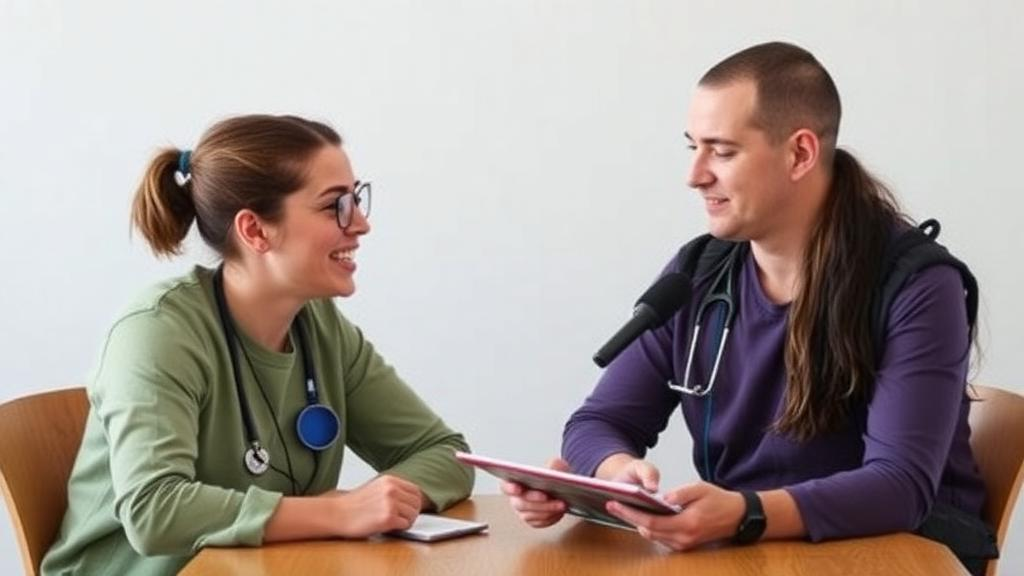
Every medical student knows the moment: a patient case unfolds, facts arrive one by one, and the differential diagnosis in your head keeps reshuffling. A podcast built in Chicago has turned that exact cognitive experience into audio, and a new study in the Journal of General Internal Medicine shows just how far it has traveled. The program, called Alert and Oriented, was founded in 2021 by Dr. Kevin Grudzinski and Dr. Richard Abrams at academic medical centers in Chicago to fill a gap in accessible, learner-centered clinical reasoning instruction. Since then, it has published 59 episodes and accumulated more than 23,655 downloads from over 40 countries and 262 cities, with the United States and Singapore leading the listener base. The new paper describes the development, implementation, and preliminary evaluation of the podcast, offering one of the most detailed published accounts of how vignette-based reasoning pedagogy can be translated into an open-access audio format.
What makes the project unusual is who runs it. Alert and Oriented is student-led: medical students write the clinical vignettes, host the episodes, and serve as discussants, with faculty physicians providing mentorship and review. Participating students come from Rush Medical College and Northwestern University Feinberg School of Medicine, and the team spans pre-clinical students, clerkship-level learners, residents, and attending physicians. Each episode runs roughly 40 to 60 minutes and is recorded longitudinally in a single take, a deliberate production choice meant to preserve natural discussion and emphasize real-time clinical reasoning processes rather than immediate diagnostic accuracy. Hosts typically include near-peer medical students, residents, and attending physicians, while guests often feature medical students and early clinical learners. The result is a conversational format that mirrors the informal yet cognitively rigorous case discussions that happen on clinical teams, now captured in a scalable audio medium.
The podcast is organized into three series that map onto the learning continuum. The flagship Clinical Vignette series is designed for clerkship-level medical students and highlights complex clinical cases that assume foundational clinical knowledge. Episodes begin with a case presentation, during which guests and hosts collaboratively construct an initial problem representation and a working differential diagnosis. As additional information is introduced sequentially—relevant history, physical examination findings, laboratory data, and imaging results—guests reason through the case in real time, reprioritizing diagnostic hypotheses after each new clinical finding. If the guest has not identified the correct diagnosis by the end of the vignette, the host guides the discussion, highlighting discriminating clinical features and redirecting the differential until the final diagnosis is reached. Afterward, the episode transitions into a debrief on the key clinical features and reasoning inflection points that led to the diagnosis, with hosts identifying generalizable reasoning pearls for listeners.
The second series, the Early Pre-Clinical Learners Series, targets first- and second-year medical students and features a distinctive format in which students author the episode’s clinical vignette, host the episode, and teach back the information. Clinical vignettes are split into aliquots of pertinent case information that are sequentially provided to the guest, beginning with a brief patient presentation and followed by labs, imaging, and extraneous details. At each aliquot, guests articulate their diagnostic thinking, receive real-time feedback from near-peer clerkship-level student hosts, and engage in guided refinement of their reasoning. Once the final diagnosis is reached, student hosts deliver a teach-back highlighting clinical pearls from real-world experiences, relevant epidemiology, clinical presentations, and key pathophysiology, with attending physician hosts adding further insight and emphasizing diagnostic reasoning strategies. Each episode concludes with a reflective question-and-answer segment in which guests identify which reasoning approaches worked best for them and how those strategies might be applied in the future.
The third series, The Doctor’s Playbook, departs from the vignette format entirely. In each episode, a medical student host interviews an expert attending clinician or leader in the medical field, drawn from diverse specialties and backgrounds. Rather than centering on clinical vignettes and pedagogy, these episodes explore the guest’s real-life clinical reasoning cases, formative training experiences, and clinical pearls learned across a career. Through structured yet conversational interviews, hosts prompt guests to reflect on their clinical journey and on the development of their own diagnostic reasoning, giving listeners longitudinal insight into how clinical expertise forms. The reflective dialogue emphasizes narrative learning and professional identity formation, and the intimate one-on-one format highlights the emotional and humanistic dimensions of medicine, complementing the vignette-based reasoning episodes with broader perspectives on clinical development.
Beneath the conversational surface, every series is deliberately grounded in established medical education theory. The sequential sharing of clinical data paired with deliberate pauses for hypothesis generation operationalizes dual process theory, which distinguishes intuitive System 1 reasoning from analytical System 2 reasoning. By slowing case progression and allowing evolving differential possibilities, each episode encourages analytical reasoning and reduces premature diagnostic closure. Recording episodes in a single take helps preserve uncertainty and iterative hypothesis review, building skills in evaluating diagnostic probabilities in response to new data. The discussion-based format also reflects example-based learning, in which learners develop reasoning skills by studying and explaining worked examples of expert problem-solving, and cognitive apprenticeship, in which expertise is shared through scaffolding, modeling, and reflection. Near-peer mentorship and attending physician feedback exemplify clinical reasoning guidance and modeling across both vignette series.
The vignette design itself draws on illness script theory, which promotes diagnostic development by linking epidemiology, pathophysiology, and clinical features of a disease. By integrating multiple aliquots of information into each case, the podcast emphasizes foundational illness script development in the Early Pre-Clinical Learners series and refinement of illness scripts in the Clinical Vignette series. Medical students participate not only as learners but also as vignette authors, hosts, and reviewers, and in the pre-clinical series they serve simultaneously as the author of the episode’s clinical vignettes and as its host. Through this process, students develop principles of generative learning by deliberately organizing clinical features and anticipating pertinent diagnostic branching points. This student-led structure allows the educational impact to extend beyond the guests to the student hosts themselves, creating a bidirectional learning environment in which students function as learners, peers, and educators.
The evaluation focused on quantitative measures of audience reach, total episode downloads, listener engagement, and download distribution by episode type. Since its launch in 2021, the podcast has accrued over 23,655 downloads across all platforms, initiated from over 40 countries and 262 cities. Median episode downloads were 244, with an interquartile range of 174 to 372, reflecting sustained learner engagement across episodes. Eighty-five percent of downloads were initiated from mobile phones, 14.02 percent from computers, and 0.98 percent from other devices. Episode download counts ranged from 74 to 3,720, and 88.14 percent of episodes reached over 100 downloads. Apple Podcasts Connect analytics, which represent engagement among Apple Podcasts users specifically, recorded 6,042 plays, 453 unique listeners, and 136 followers. Of these listeners, 186, or 41.1 percent, met Apple’s criteria for engaged listeners, defined as users who listened to the majority of an episode’s duration, indicating sustained content consumption beyond the initial play.
Stratifying downloads by series revealed clear patterns. The Clinical Vignette series accounted for 44 episodes and 20,935 downloads, or 88.5 percent of total downloads, with a mean of 476 downloads per episode, consistent with its longer publication history and its alignment with clerkship-level learner needs. The Doctor’s Playbook series, a more recent addition, comprised 11 episodes and 2,285 downloads, or 9.7 percent of the total, with a mean of 208, a median of 127, and a range of 80 to 873 downloads per episode, reaching an engaged audience drawn to its narrative interview format. The Early Pre-Clinical Learner series, the most recently launched, included 4 episodes and 435 downloads, or 1.8 percent of the total, with a mean of 109, a median of 107, and a range of 102 to 124 downloads per episode, demonstrating consistent per-episode engagement since its introduction.
The authors argue that the findings demonstrate the feasibility of translating structured, education-theory-informed clinical reasoning pedagogy into an open-access, asynchronous podcast format, preserving the authenticity of real-time diagnostic feedback while implementing dual process theory, cognitive apprenticeship, illness script development, and generative learning for listeners, guests, and hosts. The innovations, they note, lie in the near-peer implementation of example-based learning and cognitive apprenticeship paired with intentional case-based vignette design, shifting the focus from knowledge sharing to an engaging, process-based learning experience. The team acknowledges limitations: the evaluation did not formally measure changes in listener diagnostic accuracy or reasoning skills through pre- and post-listening assessments, download patterns and engagement may not equate to demonstrated learning outcomes, listen-through data are limited to the Apple Podcasts user segment, and scalability may depend on student interest, faculty mentorship, and community support. Still, the core components—student vignette authors, faculty review, basic recording equipment, and free open-access hosting platforms—are widely available, suggesting other institutions could feasibly replicate the format with modest resources. Future steps include structured qualitative and quantitative learner feedback through validated survey instruments and integration of formal knowledge assessments to examine trends in student diagnostic development more accurately. As podcasts and digital medical learning resources become increasingly integrated into medical education, the Chicago team’s experiment suggests that thoughtful, collaborative clinical reasoning instruction may be only a play button away.
Subject of Research: Alert and Oriented: Translating Vignette-Based Reasoning Pedagogy into an Open-Access Podcast for Early Learners
Article Title: Alert and Oriented: Translating Vignette-Based Reasoning Pedagogy into an Open-Access Podcast for Early Learners
Article References: Wang, C., Mohama, A., Shih, S., Abrams, R., & Grudzinski, K. (2026). Alert and Oriented: Translating Vignette-Based Reasoning Pedagogy into an Open-Access Podcast for Early Learners. Journal of General Internal Medicine. https://doi.org/10.1007/s11606-026-10775-y
Image Credits: AI Generated
DOI: 10.1007/s11606-026-10775-y
Keywords: Alert, Oriented, Translating, Vignette-Based, Reasoning, Pedagogy, Open-Access, Podcast, Early, Learners, scientific research
News Source: Ophelia Keating. (October 19, 2026). Student-Led Clinical Reasoning Podcast Reaches Thousands of Learners Worldwide. Scienmag.