• HOME
  • NEWS
  • EXPLORE
    • CAREER
      • Companies
      • Jobs
    • EVENTS
    • iGEM
      • News
      • Team
    • PHOTOS
    • VIDEO
    • WIKI
  • BLOG
  • COMMUNITY
    • FACEBOOK
    • INSTAGRAM
    • TWITTER
Thursday, June 25, 2026
BIOENGINEER.ORG
No Result
View All Result
  • Login
  • HOME
  • NEWS
  • EXPLORE
    • CAREER
      • Companies
      • Jobs
        • Lecturer
        • PhD Studentship
        • Postdoc
        • Research Assistant
    • EVENTS
    • iGEM
      • News
      • Team
    • PHOTOS
    • VIDEO
    • WIKI
  • BLOG
  • COMMUNITY
    • FACEBOOK
    • INSTAGRAM
    • TWITTER
  • HOME
  • NEWS
  • EXPLORE
    • CAREER
      • Companies
      • Jobs
        • Lecturer
        • PhD Studentship
        • Postdoc
        • Research Assistant
    • EVENTS
    • iGEM
      • News
      • Team
    • PHOTOS
    • VIDEO
    • WIKI
  • BLOG
  • COMMUNITY
    • FACEBOOK
    • INSTAGRAM
    • TWITTER
No Result
View All Result
Bioengineer.org
No Result
View All Result
Home NEWS Science News Biology

Structure of key protein for cell division puzzles researchers

Bioengineer by Bioengineer
May 13, 2022
in Biology
Reading Time: 2 mins read
0
Organization of the human CCAN
Share on FacebookShare on TwitterShare on LinkedinShare on RedditShare on Telegram

At the centre of cell division
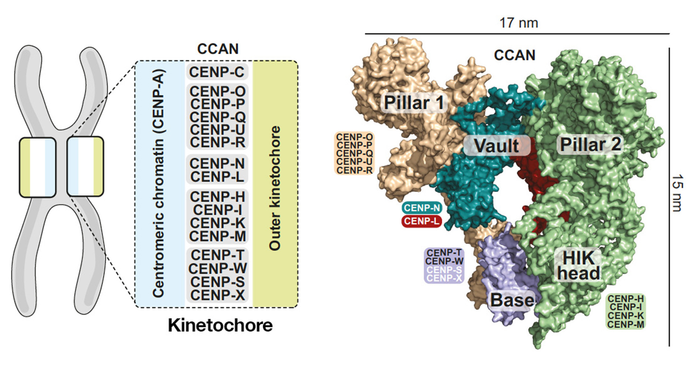
Organization of the human CCAN

Credit: MPI of Molecular Physiology

At the centre of cell division

The centromere is a constriction in the chromosome, made of DNA and proteins. Most importantly, the centromere is the dock for the kinetochore, a machinery of about 100 proteins that drives the separation of two identical chromosomes during cell division and their delivery to the daughter cells. Previous research has shown that the kinetochore docks onto the centromere through the CCAN complex: The CCAN interacts with the centromere protein A, the landmark protein of the centromere. CCAN is also responsible for replenishing the centromere protein A once the cell division has taken place. Yet, the details of the interaction between CCAN and the centromere protein A remain elusive. “Understanding how CCAN recognises and binds to the centromere could potentially lead us to build a centromere from scratch”, says Musacchio. The centromere is a major hurdle for synthetic biologists who aim to engineer artificial chromosomes to restore missing functions or introduce new ones in cells.


Unresolved questions at the core

Scientists identified the CCAN complex over 15 years ago. “Yet, building up a pipeline to synthesize all proteins in vitro has been a major obstacle”, says Musacchio. After obtaining a first reconstitution of the human CCAN complex in vitro, Musacchio joined forces with Stefan Raunser, also at MPI Dortmund, who applied cryo-electron microscopy on the whole CCAN protein complex.

In the new publication, the MPI groups have been able to determine the 3D structural details of the human CCAN complex, highlighting its unique features and the implications for an interaction with the centromere protein A. “Contrary to what was expected, this structure does not directly recognise the centromere protein A in the standard configuration”, says Musacchio. The centromere protein A is most commonly packed with DNA and other proteins as a nucleosome, the standard unit of the genetic material. The authors are now suggesting that the centromere protein A may be embedded in the centromere with a different configuration that may facilitate the crucial interaction with CCAN. They plan to identify conditions that could lead to this new configuration and prove their hypothesis.


Journal

Molecular Cell

DOI

10.1016/j.molcel.2022.04.027

Method of Research

Experimental study

Subject of Research

Cells

Article Title

Structure of the human inner kinetochore CCAN complex and its significance for human centromere organization

Article Publication Date

6-May-2022

Share12Tweet8Share2ShareShareShare2

Related Posts

Natural Hallucinogens: Evolution’s Ecological Tools, Not Mere Chemical Byproducts

June 25, 2026

This Famous Butterfly Revealed: Three Distinct Species Hidden in One

June 25, 2026

Scientists Attack Soybean Cyst Nematode by Starving Its Food Source

June 25, 2026

Decoding the Secret Code of a Crucial Immune Sensor

June 24, 2026

POPULAR NEWS

  • Saying Goodbye to PGY-6: Pediatric Fellowship Realities

    103 shares
    Share 41 Tweet 26
  • Multi-Hospital Study Reveals Long Covid Burden Is Twice as High as Current Estimates

    92 shares
    Share 36 Tweet 23
  • Detection of EDCs in Breast Milk and Infant Urine Up to Six Months Highlights Early Exposure Risks

    77 shares
    Share 31 Tweet 19
  • New Drug Candidate Developed at McMaster Shows Potential for Treating Brain Cancer

    58 shares
    Share 23 Tweet 15

About

We bring you the latest biotechnology news from best research centers and universities around the world. Check our website.

Follow us

Recent News

Tracking Lanthanide-Labeled Microplastics in Plants

POSTECH Researchers Slash Cost of Reconstituted Cell-Free Systems by 95%

AI and Physics Collaborate to Design Advanced Hydrogen Storage Materials

Subscribe to Blog via Email

Enter your email address to subscribe to this blog and receive notifications of new posts by email.

Join 82 other subscribers
  • Contact Us

Bioengineer.org © Copyright 2023 All Rights Reserved.

Welcome Back!

Login to your account below

Forgotten Password?

Retrieve your password

Please enter your username or email address to reset your password.

Log In
No Result
View All Result
  • Homepages
    • Home Page 1
    • Home Page 2
  • News
  • National
  • Business
  • Health
  • Lifestyle
  • Science

Bioengineer.org © Copyright 2023 All Rights Reserved.