• HOME
  • NEWS
  • EXPLORE
    • CAREER
      • Companies
      • Jobs
    • EVENTS
    • iGEM
      • News
      • Team
    • PHOTOS
    • VIDEO
    • WIKI
  • BLOG
  • COMMUNITY
    • FACEBOOK
    • INSTAGRAM
    • TWITTER
Thursday, June 18, 2026
BIOENGINEER.ORG
No Result
View All Result
  • Login
  • HOME
  • NEWS
  • EXPLORE
    • CAREER
      • Companies
      • Jobs
        • Lecturer
        • PhD Studentship
        • Postdoc
        • Research Assistant
    • EVENTS
    • iGEM
      • News
      • Team
    • PHOTOS
    • VIDEO
    • WIKI
  • BLOG
  • COMMUNITY
    • FACEBOOK
    • INSTAGRAM
    • TWITTER
  • HOME
  • NEWS
  • EXPLORE
    • CAREER
      • Companies
      • Jobs
        • Lecturer
        • PhD Studentship
        • Postdoc
        • Research Assistant
    • EVENTS
    • iGEM
      • News
      • Team
    • PHOTOS
    • VIDEO
    • WIKI
  • BLOG
  • COMMUNITY
    • FACEBOOK
    • INSTAGRAM
    • TWITTER
No Result
View All Result
Bioengineer.org
No Result
View All Result
Home NEWS Science News

Structural knowledge of the DNA repair complex

Bioengineer by Bioengineer
March 21, 2017
in Science News
Reading Time: 2 mins read
0
Share on FacebookShare on TwitterShare on LinkedinShare on RedditShare on Telegram
IMAGE

Credit: Kasper Røjkjær Andersen

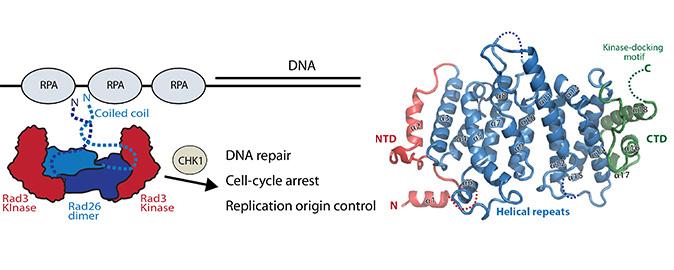
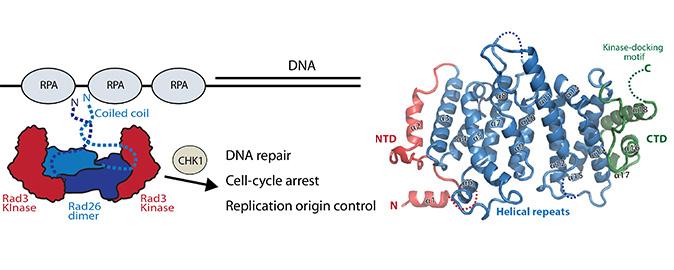
New Danish research provides mechanistic insight into how DNA is monitored and repaired if damage occurs. The results may eventually help to improve the treatment of certain types of cancer, as the DNA repair complex provides a mechanism for cancer cells to resist chemotherapy.

Our DNA is constantly exposed to damage and to protect the genome, cells have evolved mechanisms that monitor and repair these damages. Our structural knowledge of the protein complexes that monitor DNA has so far been limited. New research now describes the structure and organisation of the DNA controls protein Rad26 and shows how the kinase Rad3 is recruited to sites of damaged DNA.

To maintain the genome integrity, DNA damages have to be monitored and repaired. The first step in this process is orchestrated by the Rad3 kinase. Rad26 is a functional subunit of Rad3-rad26 DNA repair complex and is responsible for bringing the kinase to sites of DNA damage, but the mechanism behind kinase recruitment and structural knowledge of how this complete is organized has until now been unclear.

New results from Aarhus reveal the crystal structure of Rad26 and identify the elements that are important for recruiting Rad3 kinase. Rad26 is a dimer with a conserved interface in the N-terminal part of the protein. Biochemical data demonstrated that Rad26 uses its C-terminal domain and a conserved motif to recruit Rad3. From the in vitro reconstituted Rad3-Rad26 complex, small-angle X-ray scattering and electron microscopic studies, it is possible to model the quaternary structure and thus bring us closer to a mechanistic understanding Rad3-Rad26 DNA repair apparatus.

Rad3 signalling ensures that cells do not divide before DNA damages are repaired and thus provides cancer cells with a mechanism to resist chemotherapy by repairing these DNA damages. Our new structural knowledge will help the development of Rad3 inhibitors that make cancer cells more susceptible to chemotherapy and this new treatment is now being tested in clinical trials.

###

The results were published in The Journal of Biological Chemistry: doi: 10.1074/jbc.M117.780189.

Media Contact

Kasper Røjkjær Andersen
[email protected]
45-87-15-49-28
@aarhusuni

http://www.au.dk

############

Story Source: Materials provided by Scienmag

Share12Tweet8Share2ShareShareShare2

Related Posts

Confined Migration Causes DNA Damage in Neurons

June 18, 2026

Multimodal Multitask AI Transforms Lung Cancer Grading

June 18, 2026

New Study Seeks to Prolong Immune System Longevity

June 18, 2026

KAIST Creates Next-Generation Self-Powered Wearable Sensor withstanding 668% Stretch

June 18, 2026
Please login to join discussion

POPULAR NEWS

  • ESMO 2025: mRNA COVID Vaccines Enhance Efficacy of Cancer Immunotherapy

    326 shares
    Share 130 Tweet 82
  • Saying Goodbye to PGY-6: Pediatric Fellowship Realities

    102 shares
    Share 41 Tweet 26
  • Multi-Hospital Study Reveals Long Covid Burden Is Twice as High as Current Estimates

    92 shares
    Share 36 Tweet 23
  • Detection of EDCs in Breast Milk and Infant Urine Up to Six Months Highlights Early Exposure Risks

    76 shares
    Share 30 Tweet 19

About

We bring you the latest biotechnology news from best research centers and universities around the world. Check our website.

Follow us

Recent News

Confined Migration Causes DNA Damage in Neurons

Multimodal Multitask AI Transforms Lung Cancer Grading

New Study Seeks to Prolong Immune System Longevity

Subscribe to Blog via Email

Success! An email was just sent to confirm your subscription. Please find the email now and click 'Confirm' to start subscribing.

Join 82 other subscribers
  • Contact Us

Bioengineer.org © Copyright 2023 All Rights Reserved.

Welcome Back!

Login to your account below

Forgotten Password?

Retrieve your password

Please enter your username or email address to reset your password.

Log In
No Result
View All Result
  • Homepages
    • Home Page 1
    • Home Page 2
  • News
  • National
  • Business
  • Health
  • Lifestyle
  • Science

Bioengineer.org © Copyright 2023 All Rights Reserved.