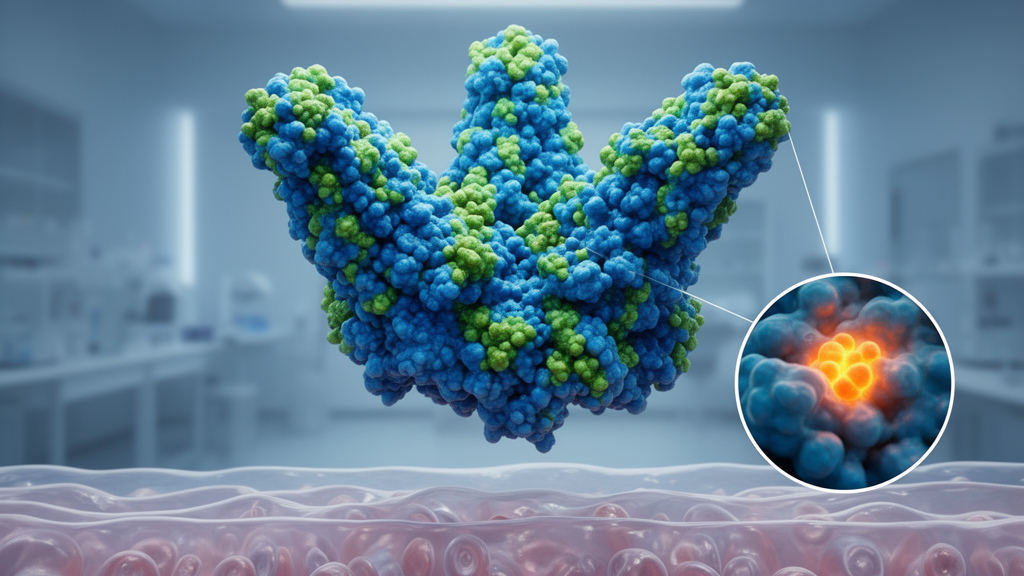
The highly pathogenic avian influenza A(H5N1) virus of clade 2.3.4.4b has been spreading across the globe at an unprecedented scale, devastating wild and domestic bird populations and, since 2024, establishing itself in dairy cattle in the United States with sustained mammal-to-mammal transmission. Although human infections have so far produced lower mortality than earlier H5N1 outbreaks, the virus’s expanding host range and its ability to replicate to high titres in bovine mammary glands have sharpened concerns about its pandemic potential. A new computational study published in npj Viruses now offers a detailed structural perspective on one of the key molecular barriers that still separate this bird virus from efficient human-to-human spread: the acid stability of its hemagglutinin, the trimeric spike protein that mediates both receptor binding and membrane fusion.
Hemagglutinin, or HA, is the major surface glycoprotein of influenza A virus. Each of its roughly 500-amino-acid monomers is cleaved into two subunits: HA1, which forms the globular head that docks onto sialic acid receptors on host cells, and HA2, which forms the stem anchoring the trimer to the viral envelope. In highly pathogenic avian viruses, a polybasic cleavage site allows activation by the protease furin throughout the body, contributing to systemic infection in birds. After a virus particle is taken up by endocytosis, the acidification of the endosome triggers an irreversible conformational change in HA that exposes the hydrophobic fusion peptide at the N-terminus of HA2, enabling the viral and endosomal membranes to merge and release the segmented viral genome into the cell.
The prefusion form of the HA trimer is metastable by design. It must be stable enough to survive the journey between hosts, yet primed to refold when the right pH is reached. If the trimer is too labile, it may fire prematurely in transmission droplets or early endosomes, destroying infectivity; if it is too stable, fusion may fail altogether. This balance differs markedly between host species. In wild aquatic birds, the natural reservoir of avian influenza viruses, greater acid stability helps virions persist in water. The jump to poultry is typically accompanied by acquisition of the polybasic cleavage site and reduced acid stability, while adaptation to mammals generally demands the opposite: a lower fusion-triggering pH, shifting from roughly 5.7 to 6.0 in avian strains to about 5.0 to 5.5 in human-adapted viruses. That extra stability helps the virus survive the mildly acidic environment of the human respiratory tract and of airborne droplets, a prerequisite for efficient airborne transmission.
Clade 2.3.4.4b, which likely emerged around 2020 through reassortment between a highly pathogenic H5N8 strain and a low-pathogenic avian virus in Central Asia or Europe, still binds preferentially to avian-type α2,3-linked sialic acid receptors and shows only weak affinity for the human-type α2,6-linked receptors. Experimental work has shown that a small number of HA mutations, such as Gln226Leu, Asn224Lys and Gly228Ser in the receptor-binding pocket, can shift receptor specificity, and that increased acid stability is essential for airborne transmission in ferrets. Yet these receptor-shifting substitutions remain rare in circulating strains, suggesting that efficient human adaptation will require multiple coordinated changes across at least three viral functions: polymerase activity, receptor-binding specificity and HA stability.
The new analysis, led by Daniel Christian Lauster, Christian Sieben, Matthias Ballauff and Andreas Herrmann of Freie Universität Berlin and the Helmholtz Centre for Infection Research, does not generate new experimental data. Instead, it builds on the deep mutational scanning study by Dadonaite and colleagues published in 2024, which used a lentivirus-based pseudovirus platform to measure how nearly every possible amino acid substitution in the HA of A/American Wigeon/South Carolina/2021, a clade 2.3.4.4b strain, affected receptor specificity, acid stability and antibody escape. The Berlin team took the stabilising mutations identified in that screen and asked a structural question: what, mechanically, do these substitutions actually do to the protein?
Because no three-dimensional structure exists for the exact strain used in the mutational scan, the researchers used the crystal structure of the HA ectodomain from A/Texas/37/2024, the reference strain of the dairy cattle outbreaks, which shares 99.4 percent sequence identity with the scanned virus, differing at only three positions. Using PyMOL to map polar interactions and the Adaptive Poisson-Boltzmann Solver to compute electrostatic surface potentials at both neutral pH 7.4 and acidic pH 5.3, they dissected each stabilising substitution in molecular detail. The electrostatic calculations, performed at physiological salt concentrations, revealed a recurring theme: many stabilising mutations act by taming a patch of dense positive charge in the lower HA1 head domain that becomes more repulsive as acidic residues become protonated at low pH.
In the HA1 subunit, the team found that substitutions such as Lys57Glu, Lys62Glu, Arg81Gly, Arg90Glu, Lys262Ile and Lys269Glu all reduce the strongly positive local surface potential of the lower head domain, diminishing electrostatic repulsion that would otherwise destabilise the prefusion trimer under acidic conditions. Other mutations work through different physics. Glu106Asp preserves the existing contact with Asn71 of HA2 while forging an additional interaction with Arg76 of a neighbouring monomer, thereby reinforcing the HA1-HA2 interface both within and between monomers. Thr318Ile, located near the fusion peptide pocket, enhances hydrophobic packing with surrounding residues, consistent with earlier work by Imai and colleagues showing that this substitution lowers the fusion pH by about 0.3 units. Histidine substitutions at positions 18 and 110 also stabilise the protein, likely because replacing these protonatable pH-sensing residues with non-charged amino acids removes a destabilising positive charge that appears at acidic pH.
In the HA2 stem, where most mutations are destabilising because the region is so finely tuned, the researchers identified a distinct set of permissive sites concentrated in the long helix and its connecting loop. Here, hydrophobic substitutions dominate: Ile77Leu, Val91Met, Asp95Met and Leu99Met all introduce methionine or leucine side chains oriented toward the centre of the three-helix bundle, creating new networks of hydrophobic interactions between the long helices of the three HA2 subunits. Asp90Glu, by contrast, strengthens a salt bridge with Lys307 of the adjacent HA1 subunit, shortening it from 3.5 to 2.9 angstroms while preserving the surrounding polar network. Arg106Glu reduces repulsion between positively charged side chains projecting into the stem centre. The short helix, notably, tolerated no stabilising mutations at all, underscoring its critical role in maintaining the metastable prefusion architecture.
The authors are careful to frame their conclusions as computationally derived hypotheses. The analysis treats each mutation in isolation and cannot capture epistasis, the phenomenon whereby combinations of mutations produce effects not predictable from their individual contributions. Recent work by Dosey and colleagues has shown that simultaneous mutations in the HA stem of clade 2.3.4.4b can stabilise the protein in ways not observed when the same mutations are studied one at a time. The study also deliberately excludes the wider viral context: neuraminidase activity must remain balanced with HA binding for efficient mucus penetration and viral release, and polymerase mutations in the circulating genotype B3.13 already point toward mammalian adaptation. Effects on acid stability, moreover, do not necessarily correlate with effects on cell entry, meaning the two phenotypes must be evaluated separately.
Nevertheless, the structural framework has immediate practical value for pandemic preparedness. By identifying which positions in the circulating H5N1 hemagglutinin can accept acid-stabilising substitutions, and by explaining the mechanisms involved, the study gives genomic surveillance teams a prioritised watch list of mutations whose appearance in sequencing data would signal progressive adaptation toward mammalian hosts. The finding that HA retains substantial structural plasticity, with multiple independent routes to enhanced acid stability spanning electrostatic tuning, hydrogen-bond reinforcement and hydrophobic packing, is a sobering one: it suggests the virus does not need a single improbable mutation to clear this barrier, but could assemble the required stability incrementally. The authors emphasise that direct experimental validation with purified mutant proteins, biophysical stability measurements and mutant HA structures will be essential, and that HA-neuraminidase co-adaptation must be studied in parallel. As clade 2.3.4.4b continues its global expansion, this kind of structure-guided surveillance may prove to be one of the most sensitive early-warning tools available for detecting the molecular steps that could bring a bird virus closer to human pandemic capability.
Subject of Research: Computational structural analysis of acid-stabilising hemagglutinin mutations in highly pathogenic avian influenza A(H5N1) clade 2.3.4.4b
Article Title: In silico analysis of pH stabilising mutations of hemagglutinin of influenza A virus H5N1 clade 2.3.4.4b
Article References: Lauster, D. C., Sieben, C., Ballauff, M., & Herrmann, A. (2026). In silico analysis of pH stabilising mutations of hemagglutinin of influenza A virus H5N1 clade 2.3.4.4b. npj Viruses, 4(1), Article 44. https://doi.org/10.1038/s44298-026-00236-y
Image Credits: AI Generated
DOI: 10.1038/s44298-026-00236-y
Keywords: H5N1, influenza A virus, hemagglutinin, acid stability, clade 2.3.4.4b, deep mutational scanning, pandemic preparedness, zoonosis, membrane fusion, electrostatics, host adaptation, structural biology
News Source: Kristina Jarvis. (October 8, 2026). Structural Analysis Reveals How H5N1 Bird Flu Hemagglutinin Could Stabilize for Human Adaptation. Scienmag.