• HOME
  • NEWS
  • EXPLORE
    • CAREER
      • Companies
      • Jobs
    • EVENTS
    • iGEM
      • News
      • Team
    • PHOTOS
    • VIDEO
    • WIKI
  • BLOG
  • COMMUNITY
    • FACEBOOK
    • INSTAGRAM
    • TWITTER
Wednesday, October 7, 2026
BIOENGINEER.ORG
No Result
View All Result
  • Login
  • HOME
  • NEWS
  • EXPLORE
    • CAREER
      • Companies
      • Jobs
        • Lecturer
        • PhD Studentship
        • Postdoc
        • Research Assistant
    • EVENTS
    • iGEM
      • News
      • Team
    • PHOTOS
    • VIDEO
    • WIKI
  • BLOG
  • COMMUNITY
    • FACEBOOK
    • INSTAGRAM
    • TWITTER
No Result
View All Result
Bioengineer.org
No Result
View All Result
Home NEWS Science News Chemistry

Strong fields and ultrafast motions – how to generate and steer electrons in liquid water

Bioengineer by Bioengineer
September 2, 2020
in Chemistry
Reading Time: 3 mins read
0
IMAGE
Share on FacebookShare on TwitterShare on LinkedinShare on RedditShare on Telegram

IMAGE

Credit: MBI

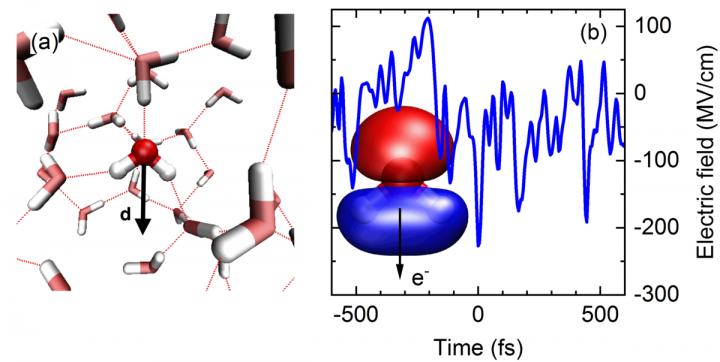
Water molecules undergo ultrafast dithering motions at room temperature and generate extremely strong electric fields in their environment. New experiments demonstrate how in presence of such fields free electrons are generated and manipulated in the liquid with the help of an external terahertz field.

The water molecule H2O displays an electric dipole moment due to the different electron densities on the oxygen (O) and hydrogen (H) atoms (Fig. 1a). Such molecular dipoles generate an electric field in liquid water. The strength of this field fluctuates on a femtosecond time scale (1 femtosecond = 10^-15 seconds = one billionth of a millionth of a second) and, for short periods, reaches peak values of up to 300 MV/cm (300 million volts per cm, Fig. 1b). In such a high field, an electron can leave its bound state, a molecular orbital (Fig. 1b) and tunnel through a potential energy barrier into the neighboring liquid. This event represents a quantum mechanical ionization process. In equilibrium, the electron returns very quickly to its initial state since the fluctuating electric field has no preferential spatial direction and, thus, the electron does not move away from the ionization site. Because of the highly efficient charge recombination, the number of unbound (free) electrons remains extremely small, on average less than a billionth of the number of water molecules.

Researchers from the Max-Born-Institute in Berlin have now shown that an external electric field with frequencies in the range of 1 terahertz (1 THz = 10^12 Hz, approximately 500 times higher than a typical cell phone frequency) enhances the number of free electrons by up to factor of 1000. The THz field has a maximum strength of 2 MV/cm, that is less than 1% of the strength of the fluctuating field in the liquid. However, the THz field has a preferential spatial direction (Fig. 2). Along this direction, electrons generated by the fluctuating field are being accelerated and reach a kinetic energy of approximately 11 eV, the ionization potential of a water molecule. This transport process suppresses charge recombination at the ionization site. The electrons travel over a distance of many nanometers (1 nm = 10^-9 m) before they localize at a different site in the liquid. The latter process causes strong changes of the absorption and the refractive index of the liquid (Fig. 2c) by which the dynamic behavior of the electrons can be followed with the method of two-dimensional THz spectroscopy (Fig. 2a).

These surprising results reveal a new aspect of extremely strong electric fields in liquid water, the occurrence of spontaneous events of tunneling ionization. Such events could play an important role in the self-dissociation of H2O molecules into OH– und H3O+ ions. Moreover, the experiments establish a novel method for the generation, transport, and localization of charges in liquids with the help of strong THz fields. This allows for manipulating the basic electric properties of liquids.

###

Media Contact
Dr. Ahmed Ghalgaoui
[email protected]

Original Source

https://www.fv-berlin.de/en/info-for/the-media-and-public/news/starke-felder-und-ultraschnelle-bewegungen

Related Journal Article

http://dx.doi.org/10.1021/acs.jpclett.0c02312

Tags: Chemistry/Physics/Materials SciencesMolecular Physics
Share12Tweet8Share2ShareShareShare2

Related Posts

Stretching a Quantum Material Splits Its Superconductivity in Two

Stretching a Quantum Material Splits Its Superconductivity in Two

October 7, 2026
Chemists Build a Molecular Sorting Machine to Forge Chiral Amino Alcohols from Simple Feedstocks

Chemists Build a Molecular Sorting Machine to Forge Chiral Amino Alcohols from Simple Feedstocks

October 7, 2026

Nitrogen Doping Cuts the Temperature Needed to Destroy a Potent Greenhouse Gas

October 7, 2026

Zinc Complexes Emerge as Safer Rivals to Platinum Cancer Drugs, Landmark Review Finds

October 7, 2026
Please login to join discussion

POPULAR NEWS

  • Alloys That Shrink Their Own Grains: New PIX Mechanism Refines Metals With Heat Alone

    Alloys That Shrink Their Own Grains: New PIX Mechanism Refines Metals With Heat Alone

    29 shares
    Share 12 Tweet 7
  • Endurance Exercise Reshapes the Liver in Males and Females Through Distinct Molecular Routes

    29 shares
    Share 12 Tweet 7
  • Single Transcription Factor PU.1 Rapidly Converts Fibroblasts into Macrophage-Lineage Cells

    29 shares
    Share 12 Tweet 7
  • New Scale Measures How Ready Nurse Educators Really Are for the AI Era

    29 shares
    Share 12 Tweet 7

About

We bring you the latest biotechnology news from best research centers and universities around the world. Check our website.

Follow us

Recent News

Alloys That Shrink Their Own Grains: New PIX Mechanism Refines Metals With Heat Alone

Endurance Exercise Reshapes the Liver in Males and Females Through Distinct Molecular Routes

Single Transcription Factor PU.1 Rapidly Converts Fibroblasts into Macrophage-Lineage Cells

Subscribe to Blog via Email

Success! An email was just sent to confirm your subscription. Please find the email now and click 'Confirm' to start subscribing.

Join 85 other subscribers
  • Contact Us

Bioengineer.org © Copyright 2023 All Rights Reserved.

Welcome Back!

Login to your account below

Forgotten Password?

Retrieve your password

Please enter your username or email address to reset your password.

Log In
No Result
View All Result
  • Homepages
    • Home Page 1
    • Home Page 2
  • News
  • National
  • Business
  • Health
  • Lifestyle
  • Science

Bioengineer.org © Copyright 2023 All Rights Reserved.