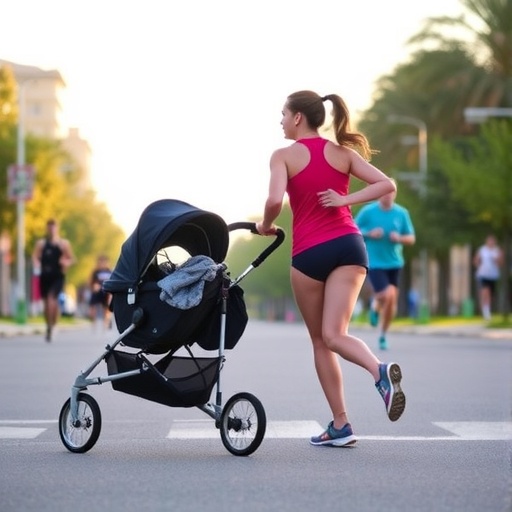
For parents who lace up their running shoes while pushing a stroller, the extra weight and altered stride may seem like a recipe for injury. A new study in PLOS One suggests the opposite may be true. Surveyed parents who ran with a stroller reported less than half the injury rate of parents who ran without one, raising fresh questions about how equipment, pace, training habits and behavior influence running-related injuries. The findings do not establish that strollers protect runners from harm, but they challenge the assumption that adding a child and a wheeled load automatically makes running more hazardous. Instead, stroller runners may represent a distinct group of athletes whose habits and expectations lead them to approach training differently.
Running injuries are shaped by the interaction of mechanical load, tissue capacity and recovery. Each foot strike sends forces through the lower limbs, including the feet, ankles, knees, hips and pelvis. When training volume or intensity increases faster than the body can adapt, muscles, tendons, bones and connective tissues may become vulnerable to overuse injuries. Running with a stroller changes several parts of this equation. The runner must control a moving object, manage turns and uneven surfaces, and often maintain contact with the handlebar. These demands can alter posture, arm movement, stride length and speed. Yet those same constraints may encourage a more conservative running pattern, potentially reducing the intensity or duration of individual workouts.
The study, titled “Injury risk and running habits in parents: Does stroller use make a difference?”, examined injury patterns and running behaviors among parents. Its central comparison was between parents who reported running with a stroller and those who ran without one. According to the study summary, stroller runners reported injuries at less than half the rate of non-stroller runners. Because the research was based on surveyed participants, the result should be interpreted as an association rather than proof of cause and effect. A survey can reveal that two characteristics occur together, but it cannot by itself determine whether stroller use directly reduces injury risk or whether other differences between the groups explain the pattern.
One possible explanation is that stroller running naturally moderates pace. The additional resistance and steering demands can make it difficult to accelerate, sprint or maintain the speed a runner might otherwise choose. Slower running generally reduces peak loading rates compared with faster running, although the relationship between speed and injury is complex and depends on terrain, stride mechanics, fatigue and training history. A stroller may also encourage shorter outings, more deliberate routes and a gradual return to exercise after childbirth or a period of reduced activity. If stroller runners are more likely to choose manageable distances and avoid maximal efforts, their lower injury rate could reflect training behavior rather than a protective effect produced by the stroller itself.
The equipment may also influence how runners distribute effort across the body. Pushing a stroller can reduce the natural reciprocal swing of the arms and may encourage a more upright trunk position, particularly when the handle is positioned comfortably. At the same time, holding the bar for extended periods can create asymmetrical loading if the runner consistently favors one hand or runs on sloped surfaces. Repeated asymmetry may affect the shoulders, back, hips or legs, especially when combined with fatigue. The mechanical consequences are therefore not universally beneficial or harmful. They depend on stroller design, handle height, wheel stability, surface conditions, the child’s weight, the runner’s strength and the duration of the session.
Behavioral differences may be just as important as biomechanics. Parents who choose to run with a stroller may be more likely to plan their workouts around childcare, exercise at predictable times and maintain a steady routine. They may also run at lower intensity because they are prioritizing time outdoors with their child rather than performance goals. In contrast, parents who run without a stroller may have greater flexibility to train for races, increase mileage, complete speed sessions or run on challenging terrain. Those activities are not inherently unsafe, but they can expose the body to higher cumulative or peak demands. The survey result could therefore reflect different types of runners rather than a simple effect of stroller use.
The study’s findings should also be viewed in light of the way injury information is collected. Self-reported injuries can include a wide range of problems, from temporary soreness to diagnosed conditions requiring medical care. Participants may remember recent or severe injuries more accurately than minor episodes, and individuals may differ in how they define an injury. People who run less often may have fewer opportunities to become injured, while experienced runners may recognize and report overuse symptoms differently. Without experimental assignment, detailed training records and clinical confirmation of every injury, researchers cannot completely separate stroller use from factors such as age, running experience, body composition, previous injury, weekly mileage, terrain and access to recovery time.
Even so, the findings carry practical significance for parents who want to remain active. A stroller should not be treated as a substitute for gradual training, appropriate footwear, rest or medical evaluation when pain persists. Runners may reduce avoidable strain by choosing smooth, level routes, checking that the stroller is designed for running, maintaining control on turns and declines, and avoiding sudden increases in distance or speed. Alternating hands when practical may limit sustained asymmetry, while strength and mobility work can support the muscles responsible for stabilizing the trunk and pelvis. Parents should also consider environmental safety, including traffic, heat, air quality and the child’s comfort, because safe stroller running involves more than injury prevention for the adult.
The PLOS One study ultimately offers a counterintuitive message: the parent carrying the apparent extra burden may not be the runner facing the greater injury risk. Stroller runners in the survey reported fewer than half as many injuries as their non-stroller counterparts, but the result is best understood as a prompt for further research rather than a prescription for every runner. Future studies could combine injury surveillance with wearable sensors, GPS-based training data, motion analysis and clinical assessments to determine how stroller running changes forces, stride patterns and workload over time. For now, the evidence suggests that disciplined pacing and realistic training habits may matter more than whether a parent runs alone or pushes a stroller.
Subject of Research: Injury risk and running habits among parents who run with and without strollers.
Article Title: Injury risk and running habits in parents: Does stroller use make a difference?
News Publication Date: 12-Aug-2026
Web References: https://doi.org/10.1371/journal.pone.0354371
References: PLOS One, “Injury risk and running habits in parents: Does stroller use make a difference?” DOI: 10.1371/journal.pone.0354371
Image Credits: neelam279, Unsplash, CC0
Keywords: running injuries, stroller running, parents, exercise science, biomechanics, injury prevention, PLOS One, physical activity, running habits, sports medicine
Tags: biomechanics of stroller runningdifferences in injury rates between stroller runners and traditional runnerseffects of running with a stroller on injury riskimpact of child-jogging equipment on runner safetyinfluence of running pace and terrain on injury riskinjury prevention for parents who run with strollersmechanical load in stroller runningoveruse injuries in runningparent athletes and injury risk managementrunning injury factors and equipmentstroller-running injury ratestraining habits of stroller runners