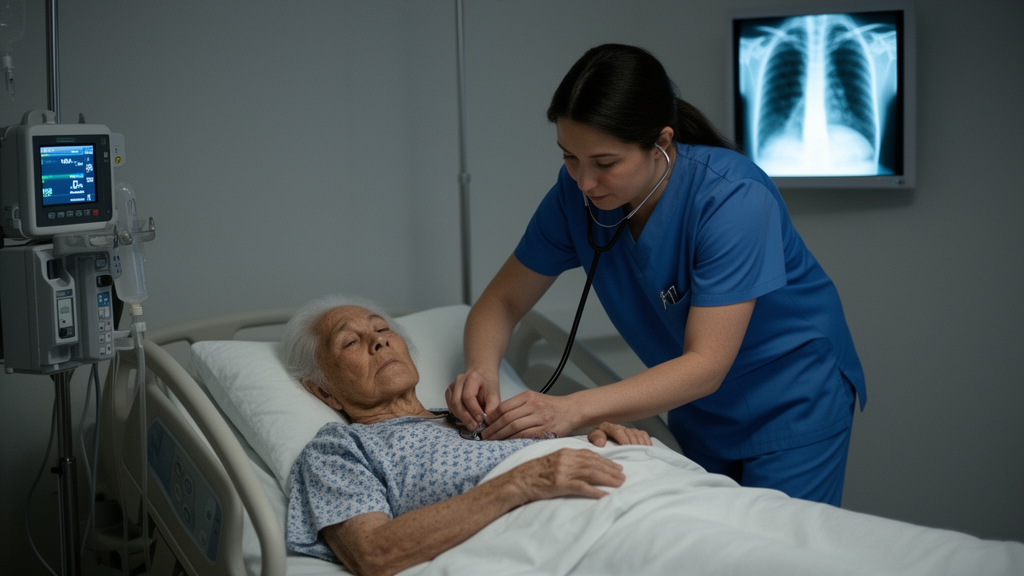
Stroke-associated pneumonia developed in 12.8% of 3,347 patients hospitalized with acute ischemic stroke in a retrospective cohort study conducted at Qianwei Hospital of Jilin Province in China. More than half of the pneumonia cases developed within 72 hours of admission, with the peak occurring on day 3. After adjustment for stroke severity and other patient characteristics, pneumonia was associated with a 2.34-fold higher hazard of in-hospital death, a 2.81-fold higher hazard of intensive-care transfer and a 3.47-fold higher hazard of invasive mechanical ventilation. The observational design means that these results describe associations rather than proving that pneumonia caused the worse outcomes.
Researchers analyzed consecutive patients admitted with acute ischemic stroke between January 1, 2019, and June 30, 2025. Eligible patients were at least 18 years old, arrived within seven days of symptom onset and were primarily admitted to the neurology service. Cases were identified from discharge diagnoses and then verified through medical records and neuroimaging. Patients with transient ischemic attack, hemorrhagic stroke, cerebral venous thrombosis, infection already present at admission, or major missing outcome data were excluded. For patients with multiple admissions, the investigators used the first eligible hospitalization to preserve the independence of the observations.
The team defined stroke-associated pneumonia as new-onset pneumonia occurring within seven days of admission. Pneumonia already present on admission was ruled out using chest imaging obtained during the routine stroke workup and the record of treatment and diagnoses. A case required three simultaneous elements: new or progressive infiltrates or consolidation on chest radiography or computed tomography; at least one systemic inflammatory-response criterion, including a temperature of at least 38.0 degrees Celsius or no more than 36.0 degrees Celsius, or a white blood cell count above 10 × 109/L or below 4 × 10⁹/L; and at least one respiratory manifestation, such as new cough, purulent sputum, rales, or room-air oxygen saturation of no more than 90% or an increase in oxygen requirement. Two investigators blinded to outcome data independently assessed suspected cases, and a senior physician resolved disagreements.
Of the 428 patients who developed pneumonia, 55.1% received the diagnosis during the first three hospital days. Day 3 alone accounted for 25.5% of all events, while 13.3% occurred on days 6 and 7 combined. Patients who developed pneumonia had a different clinical profile from those who did not. Their median admission National Institutes of Health Stroke Scale score was 11, compared with 4 among patients without pneumonia, and their median Glasgow Coma Scale score was 14 rather than 15. Dysphagia was present in 54.0% of the pneumonia group but 11.9% of the comparison group. Nasogastric tube insertion within 48 hours occurred in 40.4% of patients with pneumonia and 6.5% of those without it. Cardioembolic stroke was also more frequent among patients with pneumonia, while the pneumonia group was older and had more comorbidity, poorer pre-stroke function, lower albumin and higher inflammatory markers.
Multivariable Cox models identified several factors independently associated with the hazard of pneumonia. Each additional year of age was associated with a 2% higher hazard, with a hazard ratio of 1.02 and 95% confidence interval of 1.01–1.03. A pre-stroke modified Rankin Scale score of 3–5 was associated with a hazard ratio of 1.39, chronic obstructive pulmonary disease with 1.69, and cardioembolic stroke with 1.71 compared with small-artery occlusion. Dysphagia had an adjusted hazard ratio of 2.02, and nasogastric tube insertion within 48 hours had a ratio of 2.31; the 95% confidence intervals were 1.59–2.57 and 1.80–2.97, respectively. The tube-insertion result cannot be interpreted as evidence that tube feeding causes pneumonia. Placement was a clinical decision based on swallowing impairment, neurological severity, impaired consciousness and aspiration risk, so it may reflect severe illness while also forming part of the pathway leading to aspiration.
Restricted cubic splines showed that three continuous measures were not related to pneumonia risk in a simple linear fashion. Higher admission NIHSS scores were associated with progressively greater risk, with the gradient becoming steeper at more severe scores. The neutrophil-to-lymphocyte ratio showed an accelerating association at higher values. Lower serum albumin was associated with increased risk, and the increase appeared particularly pronounced below approximately 35 grams per liter. Tests for departure from linearity were significant for all three measures. These results show why a single effect per unit may inadequately represent the risk across the full clinical range: the modeled relationship changes more sharply within particular ranges of neurological severity, inflammation and albumin concentration.
For the prognostic analysis, the investigators used time-dependent Cox models to account for the fact that pneumonia was acquired during hospitalization rather than being present at admission. Patients were coded as unexposed before pneumonia onset and exposed afterward. This approach was intended to avoid immortal-time bias, which can arise when a later complication is incorrectly treated as present from the start of follow-up. The models adjusted for age, sex, pre-stroke disability, admission NIHSS and Glasgow Coma Scale scores, dysphagia, infarct location, stroke subtype, atrial fibrillation, diabetes, chronic obstructive pulmonary disease, albumin, glucose, thrombolysis, thrombectomy and nasogastric tube insertion. Even with this adjustment, pneumonia remained associated with all three time-to-event outcomes assessed in the overall cohort.
Among survivors, the median hospital stay was 17 days for patients with pneumonia and 9 days for those without it. The adjusted ratio of means was 1.35, with a 95% confidence interval of 1.27–1.44, indicating a 35% relative increase in hospitalization duration associated with pneumonia. At discharge, 64.1% of surviving pneumonia patients had a modified Rankin Scale score of 3–5, compared with 31.7% of survivors without pneumonia. The adjusted odds ratio for poor functional outcome was 1.90, with a 95% confidence interval of 1.43–2.52. For the time-to-event outcomes, the adjusted hazard ratios were 2.34 for in-hospital death, 2.81 for intensive-care transfer and 3.47 for invasive mechanical ventilation; all three confidence intervals excluded one, and all p-values were below 0.001.
Complete-case analyses produced estimates close to those from the primary models, including an adjusted hazard ratio of 2.29 for death among 3,236 patients with complete data. A second sensitivity analysis included only patients hospitalized for at least three days, treated pneumonia within the first three days as a fixed exposure and began follow-up on day 3. In that analysis, pneumonia remained associated with death, intensive-care transfer and mechanical ventilation, with adjusted hazard ratios of 2.18, 2.63 and 3.12, respectively. These checks support the internal robustness of the findings, but several limitations constrain interpretation. The cohort came from one tertiary hospital and may not represent other hospitals or healthcare systems. Diagnosis depended partly on documentation quality, and unmeasured factors such as precise infarct volume and location, sedative use, oral-care intensity and early rehabilitation could contribute to residual confounding. Ventilator-associated pneumonia was not analyzed separately, and follow-up ended at discharge or death rather than extending to 30-day, 90-day or longer-term outcomes.
The timing of the events gives the results practical relevance for acute stroke care. The authors identify the first days of hospitalization as a period when surveillance for pneumonia should be concentrated, especially for patients with severe neurological deficits, impaired swallowing, chronic obstructive pulmonary disease, cardioembolic stroke, elevated inflammation, low albumin or prior disability. They discuss early swallowing assessment, careful selection of feeding pathways, airway-protection measures and nutritional optimization, and they call for prospective multicenter studies with standardized surveillance and follow-up beyond discharge. They also propose trials testing whether interventions directed at modifiable factors, including nutritional status and airway protection, can reduce pneumonia incidence. The cohort does not establish that any particular bundle prevents pneumonia or improves outcomes, and the nasogastric-tube association cannot be used to withhold clinically necessary feeding. Instead, it identifies a concentrated early period of risk and quantifies the pneumonia’s independent association with acute-care escalation, prolonged hospitalization and poorer function at discharge.
Subject of Research: Temporal patterns, risk factors and in-hospital prognostic associations of stroke-associated pneumonia after acute ischemic stroke
Article Title: Stroke-associated pneumonia after acute ischemic stroke: early temporal dynamics, nonlinear risk factors, and time-dependent prognostic impact
Article References: Zhang, S., Yan, Q., Wang, Z., Xie, R., Tao, Y., Jin, Y., & Zuo, W. (2026). Stroke-associated pneumonia after acute ischemic stroke: early temporal dynamics, nonlinear risk factors, and time-dependent prognostic impact. Frontiers in Neurology, 17, Article 1841237. https://doi.org/10.3389/fneur.2026.1841237
Image Credits: AI Generated
DOI: 10.3389/fneur.2026.1841237
Keywords: stroke-associated pneumonia, acute ischemic stroke, pneumonia incidence, early hospital onset, dysphagia, stroke severity, nonlinear risk factors, in-hospital mortality, intensive care, functional outcome, Stroke-associated, pneumonia
News Source: Cassandra Pierce. (October 20, 2026). Stroke-associated pneumonia emerges early and signals worse hospital outcomes. Scienmag.