


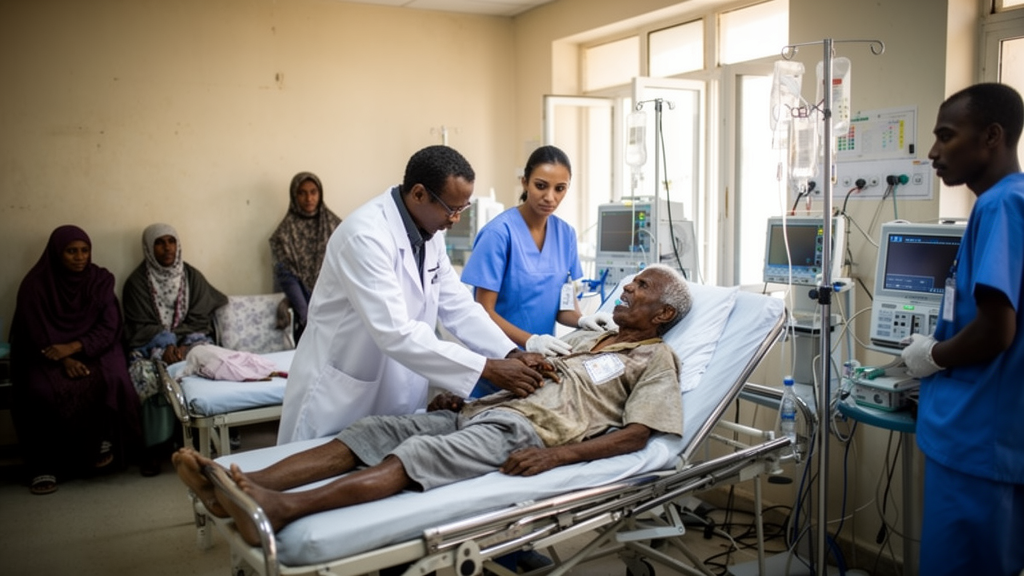
Stroke and seizure-related disorders accounted for most neurological emergencies arriving at a tertiary referral hospital in Mogadishu, according to a prospective cohort study published in the European Journal of Medical Research. Among 321 patients enrolled over a full year, ischaemic stroke was the single most common diagnosis, followed by epilepsy, haemorrhagic stroke and status epilepticus, and more than seven in ten patients reached the hospital more than six hours after their symptoms began.
The study enrolled patients aged 17 years or older who presented with neurological emergencies to the hospital’s emergency department between 10 July 2025 and 11 July 2026. Staff screened 482 potentially eligible neurological presentations and, after 161 pre-enrolment exclusions, enrolled 321 unique patients. Verbal informed consent was obtained from the patient or, when appropriate, a parent, guardian or legally acceptable representative.
The enrolled group was predominantly male and middle-aged or older. Of the 321 patients, 181 (56.4%) were men and 166 (51.7%) were aged over 50 years. The diagnostic spectrum was led by ischaemic stroke, which accounted for 123 cases (38.3%), followed by epilepsy with 62 cases (19.3%), haemorrhagic stroke with 49 cases (15.3%) and status epilepticus with 33 cases (10.3%).
Timing of presentation emerged as a striking feature of the cohort. In 229 patients, or 71.3%, more than six hours elapsed between symptom onset and arrival at the emergency department.
Most patients were admitted. Overall, 295 of the 321 enrolled patients were admitted to inpatient care, while 26 self-discharged directly from the emergency department. One admitted patient had no definitive final outcome recorded, so the mortality analysis was restricted to the 294 admitted patients who had a definitive discharge-alive or death outcome.
Among those 294 patients with definitive inpatient outcomes, 263 were discharged alive and 31 died during hospitalisation, an in-hospital mortality rate of 10.5% with an exact binomial 95% confidence interval of 7.3% to 14.6%. The authors summarise this as approximately one in ten admitted patients with a definitive outcome dying during hospitalisation, a figure calculated only among patients whose final status was known.
The study was designed as a hospital-based prospective cohort, meaning patients were enrolled and followed forward from their emergency department presentation rather than identified retrospectively from records. The authors describe baseline characteristics for all 321 participants, while the mortality estimate is deliberately confined to the admitted subgroup with definitive outcomes, a distinction that matters when comparing the findings with other hospital-based studies.
The investigators are careful about the scope of their conclusions. The data come from a single tertiary referral hospital in Mogadishu, so the case mix reflects the patients who reach that facility and may not represent neurological emergencies across Somalia, where many people may never reach hospital care. The authors also note that more complete severity, treatment and follow-up data are needed, and the published version is an early-release article that remains subject to further edits before the final version of record.
Despite these limitations, the authors argue the findings support concrete next steps: prospective neurological-emergency surveillance, better measurement of time from symptom onset to care, and richer collection of severity, treatment and follow-up information. With stroke and seizure-related disorders dominating the emergency caseload, and delayed presentation affecting most patients, the study provides a baseline against which future efforts to strengthen neurological emergency care in Somalia can be measured.
Subject of Research: Clinical profile and in-hospital outcomes of neurological emergencies at a tertiary referral hospital in Somalia
Article Title: Clinical profile and in-hospital outcomes of neurological emergencies at a tertiary referral hospital in Somalia: a prospective cohort study
Article References: Iyow, S. N., Mohamed, M. M., Mohamed, S. A., Isak, A. A., Ahmed, A. H., Mohamed, H. H., Mohamed, A. Y., & Ahmed, S. A. (2026). Clinical profile and in-hospital outcomes of neurological emergencies at a tertiary referral hospital in Somalia: a prospective cohort study. European Journal of Medical Research. https://doi.org/10.1186/s40001-026-05392-8
Image Credits: AI Generated
DOI: 10.1186/s40001-026-05392-8
Keywords: neurological emergencies, stroke, ischaemic stroke, haemorrhagic stroke, epilepsy, status epilepticus, Somalia, emergency department, in-hospital mortality, delayed presentation, prospective cohort, Mogadishu
News Source: Cassandra Pierce. (October 28, 2026). Stroke and seizures dominate neurological emergencies in Somali hospital cohort. Scienmag.



