


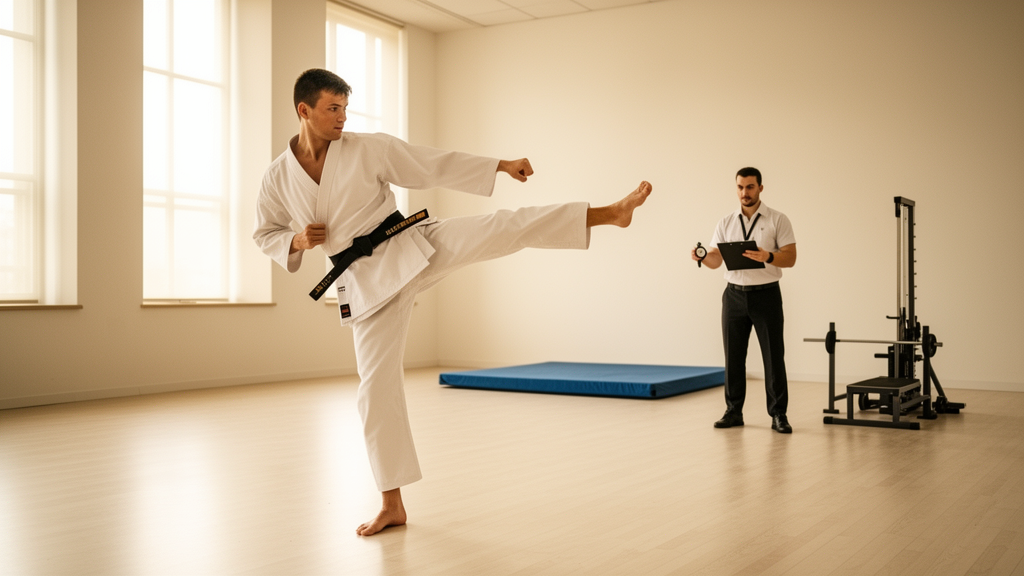
Elite karate kumite is a discipline built on fractions of a second: an opponent’s shoulder twitches, a punch is launched, and a defender has milliseconds to decide whether to block, evade, or counter. A new exploratory study of Polish national-team athletes has now asked whether the physical qualities that underpin explosive movement—maximal isometric strength and vertical-jump power—leave any measurable trace on the psychomotor skills of reaction, coordination, and anticipation. The answer, according to the researchers, is a cautious and deliberately hedged one: several moderate associations appeared in the raw data, but none survived rigorous statistical correction for the many comparisons performed.
The study, published in Frontiers in Sports and Active Living, enrolled twenty-seven adult male members of the Polish national traditional karate team, all aged between 18 and 30, with at least five years of training experience and a black belt of at least first dan. Because elite national squads are small and tightly selected, the authors described the sample as the maximum feasible recruitment from a realistically accessible population. All participants were tested in an observational, cross-sectional design at the University of Rzeszów, with ethics approval from the university’s bioethics committee and written informed consent from every athlete.
The testing protocol was unusually thorough. Across three measurement sessions separated by 48-hour recovery intervals, athletes completed a battery of neuromuscular and psychomotor assessments under standardized conditions, at the same time of day, after a familiarization session and a controlled warm-up. Isometric strength of the elbow and knee flexors and extensors was measured bilaterally with a BTE PrimusRS dynamometer, with each athlete performing three maximal four-second contractions per muscle group and the best trial retained. Lower-limb explosive power was quantified through three jump variants—the squat jump, the countermovement jump without arm swing, and the full countermovement jump with arm swing—recorded on an Optojump Next optical system.
Psychomotor performance was assessed with the TEST2DRIVE computerized battery, a platform originally developed for traffic psychology that has since been applied to handball players, kickboxers, and handcyclists. Four tasks were used: simple reaction time, choice reaction time, hand-eye coordination, and spatial anticipation. Standing upright, athletes responded with the index finger of their dominant hand to visual stimuli appearing at unpredictable intervals. Reaction time was recorded to the nearest hundredth of a second, alongside motor time and response accuracy for each task.
The statistical strategy is where the study becomes particularly instructive. Because the design generated seventy pairwise Pearson correlations between strength, jump, and psychomotor variables, the researchers applied the Benjamini–Hochberg false discovery rate procedure to guard against the well-known problem that, with enough comparisons, spurious ‘significant’ findings appear by chance alone. At the unadjusted level, the picture looked promising for hypothesis generation. The strongest association involving strength was between right-arm extension force and median motor time in the spatial anticipation task, with a correlation coefficient of 0.57. Several jump measures also correlated nominally with choice-reaction motor time and accuracy.
Yet after FDR correction, not a single one of the seventy correlations remained statistically significant; the smallest adjusted q-value was 0.137, well above the 0.05 threshold. The authors are explicit about what this means. The observed relationships should be treated as exploratory and hypothesis-generating, not as confirmatory evidence that isometric strength or vertical-jump performance is independently associated with psychomotor performance in elite kumite athletes. Notably, the data did not even support the intuitive claim that explosive power matters more than maximal strength for psychomotor speed—the study was not designed or powered to establish such a hierarchy.
Some of the unadjusted patterns are nonetheless intriguing. Greater isometric strength in selected measures was associated with longer, not shorter, motor time in the spatial anticipation task, meaning that stronger athletes did not necessarily move their responding finger faster in the laboratory task. The authors suggest this may reflect the low specificity between maximal static force production and a computerized task requiring rapid index-finger movement, while stressing that the study was not designed to identify mechanisms. Meanwhile, higher jump performance coincided nominally with shorter response times in some tasks, and a negative association between explosive-power indicators and choice-reaction accuracy raised the possibility of a speed–accuracy trade-off—an interpretation the authors explicitly decline to state categorically, given that it appeared in only one task type and computerized stimuli lack the richness of a real opponent’s movements.
A secondary exploratory regression analysis, in which the three highly correlated jump variables were combined into a single Explosive Power Composite to reduce multicollinearity, produced one statistically significant overall model for spatial-anticipation motor time, in which right-arm extension strength emerged as a positive predictor. The remaining models showed only statistical trends or null results. Given the sample of 27 athletes, the authors interpret even this finding cautiously and call for confirmation in larger cohorts.
The study’s limitations are candidly enumerated. The cross-sectional design precludes any causal inference. The sample was small, male, and drawn from a single national team, limiting both statistical power and generalizability. The neuromuscular tests and the psychomotor tests involved different effectors—lower-limb jumping versus finger movements—and neither was specific to kumite combat itself. Isometric strength was recorded as absolute force without normalization to body mass, and handedness effects were not analyzed. The authors also note that the psychomotor tasks were laboratory stimulus-response exercises without karate-specific cues, so the results speak to general psychomotor abilities rather than to technical reaction performance in actual competition.
What the study does deliver is a methodological caution for a field fascinated by the marriage of physical and cognitive performance. In highly selected populations such as national-team athletes, variance in somatic and motor outcomes is compressed by rigorous selection, making simple linear predictors difficult to identify—and making multiple-comparison correction essential. The authors recommend that future work employ larger and more diverse samples, body-mass-adjusted strength measures, and karate-specific upper-limb and whole-body reaction tasks that embed perceptual cues drawn from an opponent’s behavior. Until such studies appear, the search for the physical signature of the perfect kumite fighter remains, by the researchers’ own account, an open and deliberately humble question.
Subject of Research: Exploratory associations between isometric strength, vertical-jump performance, and psychomotor outcomes in elite traditional karate kumite athletes
Article Title: Exploratory associations between isometric strength, vertical jump performance, and psychomotor outcomes in elite traditional karate Kumite athletes
Article References: Niewczas-Czarny, P., Kędra, A., Wąsacz, W., & Rydzik, Ł. (2026). Exploratory associations between isometric strength, vertical jump performance, and psychomotor outcomes in elite traditional karate Kumite athletes. Frontiers in Sports and Active Living, 8, Article 1952574. https://doi.org/10.3389/fspor.2026.1952574
Image Credits: AI Generated
DOI: 10.3389/fspor.2026.1952574
Keywords: karate, kumite, isometric strength, vertical jump, psychomotor performance, reaction time, combat sports, correlational study, false discovery rate, elite athletes, explosive power, cross-sectional study
News Source: Ophelia Keating. (October 29, 2026). Strength, Jump Power and Reaction Time Show Only Fragile Links in Elite Karate Athletes. Scienmag.



